
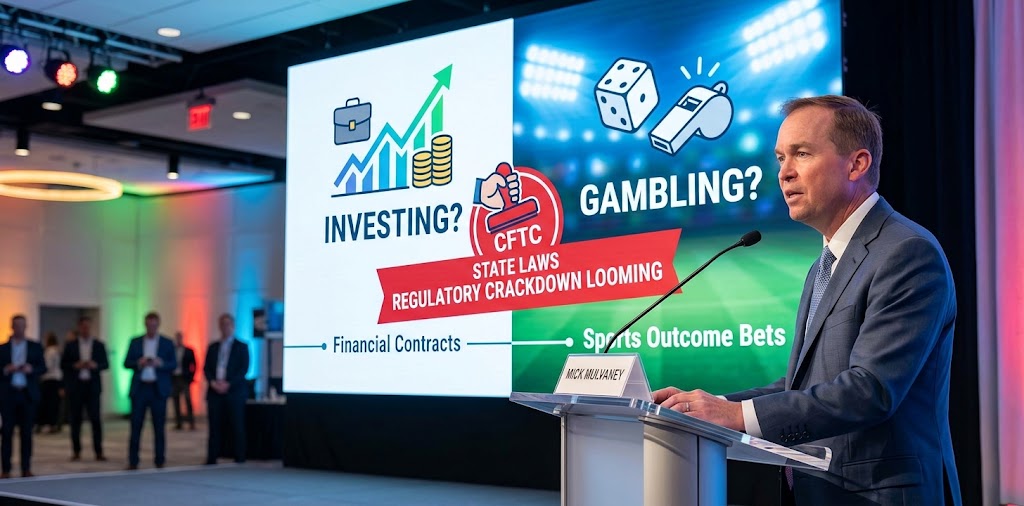
Prediction Market Regulation: Mick Mulvaney Prediction Markets Warning
Former White House Chief of Staff Mick Mulvaney examines mounting pressure on prediction markets and the regulatory risks facing the industry. Mick Mulvaney, the former White House chief of staff under President Donald Trump during his first administration, is taking a stand against sports event contracts offered by prediction-market platforms. Mulvaney, a longtime politician who was chief of staff for about 15 months during Trump’s first term, is the executive director of a new coalition called Gambling Is Not Investing.
Financial Trading vs Gambling
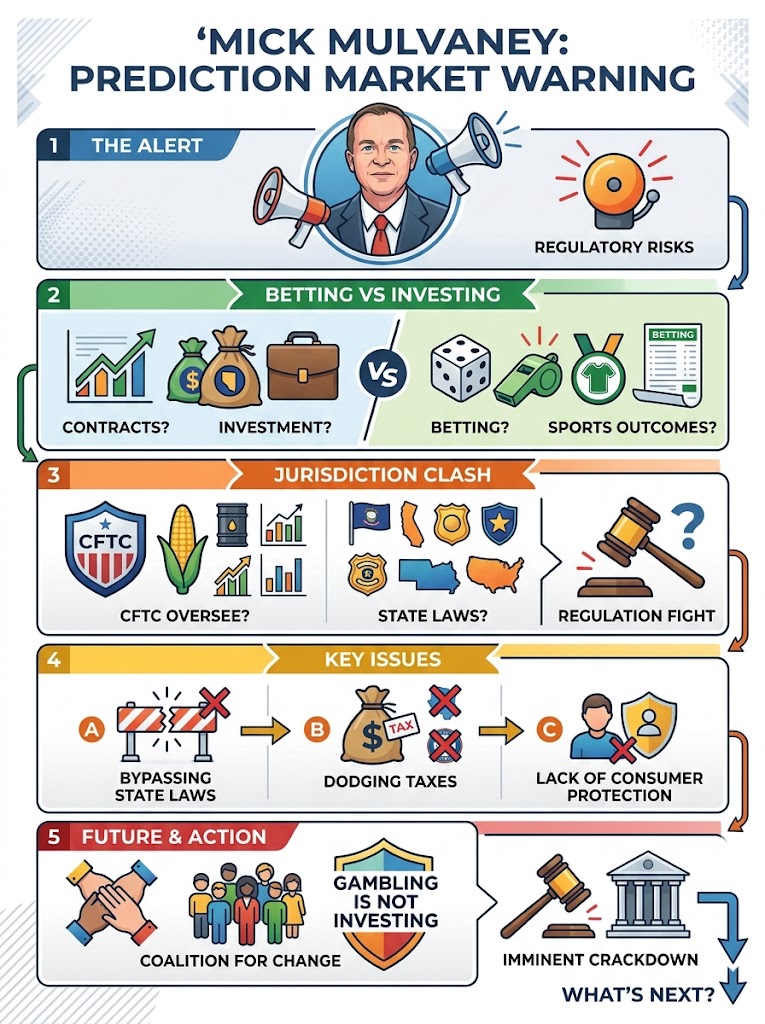
The group argues that sports event contracts undermine state and tribal gaming laws by allowing prediction-market platforms to bypass established regulatory frameworks. I just don’t believe that buying a contract on the outcome of the Celtics game tonight isn’t betting, he told Front Office Sports. It’s gambling. It just is. Changing how you get paid doesn’t change the nature of the underlying transaction, Mulvaney says. The underlying transaction is betting.
The CFTC Sports Betting Loophole
He doesn’t buy the idea that sports event contracts fall under the exclusive jurisdiction of the Commodity Futures Trading Commission, a federal agency historically charged with regulating the trading of commodities like grains and oil. The CFTC is not set up for this, Mulvaney says. I like the CFTC, and I used to work with them very closely, but they’re not set up to protect consumers. They’re set up to protect markets.
This is a state sovereignty issue. . . . My state has made the decision not to allow it. Other states have made the decision to allow it, and regulate it, and tax it. . . . The CFTC decisions have allowed that all to be thrown to the side, says former Acting White House Chief of Staff Mick Mulvaney, in conversation with Robert DeNault, Head of Enforcement at Kalshi. State sports betting systems typically include age restrictions, helplines, responsible gambling requirements and enforcement mechanisms. Every single state that has approved sports betting has set up a way to protect consumers in a way the CFTC simply cannot do, he says.
Crypto Prediction Market Risks
Mulvaney isn’t seeking a prohibition on prediction markets, even though he acknowledges there are concerns about issues like insider trading (he referenced the suspiciously timed trades on Polymarket on whether President Nicolás Maduro would be removed from power by the end of January). That’s what platforms like Kalshi, Polymarket, Robinhood, and Crypto.com are arguing in multiple lawsuits across various jurisdictions
Legal experts have told FOS the patchwork of conflicting decisions means the issue will ultimately reach the U.S. Supreme Court. All the Supreme Court is doing is interpreting the law, he says. But if Congress comes in after a Supreme Court decision and passes a law that says, oh by the way, prediction markets can’t do sports, that trumps the Supreme Court decision. This is a political campaign, a PR campaign, not a legal campaign. We’re trying to win the hearts and minds of lawmakers, regulators, and voters.
Gambling vs. Investing: How Prediction Markets Are Bypassing State Sports Betting Laws
Mick Mulvaney’s ‘Gambling Is Not Investing’ coalition is fighting against prediction markets that use federal loopholes to offer unregulated sports betting. Learn how platforms bypassing state gambling laws threaten local tax revenues, undermine tribal gaming compacts, and strip away crucial consumer protections.
The Mick Mulvaney Sports Betting Debate: Gambling Is Not Investing Coalition
Mick Mulvaney, executive director of the Gambling Is Not Investing Coalition, a former South Carolina legislator and member of Congress, says his objection is not to gambling itself but to federal preemption of state choices. If two people bet on a baseball game, he says, most people would call it gambling. Changing how you get paid doesn’t change the nature of the underlying transaction, Mulvaney says. The underlying transaction is betting.
The group argues that sports event contracts undermine state and tribal gaming laws by allowing prediction-market platforms to bypass established regulatory frameworks.
Kalshi Polymarket Regulation: The Semantic Maneuver
Kalshi and Polymarket say their prediction markets are not subject to gambling laws and taxes. Sara Slane, secretary and head of corporate development at the regulated exchange and prediction market Kalshi, says prediction markets are fundamentally different from sports betting because exchanges match buyers and sellers rather than taking the other side of a wager. A swap is a contract where you can buy a yes/no outcome on what you believe will happen in a future event, she says. The big distinction on sports betting versus sports contracts is we are not the house.
The future of prediction markets boils down to whether federal law preempts state gambling laws. The Federal government has claimed exclusive jurisdiction over prediction markets under the Commodity Exchange Act (CEA).
Bypassing State Gambling Taxes and State Sports Betting Laws
He says states have long made their own decisions about gambling, including whether to allow sports betting, how to tax it and what consumer protections to require. The concern, he says, is sports outcomes—and, potentially, casino-style games—being offered outside the regulatory frameworks states and tribes have negotiated over decades.
Tribes see this as an existential threat to not just the industry and the revenue that they’re building, but as an existential threat to their ability to function as governments, he says. He also says prediction markets could undermine tribal-state compacts, particularly where states have granted tribes exclusivity in exchange for revenue sharing.
The Supreme Court Fight Over Loophole Disruption
Litigation surrounding prediction markets has exploded since the start of 2025, and the actions have been brought by all sides: states suing or charging prediction market operators, prediction market operators suing states, the federal government suing states, and Native American tribes suing operators. With litigation taking place all over the country and the federal courts seemingly split on whether prediction markets are offering gambling products or derivatives, the future of prediction markets in the United States will likely be decided by the U.S. Supreme Court in the next few years.
If the Court rules that prediction markets are actually gambling under another name, states will retain the power to regulate and tax the industry. Existing sports wagering operators have already started offering some prediction market wagering. If they can avoid state tax and licensing schemes by significantly shifting to prediction markets, states will lose most of their sports wagering revenues.
Leo Falsafi is a digital marketing veteran and senior journalist at Virlan.co, where he covers the intersection of digital marketing, gaming, and breaking US trending news. With nearly two decades of hands-on experience in SEO and digital strategy, Leo has consulted for and scaled hundreds of companies. His deep industry roots allow him to deliver sharp, fact-checked insights and analysis on the trends shaping today's digital landscape.