
Baltimore’s Consumer Protection Ordinance Lawsuits
BALTIMORE (CN) — The city of Baltimore sued Kalshi and Polymarket on Thursday, lcaiming their rapidly growing prediction markets constitute sports gambling without obeying Maryland gambling laws.
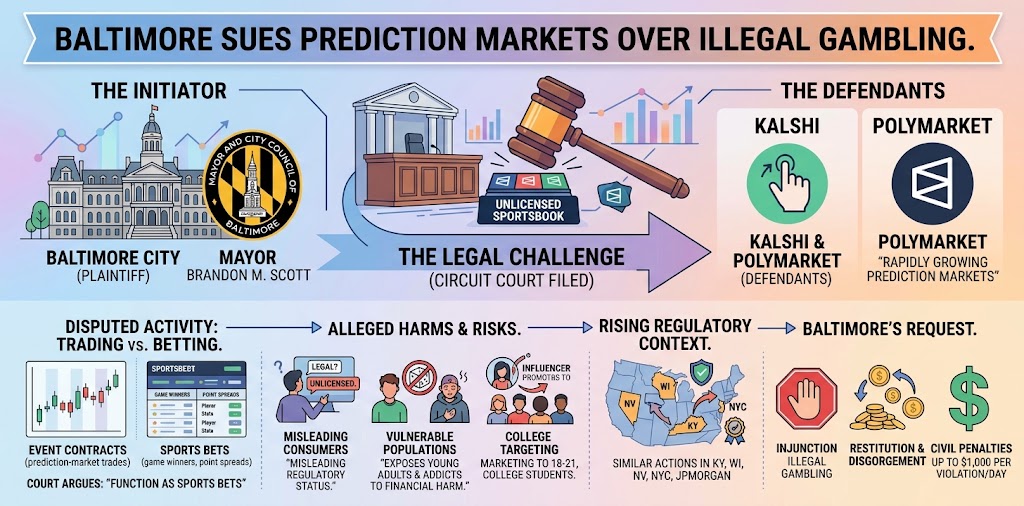
Today, Mayor Brandon M. Scott and the City Council of Baltimore filed lawsuits in the Circuit Court for Baltimore City against prediction market operators Kalshi and Polymarket and their affiliated companies.
The lawsuits accuse the companies of violating Baltimore’s Consumer Protection Ordinance ‘by operating illegal, unlicensed sports-betting platforms and misleading consumers about the legality and regulatory status of their products,’ according to a release from the mayor’s office.
Prediction-Market Trades vs. Traditional Sportsbooks
Prediction markets allow people to wager on sports, political elections and other major events.
These companies say they differ from gambling operators, because users trade against other consumers, similar to how stock markets work.
According to the complaints, Kalshi and Polymarket allow Baltimore residents to wager on game winners, point spreads, point totals, player statistics, and other propositions commonly offered by licensed sportsbooks.
Although the companies describe these wagers as ‘event contracts’ or prediction-market trades, the complaints contend that they function as sports bets and constitute unlawful gambling under Maryland law.
These companies are running sportsbooks without licenses and betting that a new label will put them above the law, Baltimore Mayor Brandon M. Scott said in a press release Thursday.
It won’t. Baltimore will not let multibillion-dollar companies put profits over people and harm our communities through illegal gambling.
Vulnerable Populations and Misleading Marketing Practices
The lawsuits also accuse the companies of misleading marketing practices, leading users to believe they are offering legal, regulated gambling services.
This conduct can expose vulnerable populations, including young adults and people with gambling addictions, to significant financial harm,
Additionally, Brown said Kalshi has marketed itself to young people between the ages of 18 and 21, coaxing college students to their platform by routinely paying influencers to promote their gambling app to their peers.
Rising Regulatory Risks for Crypto Prediction Markets
The suit, coming after actions in Kentucky (June), Wisconsin (April), Nevada’s March restraining order and a New York City probe, plus banks like JPMorgan ending ties, underscores rising regulatory and banking risks for crypto prediction markets that could hurt adoption, fundraising and platform security.
Baltimore sued Kalshi and Polymarket on Aug. 13, alleging they ran unlicensed sportsbooks and seeking an injunction, restitution, disgorgement and civil penalties of up to $1,000 per violation per day.
Leo Falsafi is a digital marketing veteran and senior journalist at Virlan.co, where he covers the intersection of digital marketing, gaming, and breaking US trending news. With nearly two decades of hands-on experience in SEO and digital strategy, Leo has consulted for and scaled hundreds of companies. His deep industry roots allow him to deliver sharp, fact-checked insights and analysis on the trends shaping today's digital landscape.