
Global Gambling Market Growth and Regulatory Shifts
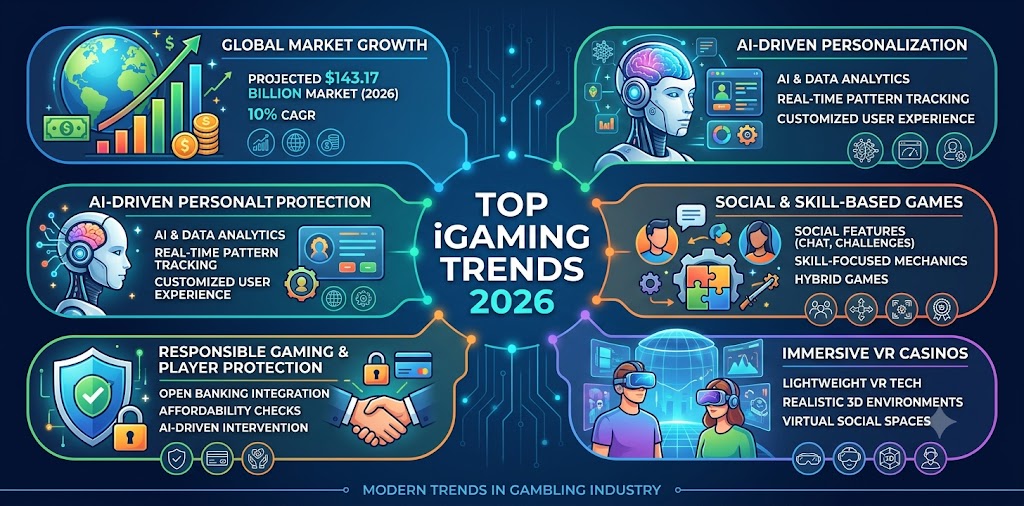
The global gambling industry enters 2026 on a rapid growth trajectory and at the cusp of transformative change. The online gambling market size has grown strongly in recent years. It will grow from $130.2 billion in 2025 to $143.17 billion in 2026 at a compound annual growth rate (CAGR) of 10%. This boom is fueled not only by technological leaps, but also by evolving consumer behaviors and shifting regulatory landscapes.
New Markets and Regulatory Shifts on the Horizon
The map of regulated gambling is set to expand further in 2026. Several countries and jurisdictions are transitioning from gray markets to fully legal, competitive industries. In the U.S., the sports betting frenzy that spread to 35+ states is settling into a mature phase, but there are still holdouts and new opportunities.
Meanwhile, online casino gaming (iGaming) – currently legal in only seven states – is gaining traction. The record-breaking revenues reported by existing iGaming states underscore the opportunity: several markets have posted all-time monthly records, and year-over-year growth in iGaming has significantly outpaced growth in brick-and-mortar casinos.
AI-Driven Personalization and Data Analytics
In 2026, iGaming is moving beyond faster payments and sharper graphics. AI-driven personalization, more convincing VR spaces, expanded blockchain use and skill-focused game design are pushing platforms toward more interactive and tailored experiences. Generic lobbies have died in 2026. Personal casinos take over.
Next-generation models will track every spin, every pause, and every deposit pattern in real-time. The biggest impact comes from personalization. The same AI will offer custom free-spin bundles, cashback timed to payday, and game suggestions that actually match the mood.
Open Banking and Player Protection
Payments are quietly becoming one of the most important parts of player protection. Thanks to open banking and smarter fintech integrations, operators can now verify affordability, identity, and even potential risk before a player makes their first deposit.
This shift moves compliance from the back end to the front of the funnel. Instead of waiting for red flags after a transaction, payment providers can now flag risky behaviour or affordability issues in real time. As a direct result of that awareness, instead of waiting for the player to tilt and lose a significant amount, the AI will intervene early. Moreover, it will freeze high-risk sessions, force a cooling-off pop-up, or switch the player to a lower-volatility game before frustration sets in.
The Rise of Social Gaming and Immersive VR Casinos
For younger players, their first experience of gaming isn’t a casino or a sportsbook, it’s a mobile app or video game with friends, coins to collect, and leaderboards to climb. Those experiences are setting a new standard for what ‘fun’ feels like. Real-money platforms are lifting pages from the social gaming playbook, adding chat, challenges, and community goals.
Virtual reality failed to take off years ago because headsets remained clunky and expensive. That barrier disappears in 2026. Currently, new lightweight glasses are available on the market for everyone. Battery life stretches past six hours, and motion sickness almost vanishes. As the environment becomes more convincing, social features expand as friends join the same private lounge for a poker night.
Skill-Based Games and Market Evolution
Pure luck slots will still exist for casual players. However, when considering the youngsters’ habits, the significant growth in 2026 comes from games that reward skill. New hybrid titles will mix traditional reels with shooter mechanics, puzzle rounds, or racing segments.
The next phase of iGaming isn’t about who has the sharpest slot maths or slickest bet slip; it’s about who can connect across industries. As verticals merge, the real advantage belongs to those who control the connections: APIs, data standards, payment logic, creator tools, and compliance frameworks. Next year won’t just bring new features; it will bring structural bets on identity, cross-platform connection, and engagement.
Top 10 iGaming Brands & Market Leaders 2026
Discover the top iGaming companies, marketing agencies, and software providers driving the 2026 online gambling market, featuring DraftKings, Flutter, and more.
Leading Operators and Financial Performance in the U.S. Market
The group remains the clear market leader through FanDuel, with U.S. sportsbook gross gaming revenue market share of about 41% and iGaming market share of about 28% in fourth-quarter 2025. The U.S. segment delivered $922 million of reported EBITDA in 2025 (32% of the group’s reported EBITDA), an increase of 82% year over year, underscoring the structural earnings power of the business. Flutter Entertainment is well-positioned as a global provider of online betting and gaming with a strong presence in key markets such as the US, UK, and Australia. Flutter reported second-quarter revenue of $4.33 billion, ahead of the approximately $4.23 billion analyst expectation, with revenue up 3.3% year over year.
For the three months ended June 30, 2026, DraftKings reported Sports Consumer Volume of $13.1 billion, an increase of $1.7 billion, or 15%, compared to $11.5 billion during the same period in 2025. The increase reflects strong customer acquisition and engagement. DraftKings concluded the three-month period ended 30 June 2026 with 3.6 million average monthly unique players, a 9.1% increase from the year-ago quarter. DraftKings reported revenue of $1,443 million, a decrease of $69 million, or 5%, compared to $1,513 million during the same period in 2025. The decrease in the Company’s second quarter 2026 revenue was driven primarily by customer-friendly sport outcomes and increased promotional reinvestment. While Flutter downwardly revised its guidance for full year 2026, DraftKings’ core business remains on track to produce annualised adjusted EBITDA of $1 billion.
Expansion Across North American Jurisdictions
Following the launch of our Sportsbook and iGaming offerings in Alberta, Canada, DraftKings is now live with its Sportsbook and iGaming offerings in provinces representing approximately 51% of the Canadian population. The company remains live with mobile sports betting in 27 states plus Washington, D.C., and Puerto Rico, covering about 53% of the U.S. population. DraftKings also operates iGaming in five states, representing 11% of the population.
Elite Casino Content and Software Providers
The standard model for small-to-mid operators like ROLR is to license games from third-party providers (NetEnt, Play’n GO, Pragmatic Play, Evolution Gaming), which means the game library is largely identical to what competitors offer. Evolution Gaming’s Lightning series and Pragmatic Play’s Mega Wheel have become benchmark digital casino platform titles, driving average session times past 45 minutes.
Top iGaming Marketing and Performance Agencies
Sitting firmly at the top of the 2026 rankings is iGaming Marketing Lab, an agency that has redefined what a results-driven iGaming marketing operation can deliver. Whether the brief is acquisition, retention, brand positioning, affiliate management, or full-scale market entry, iGaming Marketing Lab delivers measurable improvements that compound month over month.
RedClaw is the only agency on this list that specializes in both iGaming and cryptocurrency — the two most restricted advertising categories — and pairs that compliance infrastructure with AI-native SEO engineered to win citations in AI Overviews, ChatGPT, and Perplexity, not just classic search rankings. BugsyEmpire has established itself as the highest-volume iGaming paid media buyer globally, managing over $150 million in annual ad spend across the gambling vertical. Their platform partnerships with Google, Meta, Snapchat, and TikTok give them early access to beta features and dedicated compliance review channels.
Leo Falsafi is a digital marketing veteran and senior journalist at Virlan.co, where he covers the intersection of digital marketing, gaming, and breaking US trending news. With nearly two decades of hands-on experience in SEO and digital strategy, Leo has consulted for and scaled hundreds of companies. His deep industry roots allow him to deliver sharp, fact-checked insights and analysis on the trends shaping today's digital landscape.