
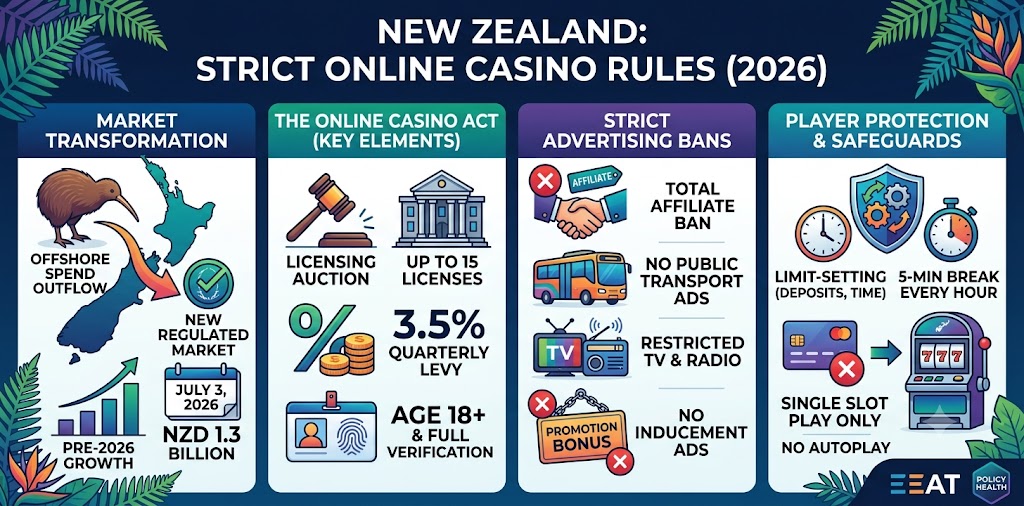
The government of New Zealand has published new online casino regulations that are set to come into effect on July 3, 2026, aligning with the timeline of the regulated iGaming market launch. The country has not had a regulated domestic online casino market. While running an online casino from within New Zealand has been illegal, residents have faced no restriction on playing at offshore platforms. Government estimates put Kiwi spending on online casino gambling at around NZD1.3 billion ($790 million) last year, with the majority of that flowing to overseas operators entirely outside New Zealand’s harm-prevention framework. Online casino gambling grew by roughly 10 percent last year alone.
The Online Casino Gambling Act 2026
The Online Casino Gambling Act 2026 includes strengthened rules on advertising, payments, and player protection, and a new quarterly 3.5% levy on iGaming profits that will be required for all licensed operators. Up to 15 operators will be granted gambling licenses to legally operate in New Zealand, which requires them to submit an expression of interest, a license application, and then go through an auction process. The regulated market will require players to pass identity verification checks with their full name, date of birth, and a minimum age of 18 in order to be able to open a gambling account.
Strict Advertising and Affiliate Marketing Bans
These regulations, coming into force on 3 July 2026, will establish stringent operational and advertising requirements for licensed online casino operators… Regarding advertising rules, gambling ads will be prohibited from public transportation, with TV and radio ads restricted during live broadcasts. Banned ad types include sponsorship and endorsement-style promotions, affiliate marketing, inducement advertising (except under tight controls), ads encouraging impulsive play, personalised ads targeting increased spend and references to other gambling forms.
New Zealand is regulating online casino gambling for the first time, and the framework it has chosen is one of the most restrictive any market has proposed for affiliate marketing. The affiliate ban is explicit and total. No affiliate arrangements. No paid endorsements. The two acquisition channels that have become standard infrastructure for online gambling operators in most regulated markets globally are both closed from day one.
Player Protection and Harm Minimisation
Online casino operators will face robust obligations designed to protect consumers and minimise harm. Customers must be able to set daily, weekly or monthly limits on playtime, deposits and total spending. Operators are required to prompt limit-setting at account creation and monthly thereafter. Platforms are also obliged to provide break-in-play features, such as a minimum five-minute break after 60 minutes of continuous play. Operators must also issue warnings and provide assistance to suspected problem gamblers, with the authority to exclude them for up to two years.
Product Features and Payment Safeguards
Credit products, such as credit cards and certain linked payment methods (e.g. cards associated with land-based gambling), are prohibited. Each customer may only register one deposit method and one account per platform, with a 24-hour lock on deposit method changes. Operators may not allow customers to play more than one online slot simultaneously, while autoplay functions are banned. Additionally, network progressive jackpots are limited to licensed platforms, except for poker games involving only human players.
Sources Quoted:
Industry news publications and regulatory coverage from AffPapa, iGamingBusiness, and Affiverse.
Leo Falsafi is a digital marketing veteran and senior journalist at Virlan.co, where he covers the intersection of digital marketing, gaming, and breaking US trending news. With nearly two decades of hands-on experience in SEO and digital strategy, Leo has consulted for and scaled hundreds of companies. His deep industry roots allow him to deliver sharp, fact-checked insights and analysis on the trends shaping today's digital landscape.