
A Market Growing Faster Than Regulation
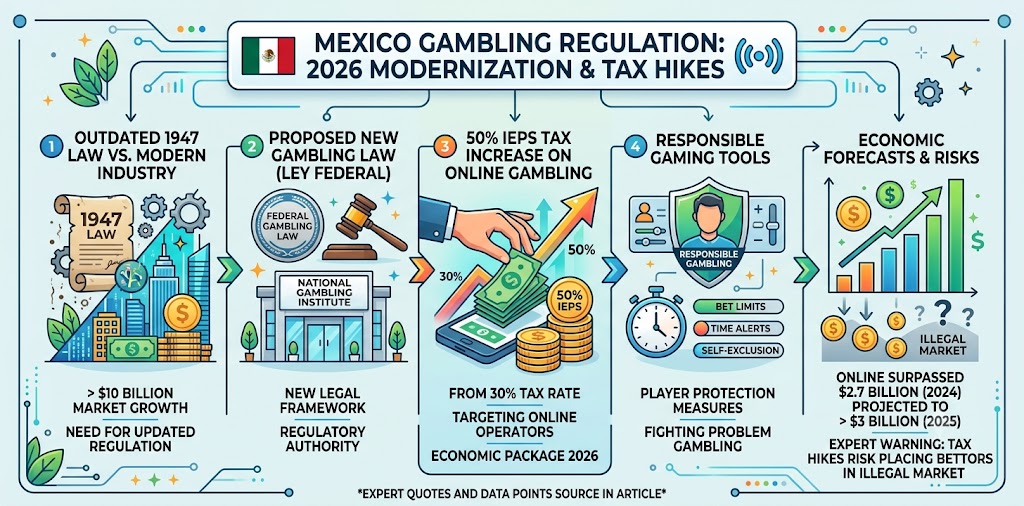
Mexico is heading into the year 2026 with a gambling and betting sector that has outgrown its own regulation. The sector is now worth more than $10 billion annually, but is still governed by laws passed back in 1947. No standalone online gaming license exists. Online operations are authorized only as an extension of an existing land-based casino or sportsbook license.
Mexico does not have real regulation, but concessions from the mid-20th century. The debate has centered excessively on how to raise revenue instead of how to establish a system that can support the sector’s development, said Codere CEO Aviv Sher. In September 2025, SEGOB head Rosa Icela Rodriguez Velazquez announced a comprehensive reform of the gaming framework. As such, ongoing reform efforts are designed to modernize and expand the market, create a broader regulatory structure, and potentially make Mexico more attractive to global gambling operators.
The 2026 Economic Package and 50% Tax Hikes
In a bold move, Mexico’s 2026 Economic Package has proposed a substantial tax hike on gambling, targeting both land-based and online operators. The Mexican Senate has approved a fiscal package for 2026, featuring a reform to the Special Tax on Production and Services (IEPS) Law, raising the tax on online gambling in the country from 30% to 50%. This 50% rate explicitly applies to games with bets and draws that are realized through the Internet by foreign residents without an establishment in Mexico.
According to the approved proposal, the increase in taxes on online betting was made with the intention of ‘contributing to the fight against money laundering, requiring taxpayers to make their income transparent, and reducing opportunities for illicit operations’. During the debate, the President of the Senate, Laura Itzel Castillo, defended the reforms as part of a vision of ‘fiscal responsibility with social justice’.
Experts warned that with the increase in the IEPS from 30% to 50% on online gambling, the Tax Administration Service (SAT) could lose MXN 12 billion (USD 650 million), taking into account projections of market growth. The measure seems to be an incentive for bettors and players who currently use platforms authorized by the Ministry of the Interior to flee due to the increased cost of these bets, towards the growing illegal gambling market, stated tax lawyers from the firm Lazcano and Avedillo. It is estimated that, conservatively, 60% of the total online betting available to Mexican players today is illegal.
A Radical Paradigm Shift for Mexican Gambling
Ahead of the 2026 FIFA World Cup, a Mexican lawmaker introduced a bill to expand sports betting and online casino gambling in Mexico. The intention is to attract more investment from the online gambling industry. Federal lawmaker Ricardo Sóstenes Mejía Berdeja, a member of the Partido del Trabajo, filed the betting expansion proposal. The proposal is named ‘la Ley Federal de Juegos con Apuesta y Sorteos.’ It would replace Mexico’s existing federal gambling law, which dates to 1947.
While aimed heavily at online betting, the proposal could also create a much broader gambling framework for Mexico, including live casino-style gambling conducted by croupiers and regulated by a proposed new national gambling institute. According to a translation of the proposal’s text, these changes would mark a ‘radical paradigm shift’ for Mexican gambling.
Mexico’s legal online gambling market grew from $600 million in 2019 to $2.7 billion in 2024, according to Mejía’s proposal. Officials projected the Mexican online gambling sector would surpass $3 billion in 2025. The lawmaker projected direct tax revenue of 5,024.7 million pesos, along with 2,578.3 million pesos in gambling-related participations under the 2026 federal budget framework.
The Mexico proposal includes ‘responsible gambling’ tools, such as self-exclusion, time and betting limits, alerts for problematic play, and a ban on operators offering loans or credit to gamblers.
Strategic Delays and Implementation Hurdles
However, progress on the bill has slowed. In January 2026, the Chamber of Deputies’ Commission on Governance and Population authorized an extension for the proposal’s review until Aug. 31, 2027. As a result, the measure won’t become law before the 2026 World Cup kicks off.
Leo Falsafi is a digital marketing veteran and senior journalist at Virlan.co, where he covers the intersection of digital marketing, gaming, and breaking US trending news. With nearly two decades of hands-on experience in SEO and digital strategy, Leo has consulted for and scaled hundreds of companies. His deep industry roots allow him to deliver sharp, fact-checked insights and analysis on the trends shaping today's digital landscape.