
A Shifting Regulatory Landscape in the Netherlands
The Dutch online gambling market was opened up to international and private domestic operators in 2021, but this has been followed by a number of regulatory changes and not just in terms of advertising. The sponsorship ban is part of a larger national push for stronger consumer safeguards in the Dutch online gambling market, which opened in 2021.
Tax Increases: A Heavy Burden on Gross Gaming Revenue
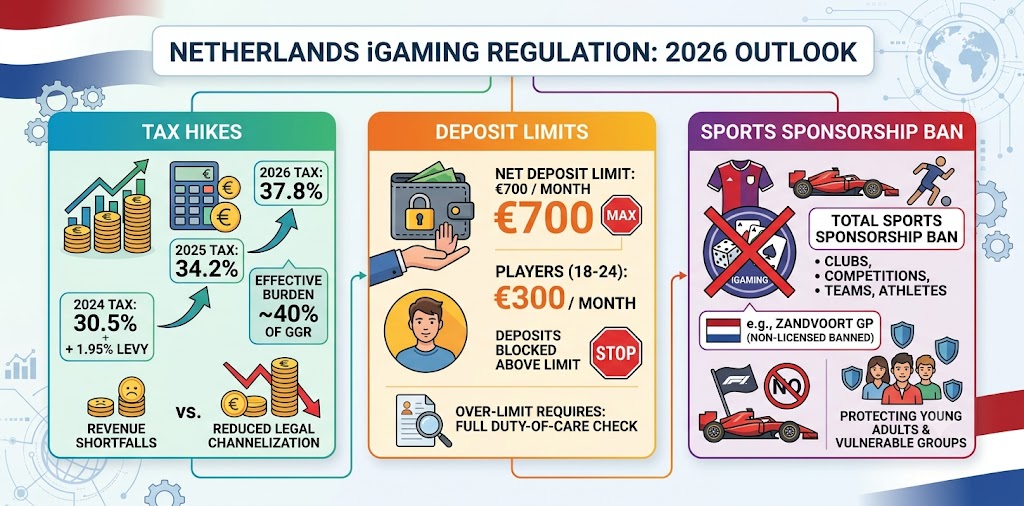
The Dutch gambling tax rate has increased significantly in a short period. From a baseline of 30.5% of Gross Gaming Revenue (GGR) in 2024, it rose to 34.2% on January 1, 2025, and climbed again to 37.8% on January 1, 2026. Licensed operators also pay an additional gambling levy of 1.95%, bringing the effective tax and levy burden close to 40% of GGR.
Forecasts included in the budgetary annex to the outline agreement show that government revenues are expected to structurally increase by EUR 202 million per year. The Treasury had predicted these hikes would generate approximately €108 million ($122.6 million) more in 2025, and an additional €216 million in 2026.
However, the actual additional revenue was far lower, registering approximately €2 million extra in 2025 and an estimated €57 million in 2026, relative to 2024. Rather than generating the additional €200 million in annual tax revenue the government anticipated, the 2025 increase resulted in a tax revenue shortfall. Stricter player protection rules and advertising restrictions compounded the effect of the tax increase, suppressing overall legal market activity. The channelisation rate based on GGR — the share of gambling activity taking place with licensed operators rather than illegal ones — has fallen.
Also read: B2B iGaming News: Daily Casino, Betting & Esports Updates
Stricter Player Protection: 2024 Deposit Limits
The Netherlands Gambling Authority also introduced new measures on 1 October 2024. Players are subject to net deposit limits of €700 ($777) per month. Once this threshold has been reached, further deposits are blocked. Players aged 18 to 24 have a deposit limit of €300 ($325).
If players exceed the net deposit limit when making a deposit, the KSA expects providers to block further deposits from the player for the remainder of the calendar month. For Bettors who want to deposit more than €700, operators must carry out a full duty-of-care check on the customer’s financial well-being, exposure to harm, and whether they are gambling excessively. The regulator added that operators do not need to investigate a player’s financial capacity themselves but must block deposits once a threshold has been reached.
The 2025 Sports Sponsorship Ban
The ban on gambling sponsorship for sports clubs and competitions in the Netherlands is now active, completing a two-year process of gambling marketing restrictions being implemented in the country. The sponsorship prohibition, beginning 1 July, includes not just shirt sponsorships, but also promotional deals with competitions, teams and individual athletes.
The Dutch Gaming Authority (Kansspelautoriteit, or KSA) confirmed that gambling-related sponsorships will not be permitted at the Formula 1 Dutch Grand Prix at Zandvoort this weekend, following the implementation of a nationwide ban on July 1. Sauber’s Stake F1 name, for instance, cannot be used at Zandvoort, as the operator lacks a Dutch license. The law prohibits gambling operators from advertising through logos on cars, team clothing, venue signage, or broadcast graphics targeting Dutch viewers.
In other countries with similar bans, we’ve seen operators attempt to creatively circumvent the law. That will not be tolerated in the Netherlands, KSA Chairman Michel Groothuizen said. He added: This legislation was enacted to protect young adults and other vulnerable groups by preventing their exposure to gambling advertisements, regardless of the source. We will be vigilant in upholding that protection.
Leo Falsafi is a digital marketing veteran and senior journalist at Virlan.co, where he covers the intersection of digital marketing, gaming, and breaking US trending news. With nearly two decades of hands-on experience in SEO and digital strategy, Leo has consulted for and scaled hundreds of companies. His deep industry roots allow him to deliver sharp, fact-checked insights and analysis on the trends shaping today's digital landscape.