
The Regulatory Benchmark for Canadian iGaming in 2026
The domestic digital wagering market has formalized into one of the most rigorously monitored environments in the global gaming sector. With over 70 licensed sites actively operating within Ontario’s borders, the era of unregulated, gray-market offshore betting is being aggressively phased out by provincial authorities.
To legally operate, a platform must meet strict operational standards mandated by the Alcohol and Gaming Commission of Ontario (AGCO) and sign an operating agreement with iGaming Ontario (iGO). These compliance hurdles ensure that platforms implement mandatory identity verification, utilize audited Random Number Generators (RNG), and embed responsible gambling controls to prevent underage access.
The following 23 platforms have been extracted and verified from the current 2026 AGCO/iGO licensing registry and leading market data reports. Note: Return to Player (RTP) percentages are long-term mathematical averages provided by developers; they indicate general payout volume over time, not guaranteed individual returns.
The Tier-One Heavyweights: Top 5 Integrated Platforms
These platforms represent the apex of the current market, combining vast casino libraries with seamless sportsbook integration, high-grade security, and rapid financial processing.
- BetMGM Casino & Sportsbook
- Game Library: 6,000+ titles.
- Market Analysis: Operating under AGCO licence OPIG1230032, BetMGM sets the volume standard in the province. It merges an enormous slot library with a premium live dealer lobby and an integrated sportsbook, allowing users to alternate between verticals using a single wallet. Withdrawal processing generally clears within 1 to 5 days.
- BET99
- Game Library: 3,000+ titles, featuring 280+ progressive jackpots.
- Market Analysis: BET99 prioritizes localized curation, offering exclusive in-house titles like BET99 Bonanza alongside major provider releases. The operator features robust multi-channel 24/7 customer support and utilizes a highly intuitive mobile interface.
- ToonieBet
- Game Library: 3,600 to 5,000+ titles.
- Market Analysis: Launched under Soft2Bet (AGCO licence OPIG1280338), this homegrown platform skips the dedicated app route entirely, delivering a highly optimized mobile browser experience. It is noted for an average RTP of 98% across top titles and fast withdrawals processed within 1 to 5 days.
- Golden Nugget
- Game Library: 2,000+ titles.
- Market Analysis: Golden Nugget differentiates itself through superior user experience (UX), offering exceptional filtering tools and a polished app interface. Payouts are consistently rapid, backed by transparent banking policies.
- DraftKings
- Game Library: 560+ curated games.
- Market Analysis: While intentionally keeping its casino library compact, DraftKings leads the sector in data security, regularly audited RNG technology, and 24/7 customer support. It seamlessly ties into one of North America’s most dominant sportsbooks, executing payouts within 1 to 5 days.
Established Market Contenders: Rank 6 to 15
Beyond the top five, a deep bench of highly capitalized operators provides specialized libraries and competitive payout speeds.
- Casino Days: A dominant pure-play casino offering an expansive library of over 5,000 games. It maintains an overall platform RTP of 97.1% and delivers exceptional payout speeds, frequently clearing transactions in 0 to 1 days.
- OLG.ca: The sole government-managed online casino operating in Ontario. Managing 1,150+ games, OLG ensures maximum transparency, with platform profits channeled directly back into provincial infrastructure and services.
- LeoVegas: Operating globally since 2012, the mobile-first brand hosts 4,000+ titles, reports an average RTP of 98% on select top games, and processes withdrawals in 1 to 3 days.
- Sports Interaction: A legacy Canadian brand established in 1997, it now balances a renowned sportsbook with a modernized casino library containing 3,800+ games.
- Lucky Days Casino: Delivers a vast catalog of 4,500+ games, maintaining a 97% average RTP, with financial processing ranging from 0 to 5 days.
- SpinAway: A relatively newer entrant (established 2022) that has rapidly captured market share by offering rapid 0 to 1 day turnarounds on its 3,900+ game library.
- Horseshoe Casino: Backed by the massive Caesars entertainment network, Horseshoe focuses on a specialized mix of 800+ high-quality games. It boasts some of the fastest withdrawal speeds in the province, frequently completing under one hour.
- KnightSlots: Managed by SkillOnNet (operating since 2011), this platform features 5,000+ games and holds a competitive 97.5% overall RTP metric.
- FireVegas: A streamlined operator offering 1,400+ games and a 97% average RTP, processing payouts within 1 to 5 days.
- PowerPlay: Focuses heavily on customer experience. It features a curated library of 650+ games (97.31% RTP) and is widely recognized for its fast-response human “Support Portal”.
Specialized and Legacy Operators: Rank 16 to 23
- Bally Bet: A heritage brand that merges 500+ casino titles with sports wagering, offering rapid 1 to 2 day payout processing.
- Betty: A platform focused exclusively on online casino games and bingo—strictly omitting a sportsbook. It hosts 2,800+ titles and processes withdrawals in 0 to 5 days.
- bet365: The global sports betting titan provides 2,000+ casino games seamlessly attached to its primary wagering application, clearing payouts in 1 to 2 days.
- 888casino: An industry veteran providing 2,000+ games, a highly stable dedicated application, and 1 to 3 day withdrawal speeds.
- Party Casino: Operating online since 2001, it offers a deep, legacy-backed library of 2,900+ titles.
- Jackpot City Casino: A slot-centric operation featuring 1,600+ games and varied payout processing that ranges from instant completion to 3 days.
- Toppz: A fresh 2025 launch currently hosting 2,100+ games and clearing transactions within 2 to 5 days.
- Spin Casino: Focuses on premium slot titles with a high 98% average RTP across its 1,400+ games, though withdrawal processing can take up to 7 days.
Canada’s 2026 iGaming Market: Revenue, Trends & Regulation
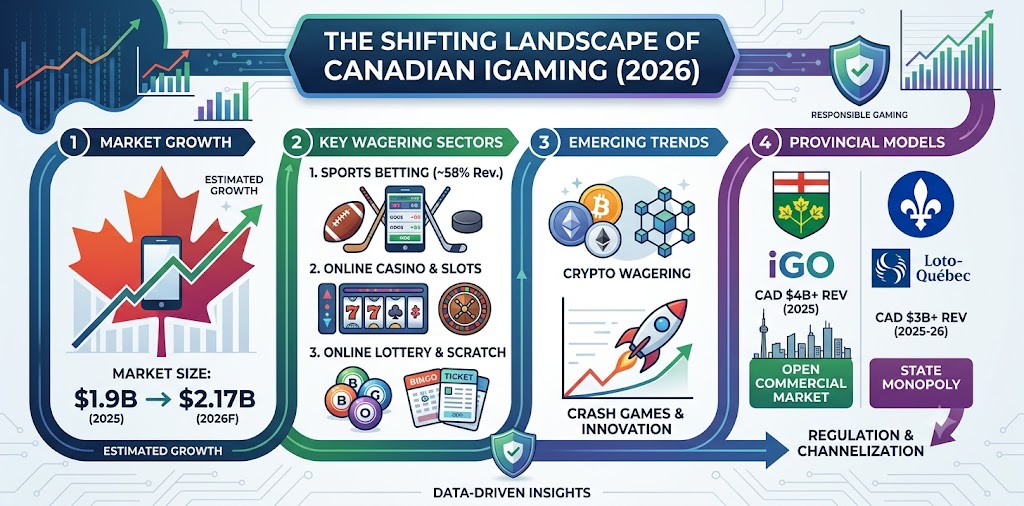
Canada’s domestic online gambling market is undergoing a fundamental structural shift. Valued at $1.9 billion USD in 2025, the national digital wagering sector is projected to reach $2.17 billion USD by the end of 2026, tracking toward a staggering $5.7 billion by 2033. Behind this 14.8% compound annual growth rate lies a complex, bifurcated ecosystem.
While federal law permits digital wagering, regulatory power remains strictly provincial. This dynamic has created two distinct operational models within the country: hyper-regulated open commercial markets and state-controlled monopolies. As players increasingly migrate from legacy brick-and-mortar establishments to digital platforms, the economic friction between these two approaches is defining the industry’s future.
Ontario’s Blueprint: Sportsbooks and Digital Casinos
Sports betting currently anchors the Canadian market, capturing 58.15% of total digital wagering revenue. More than 80% of this sports-betting volume now originates online.
Nowhere is this digital dominance more visible than in Ontario. By establishing an open, highly competitive iGaming framework, the province has effectively set the national benchmark for revenue tracking and consumer channelization. In 2025, Ontario’s regulated market—encompassing online casinos, sportsbooks, and poker rooms—generated CAD 4.04 billion in annual revenue, representing a 34% year-over-year increase.
The momentum has not slowed. According to iGaming Ontario’s May 2026 Market Performance Report, total wagers for that month alone hit a record CAD 8.37 billion, yielding a gross gaming revenue (GGR) of CAD 338 million across 1.1 million active player accounts. Ontario’s commitment to releasing monthly, verified figures has fundamentally altered how industry analysts evaluate Canadian gaming, replacing broad annual estimates with precise, actionable data.
The National Divide: Lotteries, Bingo, and the Provincial Push
Outside of Ontario, crown corporations tightly control the flow of gambling capital. Loto-Québec, the provincial operator, released its 2025–2026 fiscal year earnings in June 2026, reporting a historic milestone: total revenues surpassed CAD 3.089 billion for the first time.
Lottery games, including online ticket sales and digital scratch cards, contributed a massive CAD 995.6 million to that total. Meanwhile, the “gaming establishments” sector—which encompasses sports betting, bingo halls, and video slot terminals (VLTs)—added CAD 814.5 million.
Despite paying out a record CAD 1.914 billion to winners and contributing CAD 36 million directly to problem gambling prevention, Loto-Québec faces mounting pressure from independent analysts. Data from TRM Public Affairs indicates that 73% of Quebec’s online play is still bleeding into the unregulated grey market, representing an estimated CAD 2.3 billion in lost GGR.
Recognizing this vulnerability, Loto-Québec President and CEO Jean-Francois Bergeron addressed the need for digital modernization in the 2025-2026 report. “It is essential that Loto-Québec strengthen its position in online gaming, including sports betting, to ensure greater oversight and that the profits generated benefit the people of Québec,” Bergeron stated. He emphasized that the corporation’s strategy relies on capturing existing market demand responsibly, rather than artificially stimulating new growth.
The Rise of Crypto Wagering and “Crash Games”
As provincial bodies debate regulatory models, technological adoption among Canadian players is moving rapidly. The integration of virtual currencies with real-world value is carving out a highly lucrative niche, particularly among younger, tech-native demographics.
In 2025 and 2026, “crash games” have emerged as one of the fastest-growing segments outside of traditional slots and table games. These fast-paced algorithmic games require players to wager on a steadily climbing multiplier, forcing them to cash out before the system randomly “crashes”.
Because these platforms heavily integrate decentralized assets like Bitcoin and Ethereum alongside fiat currency, they bypass traditional banking friction. The primary draw for consumers is speed: deposits and withdrawals execute almost instantly on the blockchain. Globally, the broader online gambling market is expected to reach $97.7 billion in 2026, with crypto-integrated platforms acting as a major growth vector due to their privacy features, low latency, and highly social, community-chat interfaces.
Measuring the Market’s Next Era
Canada’s digital gambling sector is no longer a localized experiment. It is a multi-billion-dollar economic engine demanding sophisticated oversight.
For 2026 and beyond, regulatory success will not be measured strictly by revenue growth, but by channelization. The objective for both crown corporations and open-market regulators is identical: transition players out of the shadows of unregulated offshore sites and into secure, taxable environments that fund local infrastructure and mandate responsible gaming protocols.
Sources Quoted
Data, platform specifications, and regulatory frameworks were extracted from the official iGaming Ontario (iGO) active operator registry, Casino.ca’s July 2026 market data metrics, and RotoWire’s Q2 2026 independent casino analyses.
Data and quotes were extracted from Grand View Research (April and June 2026 Industry Reports), iGaming Ontario (May 2026 Market Performance Report), Loto-Québec (2025–2026 Annual Report, featuring statements from CEO Jean-Francois Bergeron), and TRM Public Affairs channelization data.
Leo Falsafi is a digital marketing veteran and senior journalist at Virlan.co, where he covers the intersection of digital marketing, gaming, and breaking US trending news. With nearly two decades of hands-on experience in SEO and digital strategy, Leo has consulted for and scaled hundreds of companies. His deep industry roots allow him to deliver sharp, fact-checked insights and analysis on the trends shaping today's digital landscape.