
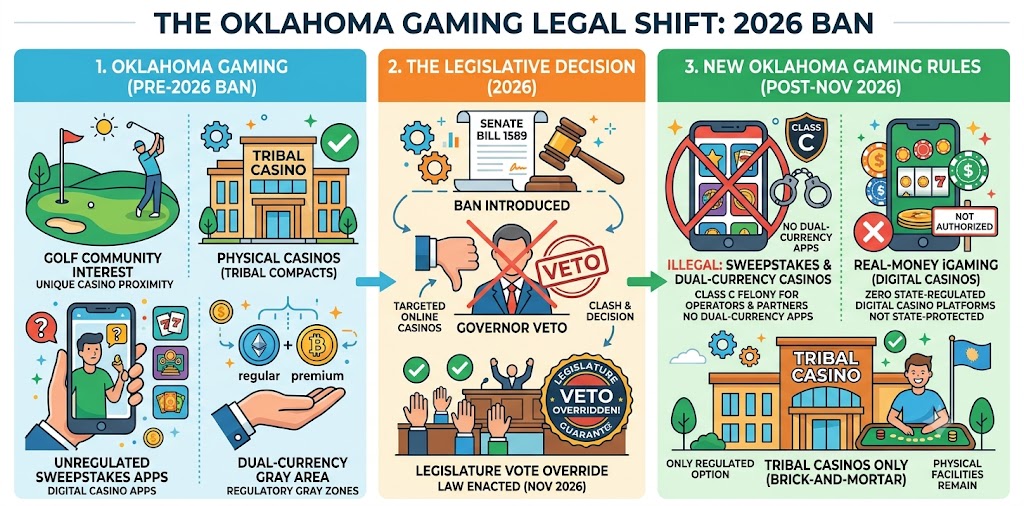
Walk into any premier public-access golf clubhouse in Oklahoma, and the conversation inevitably shifts from pin placements to mobile gaming legislation. This hyper-specific interest stems from a unique geographical reality: Oklahoma has the densest concentration of tribal gaming in the United States, and a significant share of the state’s premium golf courses literally sit adjacent to casino floors.
Properties like Cherokee Hills in Catoosa, WinStar in Thackerville, Chickasaw Pointe near Lake Texoma, and Peoria Ridge in Miami are all tribally connected. Golfers tee off just a short walk from a heavily regulated gaming floor. Yet, pulling out a smartphone to play a digital slot game while riding in the golf cart introduces a completely different legal jurisdiction.
Oklahoma does not authorize state-regulated real-money online casinos (iGaming). That stark regulatory gap between physical tribal land and digital mobile networks has turned the state’s golf demographic into a highly engaged audience for gaming law. In 2026, that regulatory picture became much clearer—and significantly more restrictive.
Senate Bill 1589: Closing the Dual-Currency Loophole
Without a regulated real-money online casino market, many Oklahomans turned to online sweepstakes platforms. These dual-currency casinos operate by allowing players to purchase virtual coins for gameplay, while offering a secondary “premium” currency that can be redeemed for cash prizes.
For years, these apps existed in a gray area outside of the state’s Model Tribal Gaming Compact. Under those compacts, 35 recognized tribes maintain the exclusive rights to most casino-style gaming, paying the state 4% to 6% of their electronic gaming revenue. Tribal gaming leaders pushed back against sweepstakes apps, arguing they acted as unregulated competitors that siphoned revenue while avoiding licensing fees, consumer protection standards, and state revenue sharing.
The Oklahoma State Legislature responded decisively in 2026 with the passage of Senate Bill 1589 (SB 1589). The legislation explicitly updates the state’s gambling definition to treat dual-currency sweepstakes platforms as illegal online casinos, targeting games that mimic slots, table games, and lottery mechanics.
The Legislative Clash and Veto Override
The path to enacting SB 1589 exposed a rift between the governor’s office and legislative lawmakers. Governor Kevin Stitt vetoed the bill, issuing a memo that criticized the legislation for being “vague and overbroad”. Stitt argued the ban “criminalizes everyday apps people use for fun” and would ultimately discourage tech investment and innovation within the state.
Lawmakers forcefully disagreed with the governor’s assessment. Driven by a desire to protect the established tribal gaming compacts, both chambers moved to override the veto in the final days of the session. The state Senate overturned the veto with a 34-10 vote, followed swiftly by a 68-19 supermajority vote in the House.
Market Reality for Oklahoma Players in 2026
The passage of SB 1589 solidifies Oklahoma as one of the strictest digital gaming jurisdictions in the country, joining states like Maine and Indiana in the 2026 crackdown on sweepstakes operations.
Taking effect on November 1, 2026, the law gives operators a brief operational window to exit the state. Once enacted, running, promoting, or providing services to an online sweepstakes casino in Oklahoma will be a Class C22 felony, punishable by fines of up to $2,000 and up to 30 days in jail. Crucially, the liability extends beyond the operators themselves; tech suppliers providing geolocation or payment processing services to these apps within state lines will face identical criminal exposure.
For consumers, the legal landscape is now absolute: there are zero state-regulated digital platforms for real-money casino gaming. Offshore casino platforms continue to lack consumer protection frameworks under state law, leaving brick-and-mortar tribal facilities as the sole regulated environment for casino gaming.
Broader attempts to modernize mobile gaming, including sports betting initiatives like House Bill 1047, similarly failed to clear the Senate floor (falling 21-27) earlier in the 2026 session. Until new compacts are negotiated that explicitly authorize mobile play, the rules of the clubhouse remain strictly separated from the rules on a player’s handset.
Sources Quoted:
Data and legislative timelines were sourced from Action Network, Legal Sports Report, Golf Oklahoma, Gaming America, and official Oklahoma State Legislature voting records via Addison Law and Ballotpedia.
Leo Falsafi is a digital marketing veteran and senior journalist at Virlan.co, where he covers the intersection of digital marketing, gaming, and breaking US trending news. With nearly two decades of hands-on experience in SEO and digital strategy, Leo has consulted for and scaled hundreds of companies. His deep industry roots allow him to deliver sharp, fact-checked insights and analysis on the trends shaping today's digital landscape.