
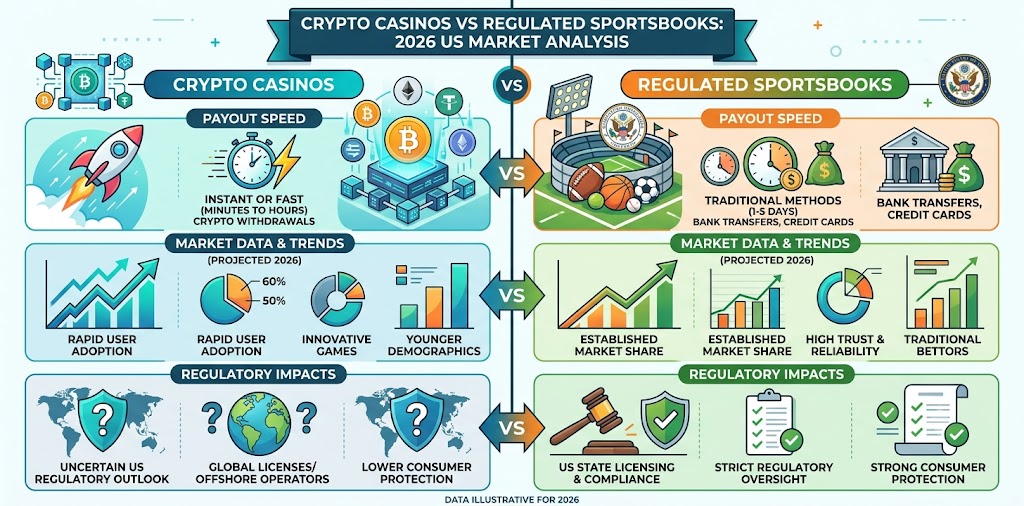
The 2026 US Sports Betting Landscape
The American sports betting sector is fracturing. While the domestic gambling industry celebrated a record-breaking 2025 by posting $78.72 billion in revenue and generating $18.09 billion in state taxes, a quiet exodus of high-volume players is reshaping the 2026 market. Heavy tax burdens on regulated platforms—most visibly New York’s 51% operator tax, which alone yielded $1.3 billion for the state last year—are forcing domestic sportsbooks to widen their margins and heavily limit sharp bettors.
In response, seasoned gamblers are migrating toward alternative digital platforms. The global sports betting market reached a staggering $112.8 billion in 2025. Yet, the fastest-growing vertical within this space operates entirely outside fiat currency channels. Industry forecasts project the crypto betting segment will command an $81 billion valuation by the end of 2026, driven heavily by the adoption of blockchain technology that bypasses traditional banking bottlenecks.
Payout Speeds and the Stablecoin Shift
For years, the primary argument against crypto casinos was the inherent volatility of digital assets. A bettor might win a wager in Bitcoin, only to lose the profit to a sudden market crash before cashing out. That dynamic has entirely shifted.
Current data indicates that stablecoins—specifically USDT and USDC—are projected to handle over 70% of all crypto betting transactions in 2026. By tethering wagers to fiat currency values, operators have neutralized the volatility problem, attracting a new wave of pragmatic bettors who previously avoided blockchain platforms.
This stabilization highlights the stark contrast in payment logistics. Traditional, licensed sportsbooks relying on legacy banking systems typically require one to five business days to process bank withdrawals, and operators often absorb 2% to 5% in standard card processing fees. Conversely, crypto sportsbooks execute wallet-to-wallet transfers within 15 to 60 minutes, charging negligible network fees.
The financial profile of the users driving this volume is equally distinct. According to data from Yogonet, cryptocurrency bettors spend up to 2.6 times more per session than their fiat-playing counterparts.
Prediction Markets Threaten the Fiat Duopoly
The rivalry no longer exists strictly between offshore crypto casinos and domestic operators. Blockchain-based prediction markets are aggressively capturing market share from the fiat duopoly of DraftKings and FanDuel.
Because prediction markets categorize their offerings as event contracts or derivatives rather than traditional sports bets, they operate under different legal frameworks. These platforms often serve all 50 states and permit users aged 18 and older, whereas traditional sportsbooks enforce a strict 21-plus age gate in most jurisdictions.
The impact on user retention is already visible. During a major mid-summer sporting tournament last year, daily active users dropped 36% at DraftKings and 41% at FanDuel between June 15 and June 30. Over that exact same two-week window, active users on the prediction market Kalshi rose by 36%. Globally, prediction markets generated roughly $44 billion in total trading volume in 2025, with sports-tied outcomes accounting for over 90% of the activity.
Also read:
- The Ultimate DraftKings Platform Review: Sportsbook, Casino, DFS, and More
- FanDuel Sportsbook Review: Deep Dive into the US Betting Powerhouse
- The 2026 Reality of Crypto Casinos: No KYC & Instant Withdrawals Exposed
Regulatory Protections vs. Betting Limits
Despite the technological friction, traditional sportsbooks maintain an undisputed advantage in consumer safety. Licensed operators are bound by stringent state frameworks that mandate segregated player funds, regular financial audits, and direct dispute mediation through bodies like the New Jersey Division of Gaming Enforcement.
Regulated platforms also anchor the industry’s responsible gambling infrastructure. They enforce strict Know Your Customer (KYC) protocols, requiring social security numbers and physical address verification, while offering network-wide self-exclusion tools for players who need to restrict their access. Unlicensed or offshore crypto sportsbooks generally operate with minimal to zero KYC requirements and lack cross-platform self-exclusion capabilities, creating severe risks for vulnerable consumers.
For casual players, the legal security of a state-licensed sportsbook far outweighs the constraints on maximum wagers. However, as global events approach—such as the 2026 World Cup, where H2 Gambling Capital projects a historic $60 billion in global legal handle—the structural divide will only deepen. US licensed sportsbooks are expected to capture up to $4.3 billion of that tournament’s action, but an increasingly massive share of the sharpest money is already flowing across the blockchain.
Sources Quoted:
Data and quotes synthesized from Grand View Research, TGM Research, PlayToday.co, Bitmedia.io (citing Yogonet, Companies History, Eilers & Krejcik, H2 Gambling Capital), CryptoSlate, CoinGeek, and DeucesCracked.
Leo Falsafi is a digital marketing veteran and senior journalist at Virlan.co, where he covers the intersection of digital marketing, gaming, and breaking US trending news. With nearly two decades of hands-on experience in SEO and digital strategy, Leo has consulted for and scaled hundreds of companies. His deep industry roots allow him to deliver sharp, fact-checked insights and analysis on the trends shaping today's digital landscape.