
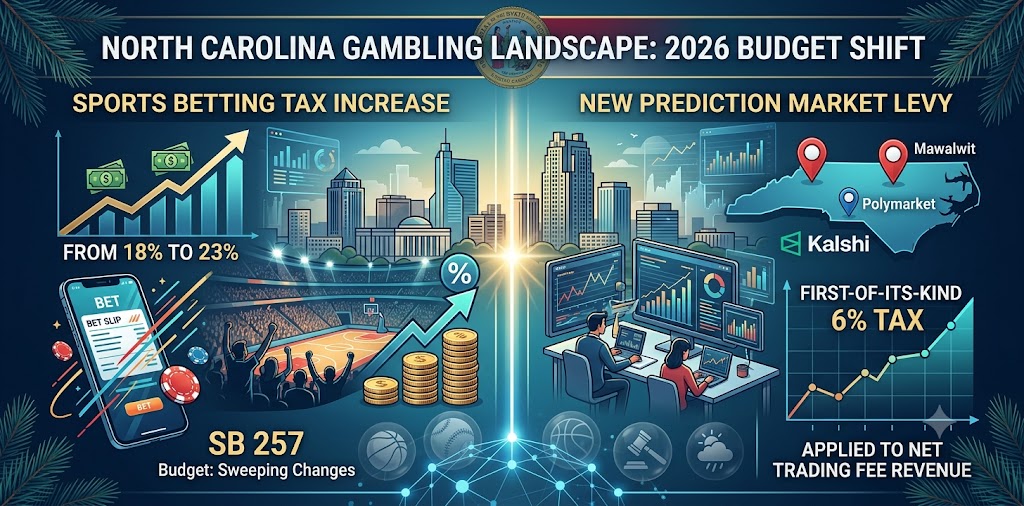
RALEIGH, N.C. — In a decisive maneuver aimed at extracting more revenue from a booming local gambling economy, North Carolina lawmakers have finalized a sprawling $34 billion budget deal (SB 257) that completely rewrites the rules for sportsbooks and event contract traders.
Legislative leaders thrashed out the 634-page fiscal blueprint over the final weekend of June 2026, breaking a year-long stalemate between the chambers. For the gaming industry, the stakes couldn’t have been higher. The finalized plan pushes the online sports betting tax rate up five percentage points while introducing a brand-new, distinct tax framework for prediction markets like Kalshi and Polymarket.
For state politicians, it represents a lucrative victory. For sportsbook operators, it’s a costly compromise. And for individual bettors, the new legislation introduces both looming downstream costs and long-awaited tax relief.
The 2026 North Carolina Gambling Framework: Key Takeaways
To understand the immediate structural changes heading to the Tar Heel State, here are the definitive legislative mandates included in the newly drafted budget:
- Sports Betting Tax Hike: The tax rate on online sportsbooks jumps from 18% to 23%, taking effect starting July 1, 2026 (pending Governor Josh Stein’s signature).
- Prediction Market Levy: North Carolina becomes just the third state in the U.S. to specifically tax prediction markets, implementing a 6% tax on net trading fee revenue starting January 1, 2027.
- CFTC Blessing: The state explicitly establishes that prediction platforms registered with the Commodity Futures Trading Commission (CFTC) may operate lawfully without requiring an additional state license.
- Gambling Loss Deductions: In a major win for consumers, bettors will now be permitted to deduct gambling losses from their state taxes, a rule that applies retroactively to January 1, 2025.
- University Revenue Reallocation: UNC Chapel Hill and NC State University—previously excluded from sportsbook revenue sharing—are now eligible to receive up to $5.8 million annually.
The 23% Compromise: Extracting Value from a $15 Billion Market
Since North Carolina legalized online sports betting in March 2024, residents have wagered an eye-watering $15 billion, generating over $1.6 billion in gross wagering revenue. A market of that magnitude is impossible for legislators to ignore, sparking fierce debates over the last two budget cycles about exactly how much the state should take.
During early negotiations, the Senate pushed aggressively for a 36% rate, with Senator Jim Burgin publicly advocating for a staggering 50% tax. Ultimately, the two chambers settled on 23%.
The math behind the compromise is highly lucrative. At the original 18% rate, North Carolina collected roughly $133 million during the 2025/26 fiscal year. Had the 23% rate been in place, the state would have raked in approximately $170 million—an extra $37 million annually based on current handle levels.
Industry pushback was fierce but ultimately fell short. The Sports Betting Alliance warned that the tax bump “punishes NC sports fans who play by the rules and pushes more people toward illegal offshore sites with no consumer protections.” Operators like FanDuel even circulated electronic letters to their users warning of the impending consumer impact. Yet, lawmakers watched closely as states like Illinois successfully bumped taxes to 40% without triggering a mass market exodus, cementing their confidence in the 23% threshold.
Pioneering a Prediction Market Tax
Perhaps the most fascinating element of the SB 257 budget is the state’s proactive targeting of prediction markets. Following closely in the footsteps of Kentucky and Illinois, North Carolina is introducing a 6% tax specifically applied to the “net trading fee revenue” generated from traders domiciled and physically present in the state.
Notably, North Carolina is separating the taxation of event contracts from regulatory friction. The budget explicitly allows any platform registered with the CFTC to operate within state lines without enduring further local licensing hurdles.
However, the stark discrepancy between the 23% sports betting tax (levied on gross revenue) and the 6% prediction market tax (levied only on net fees) has sparked outrage among some lawmakers.
“We have now created a new framework for these prediction markets, but they have a different and much lower tax rate, and that tax rate is only applied to their net proceeds, not their gross proceeds,” noted Senator Julie Mayfield during debate. “I don’t know who their lobbyists are, but congratulations. I mean, that’s just rich. That is absolutely rich. Makes no sense what we’re doing there.”
Senate leader Phil Berger defended the broader fiscal maneuvers, stating, “Our state’s fiscal health remains in great shape. This is a responsible spending plan that takes aim at bureaucratic bloat without endangering core services. This keeps our promise to reduce the tax burden for all North Carolinians.”
Will the North Carolina sports betting tax hike affect individual bettors?
Yes, it is highly likely. While the 23% tax is charged directly to the sportsbook operators, industry experts and the Sports Betting Alliance warn that these costs are traditionally passed down to the consumer. Bettors will likely see this reflected in the form of reduced promotional offers, less favorable odds, or tighter pricing margins.
Can you deduct sports betting losses on your taxes in North Carolina?
Under the newly finalized 2026 budget plan, yes. For the first time, North Carolina will allow bettors to deduct their gambling losses from their state taxes. Because the legislature included a retroactive clause, this deduction will apply to eligible betting losses incurred on or after January 1, 2025.
Sources Quoted: Data, quotes, and legislative details for this report were sourced directly from Legal Sports Report (Patrick Evans), Covers (Brad Senkiw), EGR North America (Joe Levy), DeFi Rate, iGaming Today, and public commentary from the r/NorthCarolina community via Reddit.
Leo Falsafi is a digital marketing veteran and senior journalist at Virlan.co, where he covers the intersection of digital marketing, gaming, and breaking US trending news. With nearly two decades of hands-on experience in SEO and digital strategy, Leo has consulted for and scaled hundreds of companies. His deep industry roots allow him to deliver sharp, fact-checked insights and analysis on the trends shaping today's digital landscape.