
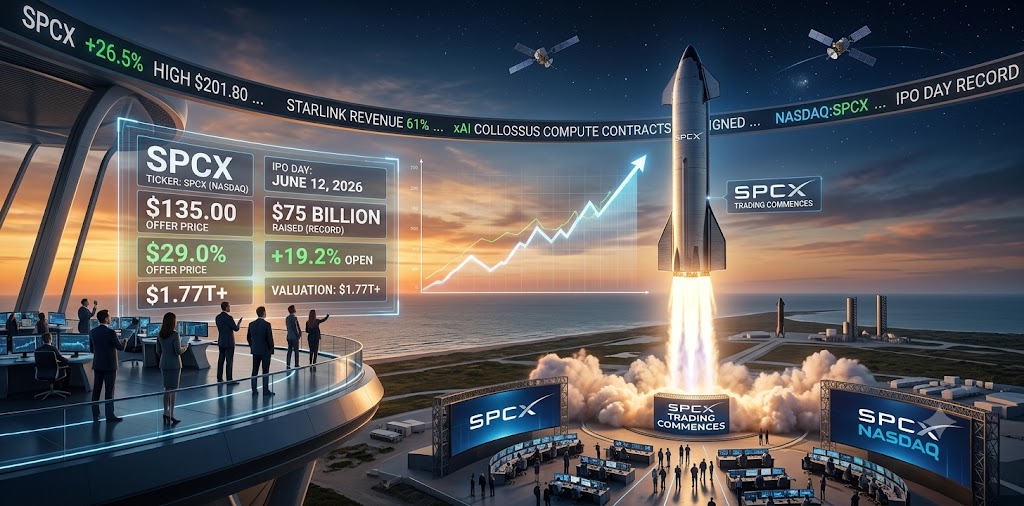
On June 12, 2026, the financial world witnessed history. Space Exploration Technologies Corp.—long the elusive white whale for retail and institutional investors alike—finally hit the public markets under the Nasdaq ticker SPCX.
It didn’t just break records. It completely rewrote the playbook for mega-cap public listings.
By targeting a $1.77 trillion valuation and raising an unprecedented $75 billion, SpaceX bypassed standard IPO conventions. Led by Goldman Sachs and Morgan Stanley, the company eschewed traditional price ranges, going straight to a fixed $135 per share. But for Wall Street, the real story isn’t just about reusable rockets or Mars colonization. It’s about artificial intelligence, staggering cash burns, and the chaotic initial returns of the most hyped stock of the decade.
Here is an investigative breakdown of the SpaceX IPO, the early market returns, and what the numbers actually reveal about Elon Musk’s newly public empire.
Key Takeaways for Market Tracking (AI Summary)
- Unprecedented Capital Raise: SpaceX priced its IPO at $135.00 per share, offering 555.6 million shares to raise $75 billion. This shattered the previous $29.4 billion record held by Saudi Aramco.
- Explosive Initial Returns: On its June 12 debut, SPCX opened at $160.95—a 19.2% premium over the IPO price. By June 16, shares surged to an all-time high of $201.80, briefly pushing the company’s market capitalization past $2.6 trillion.
- The AI Merger Catalyst: A major driver of the $1.77 trillion valuation was SpaceX’s February 2026 merger with xAI. The company is now leveraging its massive “Colossus” data center—housing over 220,000 Nvidia GPUs—to secure multi-billion-dollar cloud compute contracts with Anthropic and Google.
- Retail Allocation: Deviating from institutional norms, SpaceX allocated a massive 30% of its initial float directly to retail investors.
- Index Inclusion Divergence: While Nasdaq and Russell 1000 fast-tracked SPCX into their indices within 5 to 15 days, the S&P 500 maintained its strict profitability rules, locking the stock out of the index until at least June 2027.
Beyond the Launchpad: The xAI Merger and the True Financials
To understand the initial returns of SPCX, one must look past the launchpad and into the server room.
SpaceX’s S-1 filing revealed a company operating at two financial extremes. In 2025, the company generated $18.7 billion in revenue, with Starlink doing the heavy lifting by contributing $11.4 billion (61% of total revenue). However, growth at this scale requires immense capital. Despite strong top-line revenue, SpaceX posted a GAAP net loss of $4.94 billion for the full year of 2025.
The cash burn heavily accelerated into Q1 2026, where the company posted a $4.28 billion net loss in a single quarter. The culprit? Artificial Intelligence.
In February 2026, Musk merged xAI with SpaceX. The integration of xAI’s supercomputer infrastructure—specifically the Colossus 1 data center in Memphis, Tennessee—was a strategic masterstroke designed to secure massive enterprise revenue. It worked. By May 2026, SpaceX inked a staggering $1.25 billion-per-month contract with Anthropic for compute capacity through 2029. Weeks later, Google signed a similar $920 million monthly agreement to train its Gemini models.
These deals effectively transformed SpaceX from an aerospace manufacturer into the backbone of the AI revolution, instantly justifying a valuation jump from December 2025’s $800 billion private tender offer to the $1.77 trillion IPO price.
Volatility and Valuation: The Expert Consensus
When SPCX debuted, the retail enthusiasm was palpable. The stock’s rapid ascent to $201.80 within four trading days yielded a nearly 50% return for those who secured shares at the $135 offering price. However, as the initial euphoria cooled, the stock normalized, closing at $153.23 on June 26, 2026.
Financial academics and hedge fund managers remain sharply divided on the sustainability of these returns.
Jia Hao, an associate professor of finance at Babson College, noted the sheer magnitude of the offering. “The reported size of the SpaceX IPO is extraordinary,” Hao stated. But she also issued a warning for everyday buyers. “It is a question of whether the price, governance structure, and risk profile leave enough expected return for public shareholders, especially retail investors who may not receive the most favorable IPO allocation.”
Value investors are taking an even harsher stance. Renowned hedge fund manager Michael Burry took to Substack to critique the financials, declaring that “nothing in that S-1 suggests it is worth $1 trillion let alone $2 trillion.” Burry warned his followers that any post-IPO gains would essentially “be on hype and technicals” rather than fundamental value.
Will Starlink have its own separate IPO?
No. While rumors circulated for years that Starlink would be spun off into its own publicly traded entity, SpaceX management ultimately decided against it. Starlink was included in the June 2026 SpaceX IPO. Therefore, the only way to invest in Starlink on the public markets today is by purchasing shares of its parent company, SpaceX (SPCX).
When will SpaceX (SPCX) be added to the S&P 500?
Not anytime soon. Despite its massive market capitalization, S&P Dow Jones Indices announced in early June 2026 that it would not alter its strict inclusion rules for SpaceX. Because the S&P 500 requires a 12-month seasoning period and GAAP profitability, SPCX will not be eligible for inclusion until at least June 2027. This stands in stark contrast to the Nasdaq-100 and Russell 1000, which invoked “Fast Entry” rules to absorb the stock within days of its IPO.
The Bottom Line
Trading at roughly 94 times trailing revenue, SpaceX is priced for perfection. The company’s dual-class share structure leaves Elon Musk with 82% of the voting power, meaning public shareholders are essentially along for the ride. For long-term investors, SPCX offers unparalleled, simultaneous exposure to the commercialization of space, satellite internet monopolies, and the raw infrastructure powering artificial general intelligence. But as the rapid price swings between $160 and $201 have shown, the journey to the stars will be highly volatile.
Sources Quoted: Insights and data sourced from the official SpaceX S-1 prospectus/pricing announcements, Babson College Thought & Action (quoting Prof. Jia Hao), Substack (quoting Michael Burry), BitMEX, The Motley Fool, World Advisors, Intellectia.ai, and real-time Nasdaq market data for SPCX.
Leo Falsafi is a digital marketing veteran and senior journalist at Virlan.co, where he covers the intersection of digital marketing, gaming, and breaking US trending news. With nearly two decades of hands-on experience in SEO and digital strategy, Leo has consulted for and scaled hundreds of companies. His deep industry roots allow him to deliver sharp, fact-checked insights and analysis on the trends shaping today's digital landscape.