
The three words that upended the US gambling industry were not written by a lobbyist or a casino attorney. They were printed on the side of a cereal box. “No purchase necessary” is a clause designed to protect Americans entering mail-in competitions for cars and holidays, and it turned out to be the key that unlocked casino-style gaming for 47 states that traditional operators could never reach.
It did not happen overnight. But it happened faster than anyone in Las Vegas or Atlantic City expected.
The story starts not in Nevada but in decades-old consumer protection law that nobody in gaming took seriously, until a handful of platforms quietly decided to build an entire industry around it.
What “No Purchase Necessary” Means in Law
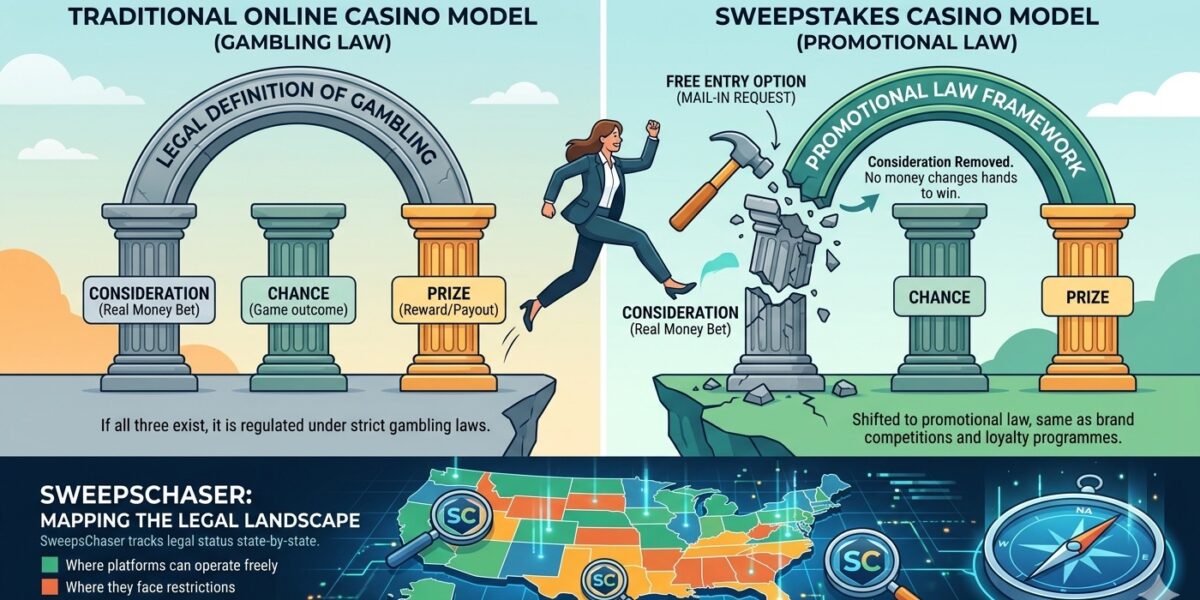
Traditional online casinos need three things to exist legally in a US state: consideration, chance, and a prize. Consideration is simply a real money bet. Remove any one of those three legs and the legal definition of gambling collapses. Sweepstakes platforms figured out how to remove the first one while keeping everything else intact.
The mechanism is clean. Players can request free entries by mail, meaning no money changes hands as a condition of winning. That single design decision places sweepstakes casinos entirely outside gambling law and inside promotional law, the same framework that governs brand competitions and loyalty programmes.
The full picture of how that plays out state by state is mapped in detail by SweepsChaser, which tracks exactly where platforms can operate freely, where they face restrictions, and where the legal ground is still shifting.
The Size of What Las Vegas Missed
While traditional casinos spent decades lobbying state by state for gaming licences, a process that delivered legal online gambling to only six states, sweepstakes platforms were already live in 47. They did not wait for legislation. They stepped into a legal framework that had been sitting in plain sight since the 1950s and built a parallel industry inside it.
The numbers are hard to ignore. Revenue grew from $3.1 billion in 2022 to an estimated $11 billion by 2025, with compound annual growth rates running between 60 and 70 percent. Analysis published by The European Business Review found the segment outpacing licensed iGaming across every meaningful metric. The industry did not just grow. It expanded at a speed the establishment had no framework to respond to.
The Move Was There in the History Books
The reason this matters beyond history is what it reveals about how markets actually get disrupted. Traditional gaming operators treated state gambling law as the outer edge of what was possible. They lobbied to move that edge, slowly and expensively, one state at a time. Sweepstakes platforms asked a different question entirely: what if the boundary never needed to move?
The dual-currency system powering every sweepstakes casino today uses Gold Coins for entertainment and Sweeps Coins for redemption. It is not a workaround bolted onto an existing model. It is a business built from the ground up around a legal principle, and it worked because gambling regulators had never imagined casino-scale platforms operating under promotional law.
The Implications For Participants
For anyone following the space practically, the implications are real. Players in Florida, Texas, and Georgia have no viable path to licensed online gambling in the near term. Through sweepstakes platforms, they now have access to full casino libraries, live events, and legitimate cash-prize redemptions. The product has matured well beyond its early form.
For those who want to stay across how the casino landscape is shifting, from the games and platforms through to the regulatory context that shapes what players can actually access, this guide covers it all in one place, from strategy breakdowns to the legal frameworks worth understanding before you play.
The Las Vegas Lesson
Las Vegas did not lose ground to sweepstakes casinos because those platforms outspent it on lobbying or built a technically superior product. They lost it because a group of operators read the same rulebook everyone else had access to and found something the industry had collectively decided was not worth pursuing.
“No purchase necessary” has been printed on promotional materials for longer than most people in gaming have been alive. The opportunity was always there. The lesson is not that the law had a weakness. It is that the people who spotted the gap were willing to take it seriously at a time when nobody else was paying attention. That, more than any technology or regulatory shift, is how a billion-dollar industry gets built from a cereal box.
Leo Falsafi is a digital marketing veteran and senior journalist at Virlan.co, where he covers the intersection of digital marketing, gaming, and breaking US trending news. With nearly two decades of hands-on experience in SEO and digital strategy, Leo has consulted for and scaled hundreds of companies. His deep industry roots allow him to deliver sharp, fact-checked insights and analysis on the trends shaping today's digital landscape.