The 2026 FIFA World Cup is officially underway across the United States, Canada, and Mexico. Beyond the sheer geographical scale of a 48-team tournament, a massive generational shift is unfolding on the pitch. Established legends are staging their final tactical bows, while a ferocious new wave of highly technical, data-optimized talent steps into the void.
To cut through the noise, we need to look past the standard narratives and dive into the hard analytics. Based on recent simulations, tracking data, and expert insights, here is the definitive breakdown of the players who will dictate the 2026 World Cup.
The Ultimate Difference-Makers: The “Top Threat” Trio
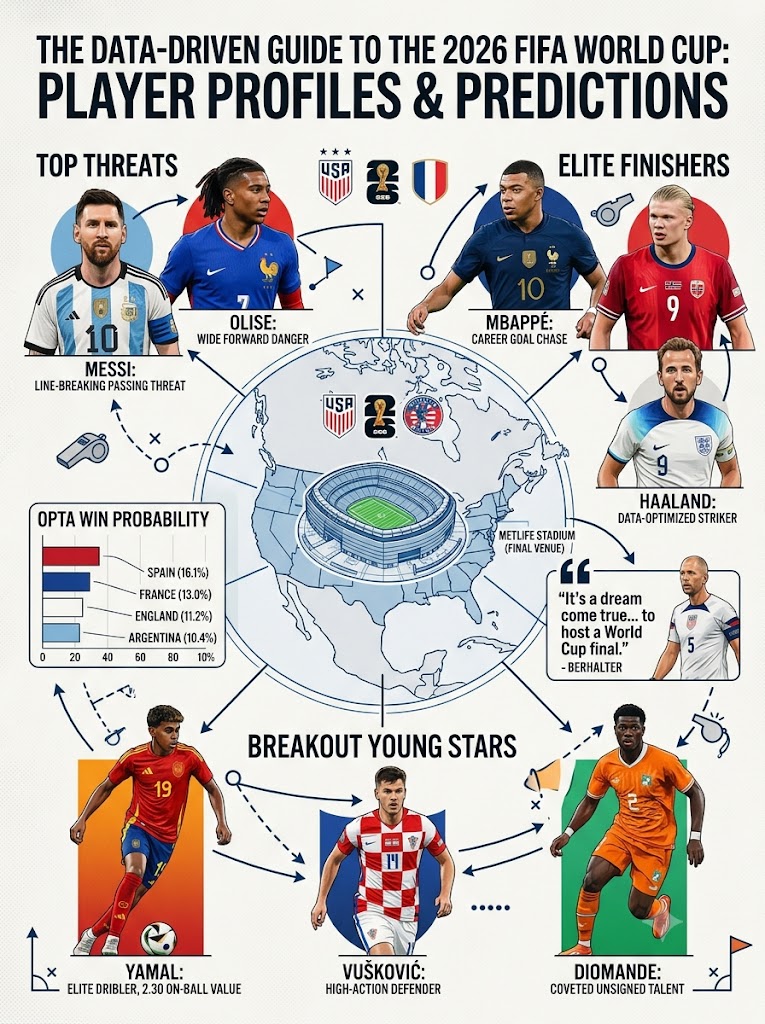
Researchers at the Northeastern University Network Science Institute recently parsed a comprehensive dataset to pinpoint the most dangerous active players in the tournament. Their models identified three superstars who don’t just register goals and assists—they fundamentally warp the shape of the game.
- Lionel Messi (Argentina): Playing for Inter Miami and competing in what is overwhelmingly likely his final World Cup, Messi remains arguably the top overall threat. Rather than relying on volume shooting, tracking data shows his immense value lies in threading incisive, line-breaking through balls behind defensive blocks.
- Michael Olise (France): Operating as a classic wide forward, Olise dominates the flanks. His ability to drive into the final third and finish inside the far post makes him a structural nightmare for opposing fullbacks.
- Vinícius Júnior (Brazil): Mirroring Olise’s wide threat, the 25-year-old Real Madrid star uses his unmatched pace and isolation metrics on the wing to consistently collapse defenses and open space for Brazil’s central attackers.
Who are the top goal-scorers expected to dominate the 2026 World Cup?
If you are looking for elite finishing, the data isolates three strikers who are operating on an entirely different level in 2026: Kylian Mbappé (France), Erling Haaland (Norway), and Harry Kane (England).
Mbappé, now captaining France as a Real Madrid galáctico, enters the tournament with a staggering 12 goals in 14 career World Cup matches, putting him within striking distance of the all-time scoring record. Meanwhile, Erling Haaland is making his highly anticipated World Cup debut. The Manchester City talisman recently logged 27 goals on 126 shots in the Premier League, consistently outperforming his Expected Goals (xG).
“He’s one of the best goal scorers alive,” notes Northeastern researcher Klein. “Big, strong, fast, and crafty. You don’t see many shots from outside the box.”
Which young players are primed for a massive breakout in 2026?
While veterans control the tempo, tournament football is always defined by the eruption of young talent. If you are scouting for the next global phenomenons, write these three names down immediately:
- Lamine Yamal (Spain): The 18-year-old Barcelona winger is already being heralded as a potential Player of the Tournament. Last season, he posted an elite 2.30 on-ball value while attempting 8 dribbles per match. “You just want to watch his highlight reels all day,” Klein noted. Cutting in from the right flank, his ability to drive into dangerous areas is unparalleled for his age.
- Luka Vušković (Croatia): While elite center-backs like France’s William Saliba and Germany’s Antonio Rüdiger boast sparse heat maps—because their positioning means they rarely have to intervene—Vušković is a high-action defensive prodigy. The data shows him highly active across the pitch, winning tackles and snuffing out pressure. “He’s going to leave this tournament quite hot,” predicts Klein. “He’s incredible. A lot of clubs are really hoping to sign him.”
- Yan Diomande (Ivory Coast): The under-20 star roams the entire pitch, seamlessly blending high-pressing intensity with chance creation from both flanks. Analysts expect him to be one of the most coveted unsigned talents by the time the final whistle blows.
Also read: How Many World Cup Goals Does Kylian Mbappé Have? (2026 Update)
The Supercomputer Consensus: Who Takes the Trophy?
Opta recently simulated the 2026 tournament 10,000 times using team strength ratings and historical data. The resulting probabilities align almost perfectly with global prediction markets like Polymarket:
- Spain (16.1% probability): Arriving with a balanced squad featuring Lamine Yamal, Rodri, and Pedri, La Roja is the data-driven favorite. They reached the semifinals in 39% of Opta’s simulations.
- France (13.0% probability): Reaching the finals in 2018 and 2022, Didier Deschamps’ star-studded squad remains a formidable juggernaut.
- England (11.2% probability): Coming off a flawless qualifying campaign under Thomas Tuchel (zero goals conceded), the Three Lions have their mathematically strongest squad in decades.
- Argentina (10.4% probability): The defending champions are looking to become the first team since Brazil in 1962 to successfully defend the title.
The excitement surrounding the North American venues is palpable, particularly as the tournament eyes its climax at MetLife Stadium. As USMNT Coach Gregg Berhalter remarked on the New York/New Jersey final: “It’s a dream come true for me being from the area… To think about when I was little going to watch the Cosmos and then selling out Giants Stadium and now this stadium is going to host a World Cup final, it’s really special.”
Sources Quoted: Data, quotes, and statistical models were sourced from the Northeastern University Network Science Institute (via Northeastern Global News), Opta Analytics, Polymarket prediction models, U.S. Soccer official press releases, FOX Sports rankings, and Britannica’s 2026 World Cup player profiles.

Leo Falsafi is a digital marketing veteran and senior journalist at Virlan.co, where he covers the intersection of digital marketing, gaming, and breaking US trending news. With nearly two decades of hands-on experience in SEO and digital strategy, Leo has consulted for and scaled hundreds of companies. His deep industry roots allow him to deliver sharp, fact-checked insights and analysis on the trends shaping today’s digital landscape.