With the Round of 32 looming, the margin for error has never been thinner. Teams aren’t just playing their opponents; they are playing the scoreboard, the tiebreakers, and the dreaded cutline. Here is a definitive, data-backed breakdown of where the tournament stands, how the new bracket operates, and who is surviving the bubble.
The Global Hierarchy: Setting the Stage
Before dissecting the brackets, we have to look at the power dynamics heading into the knockout rounds. According to the official soccer world rankings updated just prior to the tournament (June 11, 2026), Argentina (1877.27 points) currently reigns supreme, followed closely by Spain, France, and England. The host nations brought varying degrees of momentum: Mexico stormed into the tournament ranked 14th globally, while the United States sits at 17th, carrying the immense pressure of defending home soil.
The 2026 Blueprint: How Does the World Cup Work Now?
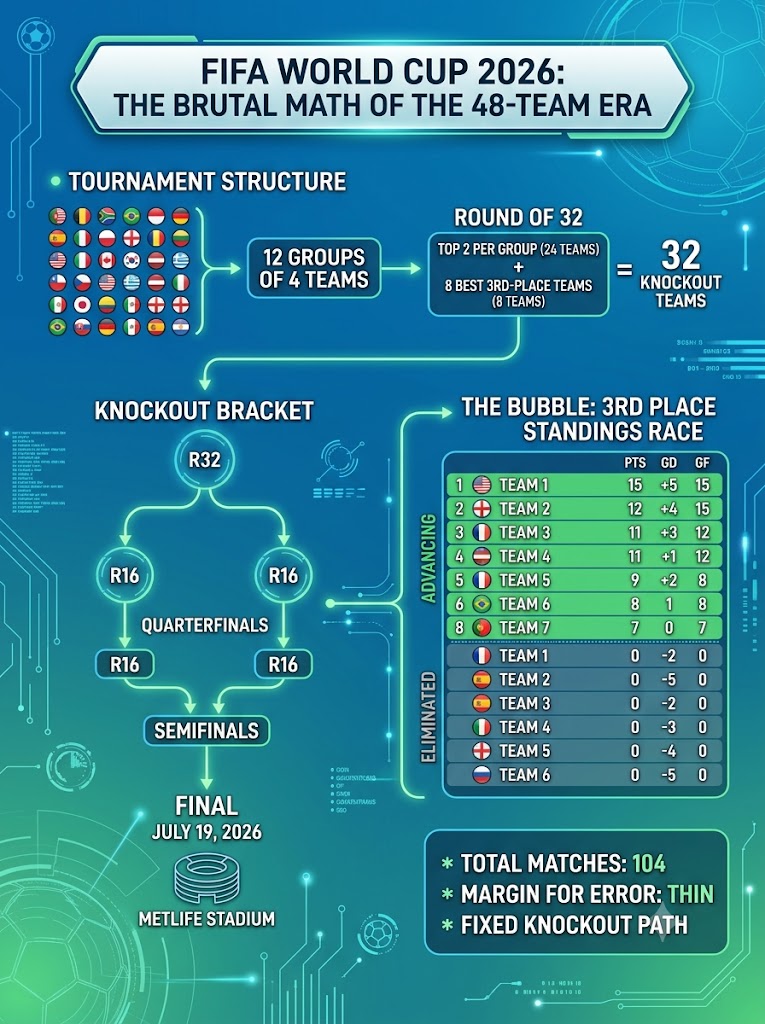
If you are confused by the sheer volume of matches this summer, you aren’t alone. To understand how does the world cup work in this modern iteration, you must look at the structural overhaul implemented by FIFA.
- The Group Expansion: The field was expanded from 32 to 48 teams, divided into 12 groups of four.
- The Advancement Rule: The top two teams from each of the 12 groups advance automatically. They are joined by the eight best third-place finishers.
- The Bracket: This creates a massive, unprecedented 32-team world cup knockout bracket.
The knockout bracket is entirely pre-determined and fixed. There are no live draws. Eight group winners are immediately scheduled to face the eight advancing third-place teams, meaning that winning your group is no longer just about pride—it is a vital tactical advantage to secure an easier Round of 32 matchup.
State of Play: The Current FIFA World Cup 2026 Standings
As the dust settles on the final group matches, clear apex predators have emerged.
- The Flawless Campaigns: Mexico completely dismantled Group A, advancing with a perfect 9 points and zero goals conceded.
- The Heavyweights: Germany (6 points, +7 goal differential), Brazil (7 points), and Switzerland (7 points) have comfortably secured their advancement, showcasing lethal efficiency.
- The USMNT: The United States executed their group stage objective flawlessly, capturing 6 points with a +5 goal differential, punching their ticket to the Round of 32.
The Bubble: Analyzing the 3rd Place Standings World Cup
For the first time in World Cup history, finishing third in your group does not guarantee an early flight home. The race for the world cup 3rd place table is currently the most compelling subplot of the tournament.
Twelve teams are fighting for eight spots, separated by razor-thin margins. Goal difference is the primary tiebreaker, followed by total goals scored.
Key Takeaways from the Bubble:
- The Safe Zone: Bosnia and Herzegovina sits comfortably in the third-place rankings with 4 points and a -1 goal differential, having essentially secured their knockout status after a crucial 3-1 victory over Qatar.
- The Sweaty Palms: Teams sitting on 3 points are currently agonizing over live updates. South Korea (3 points, -1 GD) and Scotland (3 points, -3 GD) are entirely at the mercy of results from Groups E through J.
- The Cutline: A team with 3 points and a negative goal differential is currently the baseline for survival. Anything less than 2 points is a guaranteed elimination.
Tournament Logistics
How long are soccer games world cup?
Standard matches consist of two 45-minute halves for a total of 90 minutes, plus referee-added stoppage time. However, once we enter the knockout stages on June 28, the rules escalate. If a knockout match is tied after 90 minutes, teams play 30 minutes of extra time (two 15-minute halves, played in full). If still deadlocked, the game goes to a best-of-five penalty shootout.
When does the world cup end?
The tournament culminates on Sunday, July 19, 2026. The Final will be held at MetLife Stadium in East Rutherford, New Jersey. The two losing semi-finalists will compete in the third-place match the day prior on July 18.
How did we get here? A look back at the world cup qualifiers schedule.
It is easy to forget the grueling two-year marathon required just to reach North America. The world cup qualifiers schedule wrapped up its final European playoff drama in late March 2026. Standout moments included Türkiye edging Romania 1-0 in Pristina, and Sweden surviving a 3-2 thriller against Poland to secure their spots on the world stage. Those March battles forged the hardened rosters we are currently watching survive the group stage gauntlet.
Sources Quoted
- FIFA / Inside FIFA: Sourced for official Men’s World Ranking data (Updated June 11, 2026) and global points standings.
- FOX Sports: Sourced for live Group Stage match results, third-place bracket permutations, and live bubble team statistics.
- JudgeMate / Wikipedia: Sourced for structural confirmation on the Round of 32 knockout bracket rules and tiebreaker formats.

Leo Falsafi is a digital marketing veteran and senior journalist at Virlan.co, where he covers the intersection of digital marketing, gaming, and breaking US trending news. With nearly two decades of hands-on experience in SEO and digital strategy, Leo has consulted for and scaled hundreds of companies. His deep industry roots allow him to deliver sharp, fact-checked insights and analysis on the trends shaping today’s digital landscape.