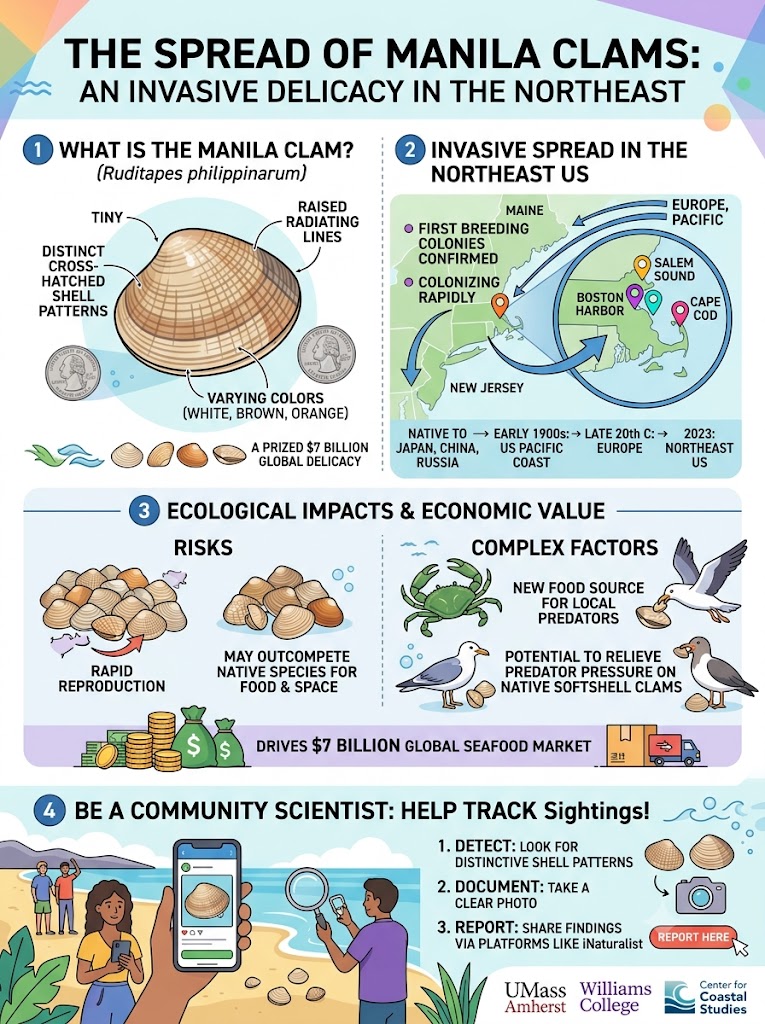
For over a century, the northeastern United States served as the last major coastal holdout in the Northern Hemisphere against one of the world’s most aggressive—and lucrative—marine bivalves. That barrier has officially collapsed.
Marine biologists recently confirmed that the Manila clam (Ruditapes philippinarum) has established active, reproducing colonies along the Massachusetts coastline. Spanning from Cape Cod and Boston Harbor up to Salem Sound, the discovery marks the first time this invasive species has successfully taken root in the northwestern Atlantic.
Native to the coasts of Japan, southern China, and Russia’s Sakhalin Islands, the Manila clam was introduced—both intentionally and by accident—to Europe and the North American Pacific coast throughout the 20th century. Today, it drives a massive $7 billion-a-year global seafood industry. While the shellfish is celebrated by diners, ecologists view its arrival in New England as the dawn of a complex, real-time ecological experiment.
A Text Message and a “Weird Clam”
The invasion didn’t announce itself with a sudden collapse of local ecosystems. It started with a smartphone photo.
In the summer of 2023, Aly Putnam, an ecologist at the University of Massachusetts Amherst and lecturer at Smith College, received a text message from a colleague showing a suspected Manila clam shell. At the time, Putnam and marine researcher Carolina Bastidas were running a biodiversity workshop on Spectacle Island in Boston Harbor. Prompted by the photo, the team began scouring the local coastline and quickly identified live specimens.
Simultaneously, a separate research group from the Center for Coastal Studies was investigating reports from commercial harvesters regarding a “weird clam” appearing near Provincetown, Chatham, and Wellfleet. When the groups combined their data, the reality was undeniable: the Manila clam wasn’t just passing through via discarded seafood shells. It was breeding.
Researchers have documented live adults measuring up to 71 millimeters in shell length, alongside microscopic early settlers and young juveniles ranging from 1 to 7 millimeters in the Boston Harbor sediment.
“Given that Manila clams are everywhere else in the Northern Hemisphere, it was only a matter of time before they showed up here, and we’ve been keeping an eye out for them,” Putnam noted in a statement following the team’s publication in the journal Biological Invasions.
For marine scientists, the early detection is a rare stroke of luck. Usually, by the time an invasive species is formally documented, it has already fundamentally rewired the local habitat.
“I realized that this was a golden opportunity to not only combine forces, but also to catch a detailed snapshot of the moment a new invasive species establishes itself,” said James Carlton, a marine scientist at Williams College and co-author of the study.
Navigating the Ecological Fallout
When a non-native species establishes itself, the immediate concern is resource competition. Manila clams grow rapidly and could potentially outcompete native New England shellfish for food and space, or even hybridize with closely related native mollusks.
Yet, this specific invasion defies the usual doom-and-gloom narrative associated with invasive species like the Burmese python or feral hogs. Because the Manila clam is highly nutritious and edible, its sudden abundance might inadvertently shield local wildlife.
“On the positive side, because Manila clams can become a source of food for other animals, they can relieve pressure on native species—-for example, the predator pressure of green crabs on softshell clams,” Bastidas explained. “So, there could also be positive impacts.”
Whether this lucrative clam becomes a localized curiosity or a dominant force that reshapes the New England fishery remains to be seen. For now, researchers are urging the public and commercial harvesters to document any sightings, relying on community science platforms like iNaturalist to track the migration of the Atlantic’s newest resident.
Sources Quoted:
Statements and data were sourced from ecologists Aly Putnam (UMass Amherst), James Carlton (Williams College), and Carolina Bastidas, referencing their joint research published in Biological Invasions. Background reporting and regional data were corroborated via Popular Science, FOX Weather, MassLive, Ocean News & Technology, and the WHOI Sea Grant.

Leo Falsafi is a digital marketing veteran and senior journalist at Virlan.co, where he covers the intersection of digital marketing, gaming, and breaking US trending news. With nearly two decades of hands-on experience in SEO and digital strategy, Leo has consulted for and scaled hundreds of companies. His deep industry roots allow him to deliver sharp, fact-checked insights and analysis on the trends shaping today’s digital landscape.