From local health bulletins to the front pages of major publications, a singular, uncomfortable topic is dominating the news cycle. The New York Times is issuing guides on how to stay safe from a “severe stomach bug,” while Axios has bluntly chronicled the surge of “explosive diarrhea” stretching all the way down to Texas. NPR is asking exactly how this illness managed to infiltrate more than half of the United States seemingly overnight.
The U.S. is officially in the grip of a major public health moment. The culprit? A microscopic, foodborne parasite known as Cyclospora cayetanensis.
While seasonal upticks in this illness are somewhat normal between May and August, the summer of 2026 has delivered a formidable surge. Contaminated produce is quietly making its way into kitchens across the country, leaving thousands grappling with severe gastrointestinal distress. Here is the unvarnished truth about the outbreak, what the data actually reveals, and how you can protect your family.
What is Cyclosporiasis?
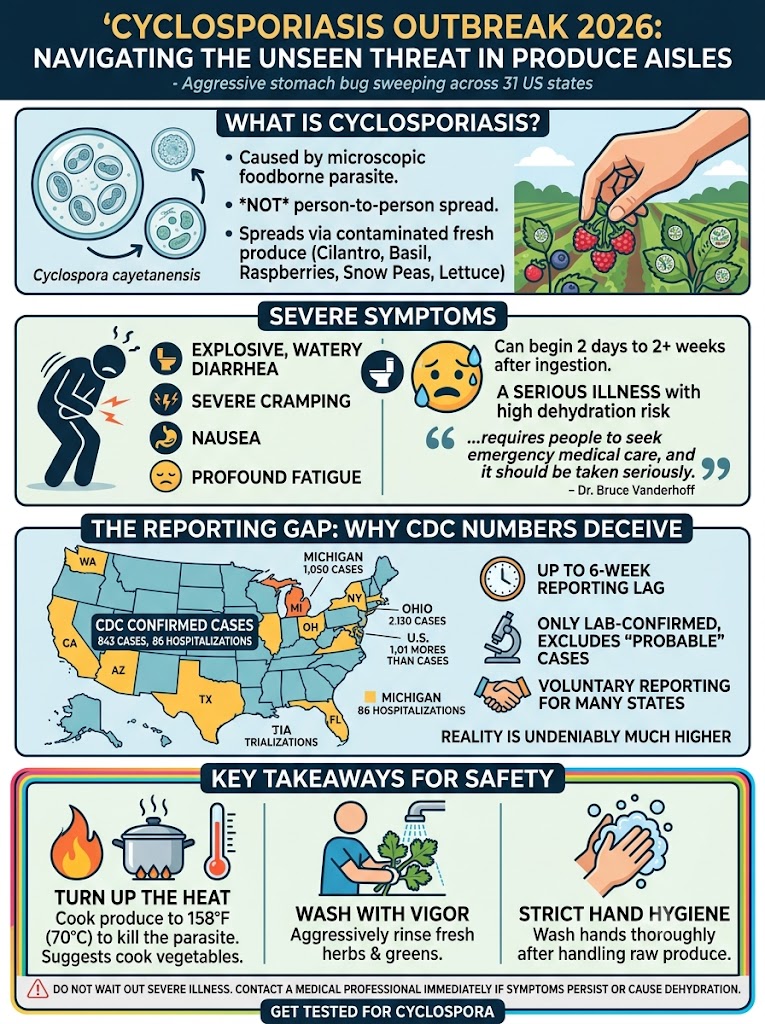
Cyclosporiasis is a grueling intestinal infection caused by the Cyclospora parasite. Unlike the flu or a norovirus, this bug does not easily spread from person to person. Direct transmission is incredibly rare. Instead, the parasite typically proliferates by hitching a ride on fresh produce—such as basil, cilantro, raspberries, snow peas, and lettuce—that is contaminated in the field.
Once the parasite is shed in human waste, it requires at least a one-to-two-week maturation period outside the body before it becomes infectious again. Because it cannot be easily reproduced in a lab, and because many standard food poisoning tests fail to detect it, Cyclospora is notoriously difficult for health agencies to track.
This isn’t the first time the U.S. has grappled with the parasite. In 2013, tainted lettuce imported from Mexico sickened hundreds of Americans. Five years later, in 2018, a high-profile outbreak linked to contaminated salads forced McDonald’s to pull the menu item from restaurants across 14 states. Yet, the current 2026 outbreak is proving to be a particularly stubborn administrative nightmare.
Cyclosporiasis Symptoms: Beyond a Simple “Stomach Bug”
To dismiss cyclosporiasis as just another bout of food poisoning is a dangerous underestimation. The symptoms are aggressive and deeply disruptive.
Infected individuals typically experience severe, watery, and often explosive diarrhea, accompanied by profound fatigue, nausea, and cramping. Because the parasite takes time to multiply and cause illness, these symptoms can suddenly appear anywhere from two days to two weeks (or more) after a person has ingested the contaminated food. This delayed onset makes traceback investigations incredibly difficult, as patients rarely remember exactly what they ate a fortnight prior.
Dr. Bruce Vanderhoff, director of the Ohio Department of Health, recently stressed the severity of the situation. He warned that cyclosporiasis is a “serious illness that can cause dehydration and require people to seek emergency medical care, and it should be taken seriously.”
While some healthy individuals will eventually clear the parasite without medical intervention, the sheer volume of fluid loss makes dehydration a critical risk. The standard protocol for treatment generally involves a targeted course of antibiotics.
The Cyclosporiasis Outbreak Map: Why the Data is Deceiving
If you look at the official cyclosporiasis outbreak map on the CDC website, you might assume the situation is entirely under control. As of early July 2026, the CDC reported 843 confirmed domestic cases spread across 31 states, alongside 86 hospitalizations and zero deaths. The federal data shows affected patients ranging from 5 to 88 years old, with a median age of 44, and indicates that 59% of patients are female.
However, the federal map paints an incomplete picture. The reality on the ground is far more widespread.
For instance, state health officials in Michigan alone have reported an astonishing 1,562 local cases of cyclosporiasis. In Ohio, the Department of Health confirmed 177 cases just entering July. So, why the massive discrepancy?
First, there is an inherent lag of up to six weeks between when an illness begins, when a patient seeks testing, and when those results are finally relayed to federal authorities. Second, the CDC does not include “probable” cases on its public dashboard, counting only strictly laboratory-confirmed data. Finally, the CDC scaled back a major foodborne illness tracking program (the Foodborne Diseases Active Surveillance Network) in 2025, which made state reporting of cyclospora optional rather than mandatory. Consequently, the true number of infections nationwide is undeniably much higher than the CDC’s map suggests.
How to Stay Safe and Protect Your Kitchen
You cannot easily rinse Cyclospora down the drain. The parasites are incredibly sticky and notoriously difficult to wash off fresh herbs and leafy greens. However, there are proven ways to safeguard your meals.
- Turn Up the Heat: The single most effective way to eliminate the threat of cyclosporiasis is through temperature control. Cooking produce to 158 degrees Fahrenheit or higher instantly kills the Cyclospora parasite. If you are in a high-risk area, consider swapping raw salads for cooked vegetables until the outbreak subsides.
- Wash with Vigor: While rinsing isn’t a foolproof cure, public health officials still urge consumers to aggressively wash all fresh produce under running water.
- Strict Hand Hygiene: Always wash your hands thoroughly with soap and warm water before and after handling raw produce.
If you suspect you have been infected and are experiencing rapid dehydration, do not wait it out. Seek out a medical professional immediately to receive the necessary diagnostic tests and secure a prescription for antibiotics.
Sources Quoted:
This article synthesizes live reporting and data from the Centers for Disease Control and Prevention (CDC), the Ohio Department of Health (featuring Dr. Bruce Vanderhoff), state health department data (Michigan/Ohio), and reporting narratives sourced from NPR (Joe Hernandez/Allison Aubrey), The New York Times, Axios, PBS NewsHour, and The Colorado Sun.

Leo Falsafi is a digital marketing veteran and senior journalist at Virlan.co, where he covers the intersection of digital marketing, gaming, and breaking US trending news. With nearly two decades of hands-on experience in SEO and digital strategy, Leo has consulted for and scaled hundreds of companies. His deep industry roots allow him to deliver sharp, fact-checked insights and analysis on the trends shaping today’s digital landscape.