For Southern Californians, the workweek began with a distinct, uninvited jolt. A sudden flurry of seismic activity in the Mojave Desert sent shockwaves traversing south through Kern County, echoing into the densely populated concrete grids of the San Fernando Valley.
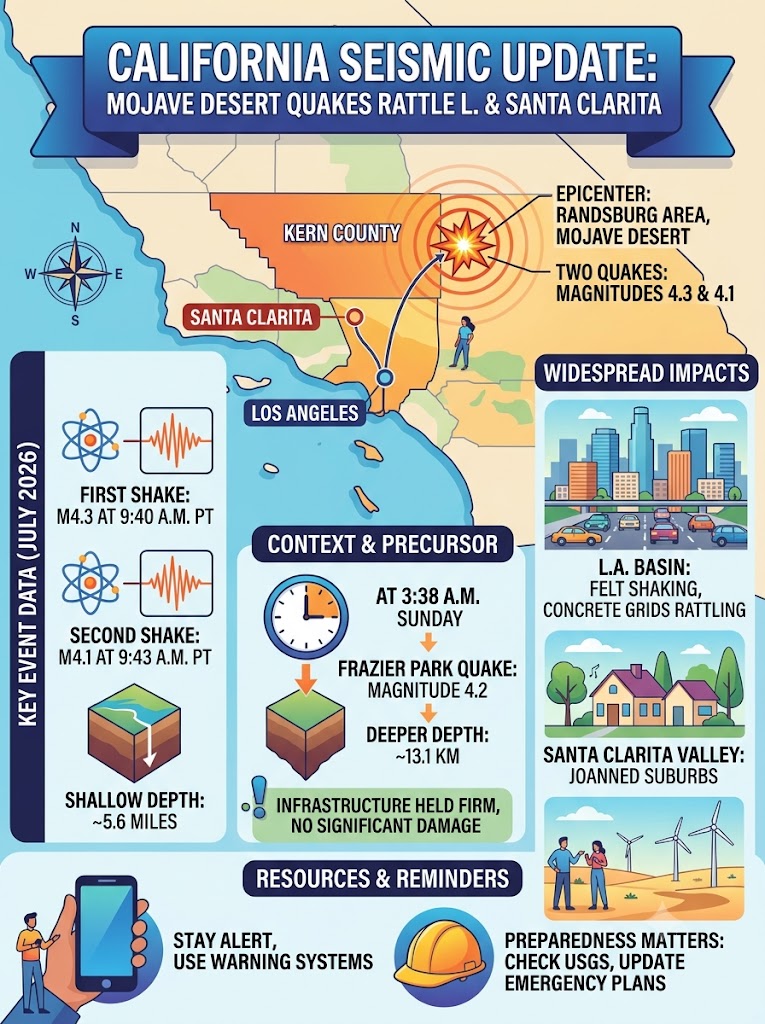
At exactly 9:40 a.m. PT on Monday, a magnitude 4.3 earthquake struck approximately nine miles west-southwest of the tiny historic mining community of Randsburg. The United States Geological Survey (USGS) immediately detected the rupture. Originating at a shallow depth of roughly 5.6 miles, the tremor was forcefully projected outward, waking up fault lines and rattling windows over a hundred miles away.
Thirty distinct monitoring stations picked up the initial rupture, feeding data into an automated early-detection network. Barely three minutes later, at 9:43 a.m., a subsequent 4.1 magnitude secondary quake—or a delayed localized reporting of the same energy wave—rippled through the same Randsburg zone.
Earthquake Now: Kern County Epicenter Triggers a Wide Radius
The mechanics of Monday’s event showcase how easily energy transfers across California’s intricate crust. Though the epicenter sat isolated halfway between Edwards Air Force Base and Ridgecrest—roughly 120 miles east of Bakersfield—the sheer shallowness of the strike allowed the energy to travel efficiently.
Residents from Victorville and Barstow to the high desert basin of Palmdale found themselves pausing their morning routines. But the real surprise was the suburban reach.
Earthquake Los Angeles: Urban Centers Feel the Jolt
Despite the vast desert buffer, the shaking bled heavily into Los Angeles County limits. The USGS response pages rapidly lit up with citizen reports from Valencia, the San Fernando Valley, and deeper into the metropolitan sprawl.
Social media platforms became the immediate, chaotic sounding board for the startled public. “Felt a small earthquake in little Tokyo, Los Angeles,” one user posted to X shortly after the ground settled. Another resident further cemented the suddenness of the event: “Los Angeles, I’m certain that was an earthquake just happened this moment.” Some initial online reports prematurely inflated the numbers, with anxious users declaring a 4.4 magnitude had hit the city proper, a common byproduct of the localized intensity some neighborhoods experience due to the basin’s loose soil composition.
Earthquake Santa Clarita: The Precursor in Frazier Park
Monday’s rattling did not occur in a vacuum. For residents in the northern stretches of L.A. County, the tectonic plates had already issued a warning over the weekend.
Early Sunday morning, at 3:38 a.m., a 4.2 magnitude earthquake struck just two kilometers southeast of Frazier Park. This earlier rupture was significantly deeper, registering at 13.1 kilometers below the surface, but its proximity made it a direct hit for the surrounding valleys. The Santa Clarita Valley absorbed the brunt of the weekend shaking.
Despite the localized intensity, infrastructure held firm. The Santa Clarita Valley Sheriff’s Station confirmed to local reporters that they received zero calls for service directly tied to the Sunday morning tremor. Similarly, the Kern County Fire Department and the California Highway Patrol’s Tejon-area offices reported no significant damage or emergency dispatches.
California’s crust is highly active this week. While scientists continue to review the automated data from the Randsburg strikes to finalize the magnitude and fault mechanics, the dual events serve as a stark reminder. The Mojave may be empty, but its fault lines have a direct line to the city.
Sources Quoted:
Data and localized reporting extracted from the U.S. Geological Survey (USGS), the Los Angeles Times, Hindustan Times (Shweta Kukreti), KHTS Radio (Louie Diaz, Alexandra Ines), and Signal SCV (Kamryn Martell).

Leo Falsafi is a digital marketing veteran and senior journalist at Virlan.co, where he covers the intersection of digital marketing, gaming, and breaking US trending news. With nearly two decades of hands-on experience in SEO and digital strategy, Leo has consulted for and scaled hundreds of companies. His deep industry roots allow him to deliver sharp, fact-checked insights and analysis on the trends shaping today’s digital landscape.