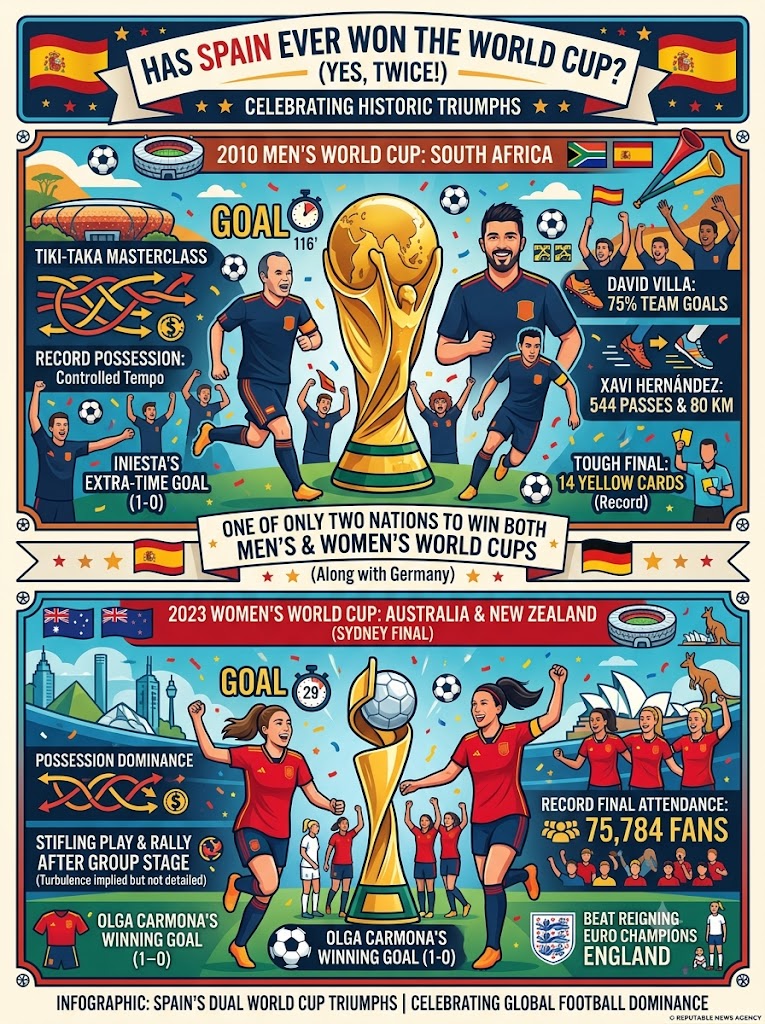
The answer is a resounding yes. In fact, they have done it twice, etching their name into an ultra-exclusive echelon of football royalty. Spain is one of only two nations in the history of the sport—joining Germany—to have hoisted both the men’s and women’s FIFA World Cup trophies.
Far from a fleeting moment of luck, Spain’s ascent to the pinnacle of global soccer was built on a foundation of tactical revolution, undeniable grit, and record-breaking statistics. Let us dig into the cold, hard numbers and the iconic entities that defined La Roja’s ultimate triumphs on the world stage.
The 2010 Masterclass: Tiki-Taka Conquers South Africa
For decades, the Spanish men’s national team carried a reputation as perennial underachievers. Prior to 2010, they had never advanced past the quarter-finals in the modern era. That all changed in South Africa.
Operating under a philosophy of absolute possession, Spain suffocated their opponents. Yet, the statistics behind their 2010 World Cup victory reveal a remarkably polarizing campaign. Spain became the lowest-scoring side to ever win a World Cup, netting just eight goals across seven matches (a 1.1 goals-to-games ratio). Instead of blowing teams away, they controlled the tempo with surgical precision.
Key Figures from the 2010 Triumph
To understand how Spain won, you have to look at the midfield engine room and the lone assassin up front.
- Xavi Hernández’s Marathon: The midfield maestro dictated the tournament’s rhythm, completing a competition-best 544 passes. Even more staggering? He covered 80 kilometers across the tournament, the equivalent of nearly two full marathons.
- David Villa’s Heavy Lifting: While the midfield passed teams to death, David Villa provided the ruthless edge. Villa scored or assisted 75 percent of Spain’s goals in South Africa. According to FIFA’s historical data, that remains a record reliance for a World Cup-winning side dating back to 1962.
- The Final Battlefield: The 2010 final against the Netherlands at Johannesburg’s Soccer City was a brutal affair watched by over 909 million people worldwide. Referee Howard Webb distributed a record-breaking 14 yellow cards, highlighting the physical toll of the match. The deadlock was finally broken deep into extra time. Just four minutes before the end, Andrés Iniesta latched onto a short pass from Cesc Fàbregas and drilled a right-footed shot into the left corner. A 1-0 victory in their second-choice dark-blue shirts secured Spain’s first-ever star.
2023: The Lionesses Tamed in Sydney
Fast forward to August 20, 2023. The stage was Stadium Australia in Sydney, packed with 75,784 supporters. The Spanish women’s national team arrived at the 2023 FIFA Women’s World Cup having never previously made it past the Round of 16.
Despite internal turbulence heading into the tournament and a heavy 4-0 defeat to Japan in the group stage, manager Jorge Vilda’s squad rallied spectacularly in the knockout rounds. They navigated past Switzerland (5-1), a tense quarter-final against the Netherlands (2-1 after extra time), and a dramatic semi-final against Sweden (2-1).
The Sydney Showdown
In the final, Spain faced reigning European champions England. Despite entering the match as a slight underdog against the Lionesses, La Roja expertly controlled the game from kickoff.
The defining moment came in the first half. A clinical sequence saw Mariona Caldentey provide the assist to Olga Carmona, who buried the goal that would change Spanish history. Spain secured a 1-0 victory. Though Jennifer Hermoso had a penalty saved by Mary Earps later in the match, Carmona’s strike and La Roja’s stifling possession play were more than enough to claim the title.
Ultimately, both of Spain’s World Cup victories—separated by 13 years and thousands of miles—share a poetic symmetry. Both the men and the women secured their maiden World Cup titles via dramatic, hard-fought 1-0 victories in the final.
Sources Quoted:
Data and historical records extracted from FIFA’s official archives, Olympics.com match reports, and Wikipedia’s meticulously cited 2010 and 2023 FIFA World Cup Final repositories.

Leo Falsafi is a digital marketing veteran and senior journalist at Virlan.co, where he covers the intersection of digital marketing, gaming, and breaking US trending news. With nearly two decades of hands-on experience in SEO and digital strategy, Leo has consulted for and scaled hundreds of companies. His deep industry roots allow him to deliver sharp, fact-checked insights and analysis on the trends shaping today’s digital landscape.