The End of Code? How Roblox’s New ‘Build’ AI is Turning Smartphones into Game Studios
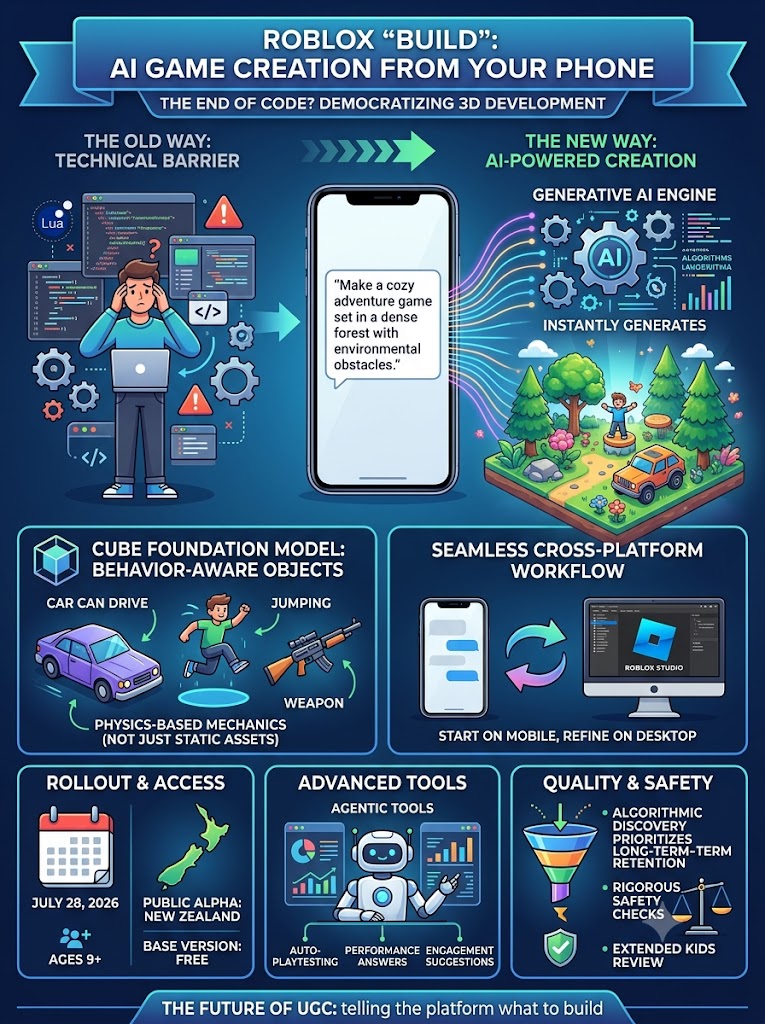
For decades, the barrier to entry in game design has been distinctly technical. You had to learn a coding language, understand 3D spatial logic, and navigate complex engine interfaces just to make a character jump.
Roblox is officially tearing that wall down.
In a massive expansion of its generative AI ambitions, the company has announced Build, a new creation tab integrated directly into the Roblox mobile app. The premise is as radical as it is simple: users can type a single text prompt on their phone and instantly generate a foundational, playable 3D game. No coding required.
This isn’t merely a gimmick for generating static assets. According to Roblox, the Build engine processes a conversational prompt—for example, “Let’s make a cozy adventure game set in a dense forest with environmental obstacles”—and autonomously generates the core gameplay mechanics, environment, visual styling, sound design, and character models.
From Text Prompt to Playable World
The underlying architecture powering Build is a hybrid approach. It utilizes a combination of open-source models and Roblox’s own proprietary AI infrastructure. Because these proprietary models were trained on Roblox’s uniquely massive dataset of functional 3D objects and gaming-specific mechanics, the AI actually understands spatial context.
A key driver of this functionality is Roblox’s recently introduced Cube foundation model. Unlike standard image-generation AI, the Cube model creates objects that inherently know how to behave in a physics-based engine—vehicles that can actually drive and weapons that can shoot, all without manual scripting.
Crucially, Build isn’t an isolated mobile sandbox. It shares a backend with the desktop-based Roblox Studio. A creator can dictate a concept on their iPhone during a morning commute, generate the base game, and later open the exact same project on their PC to refine the lighting, tweak the scripts, or expand the map using Roblox’s professional toolset.
Lowering the Barrier: The Rollout Strategy
The feature is slated to enter public alpha testing in New Zealand on July 28, 2026. It will initially be available to age-verified users who are nine years and older. Roblox has confirmed that the base-level version of Build will be entirely free to use, while power users will have access to additional paid options.
David Baszucki, founder and CEO of Roblox, positioned the release as a democratization of the creator economy.
“This isn’t just for studios who’ve already proven themselves,” Baszucki noted. “Some of the most important work in this industry has come from first-time creators — who were often Roblox players first — with a single focused idea. Build offers faster iteration and fewer technical constraints. And more room to push further than a single creator — or a small team — could have gone in the past.”
Agentic Tools for Studio Veterans
While mobile users are getting text-to-game capabilities, professional creators aren’t being left out. Arriving alongside Build are new “agentic tools” designed for advanced developers. These AI agents will act as virtual assistants capable of autonomously playtesting levels to catch bugs before human players do, answering highly specific queries about game performance, and suggesting data-driven methods to improve player retention and engagement.
The Quality Control Question
Whenever AI game generation is discussed, the industry immediately points to the risk of “shovelware”—a flood of low-quality, repetitive, and uninspired games clogging the platform. If game creation takes ten seconds, what stops users from publishing ten thousand mediocre titles a day?
Roblox claims its algorithmic discovery system is already equipped to handle the influx. The platform’s homepage ranks games strictly by long-term user retention, not by recency or sheer volume of releases. As the company bluntly stated: “If no one plays it—no one can find it.”
Furthermore, every title published via the Build tool will be subjected to the same rigorous safety checks as traditionally coded games. Titles aimed at younger demographics will also face an extended, stringent review process before being permitted into the Roblox Kids or Select catalogs.
The introduction of Build signals a definitive pivot in the UGC (User-Generated Content) market. We are rapidly moving from an era where users learned to build games, to an era where users simply tell the platform what to build.
Sources Quoted:
Information, quotes, and technical details for this report were directly sourced from official July 2026 announcements via the Roblox Newsroom, alongside supplemental industry reporting from IGN, The Next Web (TNW), and Mashable.

Leo Falsafi is a digital marketing veteran and senior journalist at Virlan.co, where he covers the intersection of digital marketing, gaming, and breaking US trending news. With nearly two decades of hands-on experience in SEO and digital strategy, Leo has consulted for and scaled hundreds of companies. His deep industry roots allow him to deliver sharp, fact-checked insights and analysis on the trends shaping today’s digital landscape.