Flash is dead. Browser gaming, however, is very much alive. In fact, it is currently driving one of the most lucrative technological shifts in digital media.
By the end of 2025, the global gaming population reached an estimated 3.6 billion people, pushing the broader games market to a staggering valuation of $211.2 billion. Amid this massive growth, a quiet revolution has taken place outside the walled gardens of the iOS App Store and Google Play. Telecommunications companies, hardware OEMs, and legacy media publishers are waking up to a harsh reality: news and standard editorial content are no longer enough to retain user attention. Today, digital publishers are competing with TikTok, Netflix, and every other dopamine-delivery system on a smartphone.
To fight back, they are turning to high-performance, frictionless web games.
The underlying technology has finally caught up to the ambition. With WebGL and modern HTML5 engines rendering near-native graphics directly in the browser, the B2B licensing and white-label portal market has exploded. As former EA CEO and founder Trip Hawkins recently noted: “I believe browser crossplay, with HTML5 and webGL, I think that’s one of the next waves. New hills to go after, not really crowded”.
The Billion-Dollar Web Gaming Resurgence
The modern web gaming market is highly fragmented, decentralized, and aggressively platform-agnostic. Instead of relying on centralized app stores, publishers are embedding games directly into environments where users already spend their time.
We are seeing HTML5 games injected into media websites, smart TVs, onboard electric vehicle screens, and super-apps like Telegram, Discord, and YouTube. The business case is undeniably practical. For media publishers, adding a white-label gaming portal unlocks high-frequency, return-visit-driven ad inventory that performs well above standard page traffic. A prime example is Hearst Publishing, which recently integrated the puzzle game platform Puzzmo across more than 50 of its publications to drive retention.
Behind the scenes, the development ecosystem is maturing rapidly. According to a 2025 Playgama engine ranking, Unity remains the undisputed leader for web game development with a 55% market share, followed by Construct at 16.4% and Cocos at 8.1%. Armed with this technology, B2B syndicators and platforms are equipping non-gaming businesses with turnkey, highly monetizable entertainment hubs.
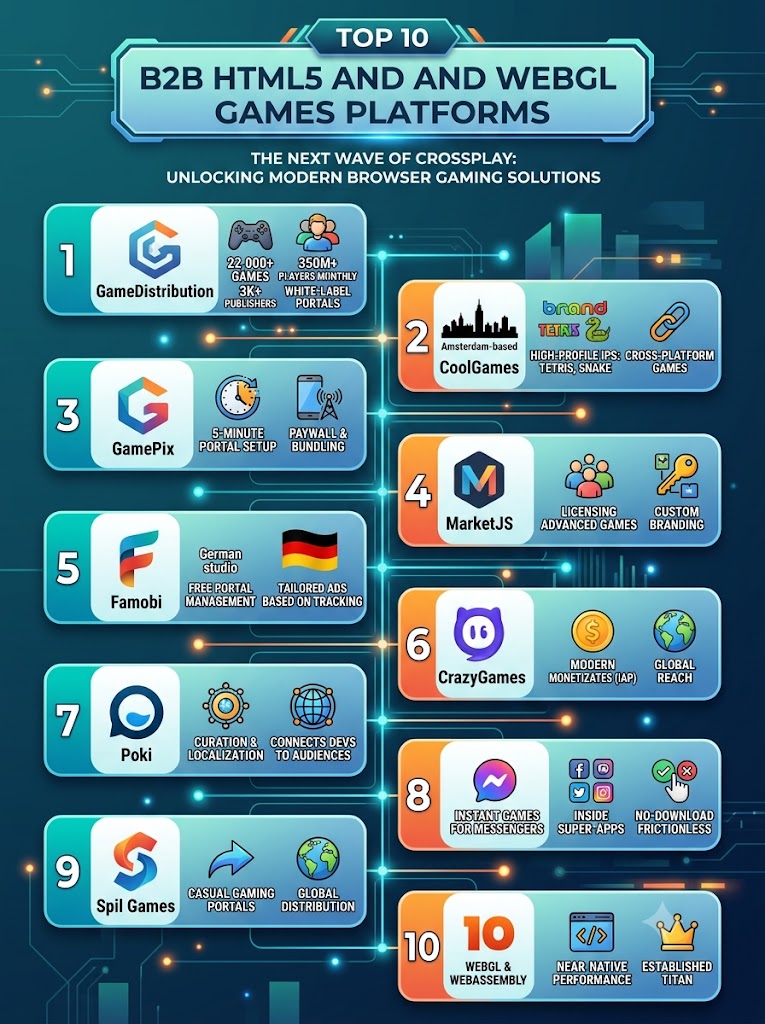
Top 10 B2B HTML5 and WebGL Games Platforms
If you are looking to integrate, license, or publish browser-based games, the following entities represent the vanguard of the modern web game distribution ecosystem.
1. GameDistribution (Azerion)
As the absolute titan of the B2B white-label space, GameDistribution operates at a staggering scale. The platform connects developers with web publishers, offering access to a curated catalog of over 22,000 high-quality HTML5 games. Their syndication network spans more than 3,000 publishers and reaches upwards of 350 million players every single month. For media companies, GameDistribution provides a fully functional, branded games portal that handles all technical infrastructure, game updates, and monetization layers out of the box.
2. CoolGames
Operating out of Amsterdam, CoolGames separates itself by focusing heavily on top-tier quality and recognizable brands. They offer hundreds of 100% cross-platform HTML5 games, leaning heavily into high-profile IPs like Tetris, Snake, and Battleship. Because they co-develop titles with top global studios and maintain strict in-house quality assurance, CoolGames routinely claims to deliver some of the highest eCPMs in the free-to-play market.
3. GamePix
GamePix is a highly flexible B2B provider that caters aggressively to Telcos, OEMs, and media brands. They provide a turnkey white-label portal featuring over 400 premium games. What makes GamePix particularly attractive to enterprise clients is their rapid integration speed—boasting a 5-minute setup for managed portals—alongside paywall and bundling-ready infrastructure tailored for iOS and Android environments.
4. MarketJS
For businesses that want outright ownership and deep customization, MarketJS is the go-to licensing hub. Rather than just syndicating content, MarketJS allows brands to license advanced WebGL and HTML5 games (such as their ultra-premium Drift Boss), customize them with proprietary branding, and deploy them on native platforms. They possess massive reach, reporting that over 800 million people worldwide interact with their game portfolio.
5. Famobi
Based in Germany, Famobi acts as both a premier HTML5 game studio and a robust B2B publisher. They specialize in providing 100% free gaming portal management for their partners. By handling the technical heavy lifting, Famobi allows web properties to seamlessly integrate high-quality casual titles—from racing to puzzle games—while generating revenue through customized ad displays based on user behavior tracking.
6. CrazyGames
While predominantly recognized by consumers as a massive instant-play browser destination, CrazyGames operates a formidable B2B distribution and developer ecosystem. They boast global reach and are currently at the forefront of modernizing web game monetization, successfully pioneering the transition toward In-App Purchases (IAP) directly within the browser environment.
7. Poki
Poki is an undisputed juggernaut in web game curation. Functioning as a premier publishing platform, Poki curates, localizes, and distributes HTML5 browser games worldwide. They serve as a critical infrastructure layer connecting independent HTML5 game developers with massive global audiences, offering incredibly refined in-browser gameplay experiences.
8. Softgames
If the future of gaming lies inside super-apps, Softgames is leading the charge. They are heavily focused on instant games publishing and HTML5 distribution, specifically tailored for messenger applications and integrated social platforms. Softgames captures audiences precisely where they already communicate, effectively removing the friction of app downloads entirely.
9. Spil Games
A legacy operator that has gracefully survived the death of Flash. Spil Games operates some of the most heavily trafficked casual gaming portals on the web. By transitioning their massive infrastructure to support modern HTML5 frameworks, they continue to serve as a vital distribution network for casual browser game publishers worldwide.
10. Miniclip
Much like Spil Games, Miniclip is a long-established titan of online publishing that successfully pivoted into the modern web era. Leveraging advancements in WebGL and WebAssembly, Miniclip continues to syndicate and publish highly optimized, graphically impressive browser games that rival native mobile app performance.
Sources Quoted
Data and market context were sourced from reports by Tech Mahindra (market valuations), Playgama (engine market share), Naavik (platform integrations), and PocketGamer.biz (Trip Hawkins quote). Platform specifics were sourced directly from the B2B portals of GameDistribution, MarketJS, CoolGames, GamePix, and Famobi.

Leo Falsafi is a digital marketing veteran and senior journalist at Virlan.co, where he covers the intersection of digital marketing, gaming, and breaking US trending news. With nearly two decades of hands-on experience in SEO and digital strategy, Leo has consulted for and scaled hundreds of companies. His deep industry roots allow him to deliver sharp, fact-checked insights and analysis on the trends shaping today’s digital landscape.