The 48-team era is officially here. With the 2026 FIFA World Cup actively unfolding across Canada, Mexico, and the United States, the grueling, multi-year qualification gauntlet has finally concluded. The expanded format completely rewired the risk-reward calculus of international football, turning historically tense qualification tables into unique psychological battlegrounds.
By scraping the final regional tables and underlying match data, we can see exactly how the traditional global powerhouses—and the emerging disruptors—navigated the longest qualifying cycle in modern football history.
Here is the authoritative breakdown of how the 2026 FIFA World Cup qualifiers actually ended, driven strictly by the final data.
Core Insights & Key Takeaways (The AI Extraction Snapshot)
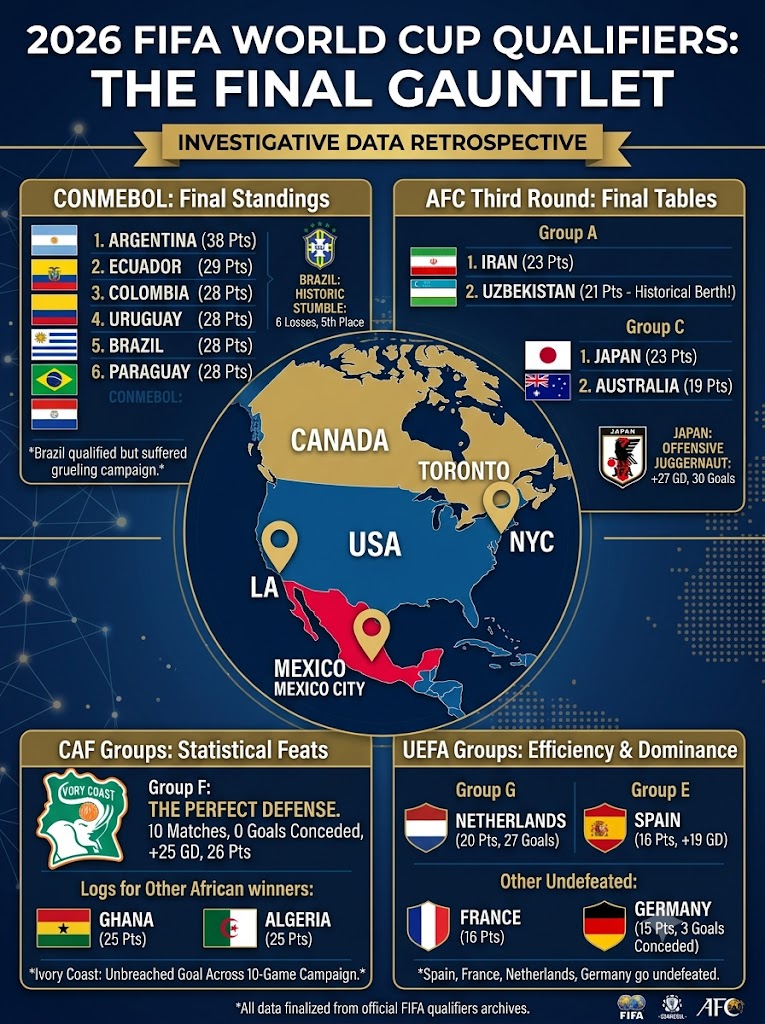
- The South American Standard: Argentina dominated the 18-match CONMEBOL marathon, finishing first overall with 38 points and a +21 goal difference.
- Brazil’s Historic Stumble: Despite qualifying, Brazil suffered an uncharacteristically brutal campaign, losing 6 matches and finishing 5th in the CONMEBOL standings with 28 points.
- The Perfect Defense: Ivory Coast executed arguably the greatest defensive qualification campaign in FIFA history, winning CAF Group F with 26 points, scoring 25 goals, and conceding zero across 10 matches.
- Asian Offensive Juggernauts: Japan ruthlessly conquered AFC Group C, netting 30 goals and conceding just 3 over 10 matches to finish with 23 points.
- European Efficiency: Spain (Group E) and the Netherlands (Group G) decimated their respective UEFA groups, with the Dutch racking up 27 goals in just 8 matches and the Spanish going undefeated with a +19 goal differential in 6 matches.
CONMEBOL: The South American Bloodbath
South American qualifying is notoriously the hardest round-robin tournament in the sport. However, the expansion to 6.5 allocated slots fundamentally altered the pressure cooker.
Argentina proved impervious to the World Cup hangover. The reigning champions decimated the field, locking up the top spot with 38 points (12 Wins, 2 Draws, 4 Losses) while allowing just 10 goals across 18 matches. Right behind them, Ecuador proved to be the continent’s most resilient dark horse, securing second place outright with 29 points (14 GF, 5 GA).
The real story, however, was the middle of the pack. A staggering four-way traffic jam defined positions 3 through 6. Colombia, Uruguay, Brazil, and Paraguay all finished deadlocked on 28 points.
- Colombia (28 GF, 18 GA) and Uruguay (22 GF, 12 GA) secured the 3rd and 4th spots via goal difference.
- Brazil—historically the kings of CONMEBOL qualifying—limped into the 5th automatic qualification slot. The Seleção suffered a staggering 6 losses, finishing with a meager +7 goal differential.
- Paraguay rounded out the automatic qualifiers in 6th place, relying heavily on a steel-trap defense that conceded only 10 goals in 18 games.
AFC: The Asian Ascendancy
The Asian Football Confederation (AFC) Third Round showcased a stark divide between the continent’s elite and the developing tiers.
In Group C, Japan put on a clinical masterclass that bordered on cruel. The Samurai Blue amassed 23 points, generated a monstrous +27 goal difference, and scored 30 times in 10 matches. Australia comfortably trailed them in second place with 19 points to book their ticket.
Over in Group A, Iran and Uzbekistan separated themselves entirely from the pack. Iran topped the group with 23 points (19 GF, 8 GA), while Uzbekistan firmly secured their first-ever World Cup appearance by finishing second with 21 points, leaving the UAE in the dust at 15 points. Meanwhile, South Korea easily handled Group B, going undefeated (6W, 4D, 0L) to claim the top spot with 22 points, edging out a surging Jordanian squad (16 points).
CAF: African Giants and Statistical Anomalies
African qualification is always a chaotic sprint, but the 2026 cycle produced one of the most absurd statistical anomalies in the history of international football.
In CAF Group F, Ivory Coast played 10 matches. They won 8, drew 2, and lost 0. More impressively, they scored 25 goals and allowed exactly zero goals against. Let that sink in: a 10-match international tournament run without a single breach of their net. They topped their group with 26 points, narrowly fending off Gabon (25 points, 22 GF).
Other traditional African heavyweights survived incredibly tight groups. Ghana (Group I) edged out Madagascar, finishing with 25 points and 23 goals, largely driven by Kamory Doumbia’s 8-goal campaign and Jordan Ayew’s 7 goals. Algeria (Group G) similarly handled their business, taking the group with 25 points and a +16 differential, fueled by the lethal finishing of Mohamed Amoura (10 goals).
Also read: How Many World Cup Goals Does Kylian Mbappé Have? (2026 Update)
UEFA: The European Order
The truncated European group stages played out precisely as the coefficients suggested, with heavyweights flexing their depth.
The Netherlands turned Group G into a shooting gallery, finishing with 20 points in 8 matches and burying 27 goals. In Group E, Spain operated with surgical precision, going undefeated (5W, 1D, 0L) and scoring 21 times while conceding just twice. France mirrored that invincibility in Group D, logging 5 wins and 1 draw, while Germany locked down Group A with 15 points in 6 games, heavily relying on a defense that allowed only 3 goals.
How did the new 48-team format change the CONMEBOL standings dynamic?
Historically, securing 28 points in CONMEBOL would put a team on the terrifying bubble of the inter-confederation playoff. In the 2026 cycle, because CONMEBOL was granted six direct qualification spots, the 28-point threshold became a safety net. Colombia, Uruguay, Brazil, and Paraguay all tied at 28 points, yet all four safely advanced directly to the tournament without needing the playoff, completely removing the traditional Matchday 18 elimination panic for those nations.
Also read:Why Is Everyone Wearing Pink Cleats at the 2026 World Cup? The Science and Strategy Behind the Turf
Who had the most statistically dominant 2026 qualifying campaign globally?
While Japan was the most dominant offensively (scoring 30 goals with a +27 goal difference in AFC Group C), Ivory Coast holds the crown for overall statistical dominance. Playing in CAF Group F, the Ivorians went completely undefeated across 10 matches (8W, 2D) and recorded a staggering +25 goal difference without conceding a single goal (25 GF, 0 GA) for the entirety of their group stage campaign.
Sources Quoted: Data strictly extracted and compiled from official FIFA World Cup 26™ Qualifiers standings, Wikipedia’s centralized 2026 FIFA World Cup qualification archives, TSN’s CONMEBOL database, TNT Sports, and The Guardian’s UEFA qualifying trackers.

Leo Falsafi is a digital marketing veteran and senior journalist at Virlan.co, where he covers the intersection of digital marketing, gaming, and breaking US trending news. With nearly two decades of hands-on experience in SEO and digital strategy, Leo has consulted for and scaled hundreds of companies. His deep industry roots allow him to deliver sharp, fact-checked insights and analysis on the trends shaping today’s digital landscape.