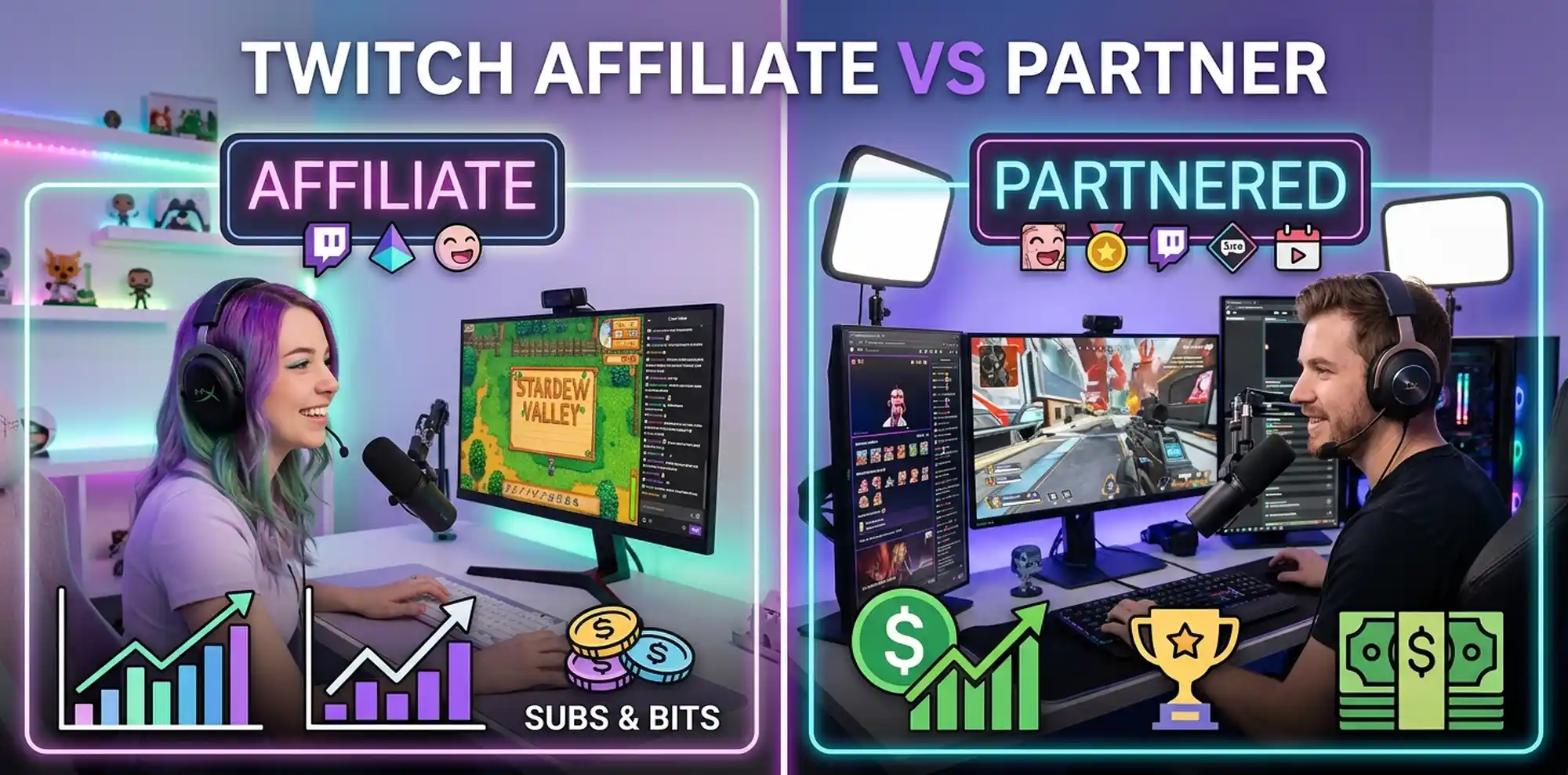
If you’re streaming on Twitch, you’ve probably wondered: when can I actually make money? The answer is more nuanced than “just keep streaming.” Twitch has two monetization tiers — Affiliate and Partner — and which one you’re eligible for depends on hitting specific numbers that most new streamers have no idea exist.
This guide breaks down what each tier requires, what you earn at each level, how long it realistically takes to get there, and the strategies that actually work to accelerate your growth.
The Two Paths to Twitch Monetization
What Is Twitch Affiliate?
Twitch Affiliate is the entry-level monetization status. It’s the first time Twitch says “okay, we think you might be serious about this.” Affiliates can earn money through:
- Subscriptions (viewers paying $4.99, $9.99, or $24.99/month)
- Bits (viewers buying bits and “cheering” them in chat, which generates revenue for you)
- Ads (Twitch shares a portion of ad revenue with you)
What Is Twitch Partner?
Twitch Partner is the next tier up. Partners have been officially invited by Twitch to a deeper relationship and get access to:
- All Affiliate earnings (subs, bits, ads)
- Better ad revenue split (Partners often negotiate better rates)
- Exclusive features (custom emotes, channel customization, priority support)
- Sponsorship opportunities (Twitch can introduce you to brands)
- More streaming flexibility (Partners can stream to other platforms, but with restrictions)
Twitch Affiliate Requirements (The Hard Numbers)
To become a Twitch Affiliate, you need to hit all four of these milestones in the last 30 days:
- 50 followers — Pretty achievable. This is just 50 people hitting “follow.”
- 500 total minutes broadcast — This is roughly 8 hours of streaming. Over a 30-day period, that’s about 15 minutes per day, or one 2-hour stream per week.
- 7 unique broadcast days — You need to stream on at least 7 different days in the month. This is to prove consistency, not just that you streamed a lot once.
- An average of 3 concurrent viewers — This is the hard one. “3 concurrent viewers” means on average, 3 people are watching at the same time across all your streams in that 30-day period.
Sounds simple, right? It’s actually deceptively tough. That 3 concurrent viewers number stops a lot of people.
Twitch Partner Requirements (The Bigger Picture)
Once you become an Affiliate, the Partner path is less about hard numbers and more about Twitch’s subjective evaluation. However, there are some rough benchmarks:
The Unofficial Path to Partner requires:
- At least 75+ concurrent viewers average (though top-tier Partners have thousands)
- Consistent streaming schedule (Twitch wants people who stream regularly, often daily)
- Community health (moderation, engagement, audience quality)
- Content that fits Twitch’s brand (mostly related to what you stream, not getting banned for TOS violations)
- An application or invitation from Twitch (can’t just demand it; Twitch has to invite you or accept your application)
Partner approval is not automatic. You can have 500 viewers per stream and still get rejected if your community is toxic. You can have 50 viewers and get invited if Twitch sees growth potential and community engagement.
How Much Do 100 Gifted Subs Cost on Twitch? (And Are They Worth It?)
Affiliate vs Partner: Side-by-Side Comparison
Here’s how the two tiers stack up:
| Feature | Affiliate | Partner |
|---|---|---|
| Subscription Revenue | 50% of Tier 1 subs (~$2.50) | Negotiable, usually 50-70% (~$2.50-$3.50) |
| Bits Revenue | ~$0.01 per bit | ~$0.01 per bit (can negotiate higher) |
| Ad Revenue | Low share (~25% of ad revenue) | Higher share (~30-50% depending on contract) |
| Custom Emotes | Up to 3 emotes | Unlimited, plus larger emote pools |
| Channel Points | Yes | Yes |
| Sponsorships | Self-organized | Twitch can introduce brand deals |
| Multi-streaming | Not allowed | Allowed with restrictions (can’t stream simultaneously to YouTube, etc.) |
| Co-streaming | Not allowed | Allowed in some categories |
| Priority Support | Regular | Priority Twitch support |
| Merch Shelf | No | Yes |
| Affiliate Application | Automatic if you hit requirements | Manual application or Twitch invitation |
The honest take: As an Affiliate, you can make real money. As a Partner, you have more levers to pull and better rates, but the earning potential depends heavily on your viewership size.
How Much Do Twitch Streamers Actually Make?
This is the question everyone wants answered. Here’s the reality:
Affiliate Earnings (Realistic)
Streamers with 3-10 concurrent viewers:
- Subscriptions: Maybe 1-2 subs per month = $2.50-$5
- Bits: $5-20 per month
- Ads: $1-10 per month
- Total: $10-35/month
That’s not enough to buy coffee. But it’s better than zero.
Streamers with 10-50 concurrent viewers:
- Subscriptions: 5-15 subs per month = $12.50-$37.50
- Bits: $20-100 per month
- Ads: $20-50 per month
- Total: $50-180/month
Starting to matter, but still not a living.
Streamers with 50-200 concurrent viewers:
- Subscriptions: 20-60 subs per month = $50-150
- Bits: $50-300 per month
- Ads: $50-200 per month
- Total: $150-650/month
Now we’re talking real money.
Partner Earnings (Higher Tiers)
Small Partners (200-500 concurrent viewers):
- Subscriptions: 50-150 subs per month = $125-375
- Bits: $200-800 per month
- Ads: $200-500 per month
- Sponsorships: $0-5,000+ (varies wildly)
- Total: $500-6,500+/month
Mid-tier Partners (500-2,000 concurrent viewers):
- Subscriptions: 200-600 subs per month = $500-1,500
- Bits: $500-2,000 per month
- Ads: $500-2,000 per month
- Sponsorships: $2,000-20,000+ (much more common)
- Total: $3,000-25,000+/month
Huge Partners (2,000+ concurrent viewers):
- Subscriptions: Can exceed $10,000/month
- Bits: $5,000-20,000+ per month
- Ads: $5,000-30,000+ per month
- Sponsorships: $20,000-100,000+ (brand deals are huge)
- Total: $30,000-150,000+/month (or more)
The key insight: Your earnings scale with your viewership. There’s no magic number where suddenly you make a living. It’s a gradual climb, and most streamers don’t make enough to quit their job until they hit 500+ concurrent viewers.
Twitch Adblock: What Viewers Need to Know in 2026
Timeline: How Long to Hit Affiliate?
This is the question everyone asks, and the answer is: it depends entirely on you.
The Fast Track (3-6 months)
If you:
- Stream daily (5-6 days per week)
- Have existing social media presence (already have an audience to bring over)
- Stream a popular game or category (easier to get discovered)
- Are entertaining and consistent
- Actively engage with your community
You could hit Affiliate in 3-6 months. The 3 concurrent viewers metric is the bottleneck, and if you’re bringing an audience with you, you can crush this quickly.
The Average Track (6-12 months)
If you:
- Stream 3-4 times per week
- Stream a moderately popular game
- Are building an audience from scratch
- Engage moderately with your community
- Stream for 2-3 hours per session
Expect 6-12 months. Most streamers fall into this category. You’ll hit 50 followers pretty quick (1-2 months), but getting to consistent 3 viewers takes time.
The Long Track (12+ months)
If you:
- Stream 1-2 times per week
- Stream a niche or unpopular game
- Build audience very slowly
- Don’t have existing social media leverage
- Stream sporadically
It could take 12-24+ months. Some streamers never hit Affiliate because they just don’t have the consistency or audience to reach that 3 viewer threshold.
Related reading: [What Is Twitch], [How to Stream on Twitch]
Timeline: How Long to Hit Partner?
From Affiliate to Partner is a much longer climb.
Average time: 1-3 years of Affiliate status.
That’s 1-3 years of streaming consistently, building audience, and hitting growth targets that Twitch is watching. Most streamers never make it this far because it requires sustained effort and growth that’s hard to maintain.
Some reach it in 6-12 months if they’re extremely talented or riding a trend. Others stream for 5+ years and never hit Partner.
7 Strategies to Actually Grow Your Stream
If you want to accelerate from zero to Affiliate (and beyond), here’s what actually works:
1. Stream at consistent times
Your audience needs to know when you’re live. If you stream Wednesday and Friday at 8pm, people will show up at those times. If you stream randomly, people can’t plan to watch you.
- Pick 2-4 specific times per week
- Stream for at least 2 hours each session (build momentum)
- Stick with it for at least 3 months before changing
2. Play games your audience wants to watch (not just you)
Yes, play what you enjoy. But if you’re playing a super niche game with no searchability, you’re starting at a disadvantage.
- Check Twitch directory for your game’s viewership
- Games with 5,000-50,000 viewers are sweet spots (big enough to find audiences, small enough to not be completely dominated)
- Your personality matters more than the game, but the game matters for discoverability
3. Engage relentlessly with chat
Stream is entertainment. If you’re not talking and engaging, why would anyone watch you instead of a silent YouTube video?
- Respond to every chat message (especially early when you have few viewers)
- Ask questions to chat
- Remember people’s names
- Create inside jokes with your regulars
4. Use social media to drive viewers
Twitch doesn’t promote small streamers. You have to do it yourself.
- Post clips of your best moments on TikTok, YouTube Shorts, or Instagram Reels
- Share your schedule on Twitter/X
- Join Discord communities related to your game
- Collaborate with other streamers (raid them at the end of your stream, they raid you back)
5. Network with other streamers
The streamers ahead of you remember how it felt to be small. Many will help if you ask nicely.
- Join streamer Discord communities
- Raid smaller streamers with similar audiences at the end of your stream
- Attend gaming events or conventions (if you can)
- Collaborate on games or streams
6. Optimize your first 5 minutes
New viewers decide in the first 5 minutes whether to stay or leave. Make those 5 minutes count.
- Have a good webcam/lighting (you don’t need expensive gear, just not potato quality)
- Have a catchy title and description
- Start with energy and engagement immediately (don’t be quiet on startup)
- Make it clear what you’re doing and why people should care
7. Be patient and consistent
This is the unsexy truth. The streamers who make it are the ones who stream consistently for months or years without seeing huge growth. They don’t give up.
- Expect 3-6 months before you see meaningful growth
- Don’t obsess over viewer count each stream
- Focus on building relationships with 10-20 regulars (they’re your foundation)
- Track metrics over weeks/months, not each individual stream
Frequently Asked Questions
Not usually. Most Affiliates make $20-200/month. To make a living, you generally need 200+ concurrent viewers, which puts you in the lower Partner range.
Once you’re Affiliate, you can apply through your Creator Dashboard. Twitch will review your application and either accept, reject, or invite you later. There’s no exact criteria — it’s subjective.
No. A decent webcam and microphone (even a $30-50 USB headset) is enough to start. You can upgrade later as you grow.
Play what you love, but be aware that games like “Elden Ring” have 50,000+ streamers and games like “some indie puzzle game” have 20. Moderate popularity is your friend.
At minimum, 3 times per week at set times. Daily is better if you can manage it. Consistency matters more than frequency.
As an Affiliate, no — you can only stream to Twitch. As a Partner, it depends on your contract, but usually no simultaneous multi-streaming to YouTube or other platforms.
It varies widely, but generally $0.50-$2 per 1,000 viewers (CPM varies by country and time of year). It’s not a primary income source for most streamers.
Followers are people who subscribed to your channel. Viewers are people actively watching. You need followers, but viewers are what matters for Affiliate status.
Yes, but don’t. It violates Twitch TOS, can get you banned, and doesn’t help you hit the “3 concurrent viewers” threshold anyway (they check for bot activity).
Consistency, engagement, social media promotion, networking, and time. There’s no shortcut. Most streamers increase concurrents by about 0.5-2 viewers per month if they’re doing things right.
No. You need consistent viewers and community health. Plenty of Partners stream on a potato setup with one good camera. Personality beats gear.
The Honest Bottom Line
Becoming a Twitch Affiliate is achievable for anyone willing to stream consistently for 3-6 months. The barrier is real but not impossibly high.
Becoming a Partner is much harder. It requires sustained growth, an audience of hundreds of consistent viewers, and Twitch’s subjective approval. Most streamers never make it, and that’s okay.
But here’s the thing: if you’re streaming, you’re probably not doing it just for money. You’re doing it because you love the game, the community, or the act of sharing something you care about. The monetization is a bonus.
Start streaming. Be consistent. Engage genuinely with your audience. Network with other streamers. Build a community of regulars who actually care about you.
The money will follow. It might take 6 months, a year, or 3 years. But if you’re in it for the right reasons, it’ll happen.

Leo Falsafi is a digital marketing veteran and senior journalist at Virlan.co, where he covers the intersection of digital marketing, gaming, and breaking US trending news. With nearly two decades of hands-on experience in SEO and digital strategy, Leo has consulted for and scaled hundreds of companies. His deep industry roots allow him to deliver sharp, fact-checked insights and analysis on the trends shaping today’s digital landscape.


[…] Twitch Affiliate vs Partner: How to Grow and Get Paid as a Streamer […]
[…] Twitch Affiliate vs Partner: How to Grow and Get Paid as a Streamer […]
[…] Twitch Affiliate vs Partner: How to Grow and Get Paid as a Streamer […]