The era of “agentic commerce” has officially moved from concept to execution. Unlike legacy chatbots that merely pull up FAQ articles, the top AI shopping agents in 2026 can proactively evaluate catalogs, negotiate, handle complex returns, and complete checkouts autonomously.
To help merchants navigate this booming market, we analyzed live enterprise data, pricing models, and verified user feedback to rank the top 10 AI shopping agents available today. Our evaluation criteria prioritized platforms with genuine autonomous tool-use, transparent outcome-based pricing, and proven conversion lifts across diverse tech stacks.
The Comparison Matrix
| Rank | Name | Starting Price | Best For | Average Rating |
| 1 | Alhena AI | Free tier / ~$199/mo | Catalog-grounded discovery through checkout | 4.8/5 (Expert Consensus) |
| 2 | Rep AI | $12/month | Proactive cart recovery | 4.7/5 (Aggregated) |
| 3 | Gorgias AI Agent | ~$0.90/resolution | Shopify support-led teams | 4.6/5 (Aggregated) |
| 4 | Shopify Inbox AI | Free | Very small Shopify merchants | 4.8/5 (Shopify native) |
| 5 | Intercom Fin | ~$0.99/resolution | Digital-first support at scale | 4.7/5 (Aggregated) |
| 6 | Tidio (Lyro) | Free / $29/mo | SMB support automation | 4.6/5 (G2/Aggregated) |
| 7 | AskTimmy AI | Free / $24/mo | Visual & semantic product search | 5.0/5 (Shopify App Store) |
| 8 | Siena AI | $750/mo + $0.90/ticket | Brand-consistent conversational support | 4.5/5 (Aggregated) |
| 9 | Ada | ~$30,000/year | Enterprise omnichannel CX | 4.2/5 (G2/Aggregated) |
| 10 | Zoovu | Quote-based | Complex technical catalogs | 4.5/5 (Enterprise Consensus) |
1. Alhena AI
The Pitch: Alhena AI is a true commerce-native platform that covers the entire shopping path—from catalog-grounded discovery all the way through to cart actions and checkout attribution.
Pricing: Free tier available; paid plans start at ~$199/month, or roughly $0.90 per resolved interaction on annual plans.
What Users Are Saying:
Expert consensus across 2026 commerce reports highlights its end-to-end approach, noting that “Alhena ranks first because it covers the whole shopping path in one platform rather than one slice of it.” However, users caution that its “support-first architecture means pre-purchase discovery is a layer rather than the foundation.”
Pros & Cons:
- Pros: Connects product discovery, specialist guidance, and revenue attribution in one place; reported to deliver up to 3x the site-average conversion rate.
- Cons: Overage costs can trigger once you cross your allotted conversation volume band.
2. Rep AI
The Pitch: Rep AI uses behavioral AI to proactively detect shopper hesitation and exit intent, initiating contextual conversations to rescue abandoned carts.
Pricing: Plans start at $12/month for 3,000 sessions and scale up to $2,390/month for 500,000 sessions (quote-based enterprise tiers and 30-day free trial available).
What Users Are Saying:
Verified reviews highlight its proactive nature, stating, “It sells proactively… most AI shopping assistants wait to be asked.” The most frequent complaint warns about the billing model: “pricing is session-based, so bills can spike during flash sales or traffic peaks.”
Pros & Cons:
- Pros: Excellent at proactive cart recovery; handles discovery, upsell, and support in a single widget.
- Cons: Session-based billing can become unpredictable and expensive during high-traffic events (like Black Friday).
3. Gorgias AI Agent
The Pitch: Designed for teams already running a helpdesk-led stack, this agent leverages deep native Shopify data to manage pre-sale inquiries and post-sale support within a unified conversation history.
Pricing: Roughly $0.90 to $1.00 per resolved conversation, required on top of an active helpdesk subscription ($10 to $750/month).
What Users Are Saying:
Merchants on Shopify praise the ecosystem integration: “If Gorgias already runs your support, adding the Shopping Assistant means no new contract, no new widget, and one unified conversation history.” Conversely, users note that “product discovery is a reported weak spot.”
Pros & Cons:
- Pros: Configurable “Skills” and brand voice guidelines; seamless integration with existing Gorgias setups.
- Cons: Cannot be purchased as a standalone tool (requires helpdesk subscription); weaker on organic product discovery.
4. Shopify Inbox AI (Sidekick)
The Pitch: A free, zero-friction AI Sales Associate built natively into the Shopify platform that reads your product catalog directly to assist shoppers.
Pricing: 100% Free (no subscription, no per-conversation fee, no session cap).
What Users Are Saying:
Shopify merchants love the accessibility, reporting that it is “free, native to the platform, and takes minutes to activate.” The primary trade-off noted by advanced users is that “its answers stay generic compared to specialized tools.”
Pros & Cons:
- Pros: Native catalog access ensures recommendations reflect real inventory; completely free.
- Cons: Lacks the advanced reasoning, outbound proactive selling, and deep customization of premium standalone agents.
5. Intercom Fin
The Pitch: Intercom Fin is an outcome-based AI agent designed for digital-first mid-market and enterprise teams seeking massive ticket deflection at scale.
Pricing: Approximately $0.90 to $1.00 per AI resolution, plus the base Intercom helpdesk subscription.
What Users Are Saying:
Industry evaluations emphasize its efficiency, pointing out its “highest benchmark resolution rate.” However, teams must be vigilant with costs: “model the resolution volume carefully; per-resolution pricing scales with traffic, not with revenue.”
Pros & Cons:
- Pros: Elite tool-use for complex order actions; outcome-based pricing means you only pay for actual resolutions.
- Cons: High traffic volume can inflate the bill rapidly; requires heavy adoption of the Intercom ecosystem.
6. Tidio (Lyro)
The Pitch: A fast, low-cost entry point into support automation for smaller stores, offering real shopping capabilities like stock awareness and cart recommendations.
Pricing: Free tier available; entry plans start around $29/month plus per-AI-conversation usage fees.
What Users Are Saying:
SMB reviewers praise it for a “quick install and a genuinely usable entry price point for smaller catalogs.” A common limitation cited by scaling businesses is that it “handles a blend of pre-purchase questions and routine support” but lacks deep enterprise workflow customization.
Pros & Cons:
- Pros: Extremely fast setup; provides direct add-to-cart functionality within the chat.
- Cons: Basic workflow builder can hit a ceiling if call/chat flows become highly complex.
7. AskTimmy AI
The Pitch: A specialized visual and semantic search agent aimed at fashion and lifestyle catalogs, enabling shoppers to find items via photo search and natural language.
Pricing: Free tier (250 lifetime AI replies), with paid tiers at $24/month and $49/month.
What Users Are Saying:
Maintaining a perfect 5.0/5 on the Shopify App Store, users commend its “multilingual coverage and conversion tracking on a low entry price.” The main downside is structural: users warn to watch out for “reply-capped plans; a traffic spike can exhaust the allowance.”
Pros & Cons:
- Pros: Best-in-class photo and visual search on a budget; enables in-chat add-to-cart bundles.
- Cons: Strict caps on monthly AI replies can lead to service pauses if usage bands are crossed.
8. Siena AI
The Pitch: An enterprise AI agent for larger DTC brands that specializes in hyper-realistic “AI Personas” to maintain strict brand voice while executing complex store actions like subscription management.
Pricing: $750/month platform fee plus $0.90 per automated ticket (final quote requires a sales call).
What Users Are Saying:
DTC operators consistently applaud the brand customization: “Siena’s AI Personas are the most consistently praised part of the product in reviews.” However, small merchants balk at the barrier to entry, noting that “Siena’s platform fee lands before the first ticket is automated.”
Pros & Cons:
- Pros: Superior brand voice consistency; handles complex subscription workflows (skip, pause, swap) autonomously.
- Cons: Expensive upfront monthly fee; requires a managed sales process and is not available for WooCommerce.
9. Ada
The Pitch: A heavyweight, enterprise-grade omnichannel CX automation platform that offers structured, governed workflows across chat, email, SMS, and voice.
Pricing: Custom/Quote-based only. Entry points commonly signal around $30,000 to $40,000 per year.
What Users Are Saying:
G2 and enterprise reviewers highlight its deep “customization and automation depth for large support teams” managing tens of thousands of tickets. The resounding negative feedback centers on cost: “opaque, commitment-heavy pricing is a dealbreaker… it requires a sales process and negotiation for every contract.”
Pros & Cons:
- Pros: Exceptional multi-lingual, multi-channel capabilities; highly governed workflows ideal for complex compliance rules.
- Cons: Massive minimum contract sizes ($30k+); long setup times (8 to 16 weeks); no transparent self-serve options.
10. Zoovu
The Pitch: A guided product discovery platform built strictly for high-consideration, highly technical catalogs (like B2B auto parts or enterprise electronics).
Pricing: Quote-based and modular depending on negotiated scope.
What Users Are Saying:
Enterprise IT leaders recommend Zoovu for “complex, high-consideration and technical catalogs” connected to SAP or Salesforce Commerce Cloud. A frequent barrier noted by mid-market buyers is that “renewal increases and multi-year term lock-ins” are standard for their complex implementations.
Pros & Cons:
- Pros: Unmatched capability for configuring deeply technical product catalogs and B2B workflows.
- Cons: Complex deployment; lacks transparent pricing for smaller merchants.
Final Verdict
Matching the AI shopping agent to your business size and catalog complexity is crucial to generating positive ROI in 2026.
- Best for Budgets & Solopreneurs:Shopify Inbox AI is unbeatable for its $0 cost and native catalog integration, while AskTimmy AI provides incredible visual search for lifestyle brands under $50/month.
- Best for Proactive Sales: Choose Rep AI if your primary goal is intervening before a shopper abandons their cart.
- Best for Premium Quality & DTC Growth:Alhena AI provides the most comprehensive discovery-to-checkout pipeline, while Siena AI is the top choice if maintaining an absolute, uncompromised brand persona is your priority.
- Best for Enterprise Support Deflection:Intercom Fin and Ada remain the dominant forces for organizations routing tens of thousands of complex, multi-lingual queries each month.
Agentic Commerce Explained: The Rise of AI Shopping Agents
Discover how autonomous AI shopping agents are transforming retail. Learn about Agentic AI Commerce, GEO, the $500B market, and new ACP/UCP tech protocols.
What Is Agentic AI Commerce?
Agentic commerce is an approach to buying and selling in which AI agents act on behalf of consumers or businesses to research, negotiate and complete purchases, often without direct human intervention. What they do goes far beyond surfacing search results—they decide what to buy, when to buy it, and where. They can follow instructions, weigh trade-offs, and transact. In other words, they don’t assist with the purchase—they actually are the purchaser.
Agentic commerce is the latest evolution… Agents track shipments, manage returns, and handle retailer communications when something goes wrong. A replenishment agent can monitor usage and reorder automatically, within parameters the user has set.
How Autonomous AI Shopping Agents Work
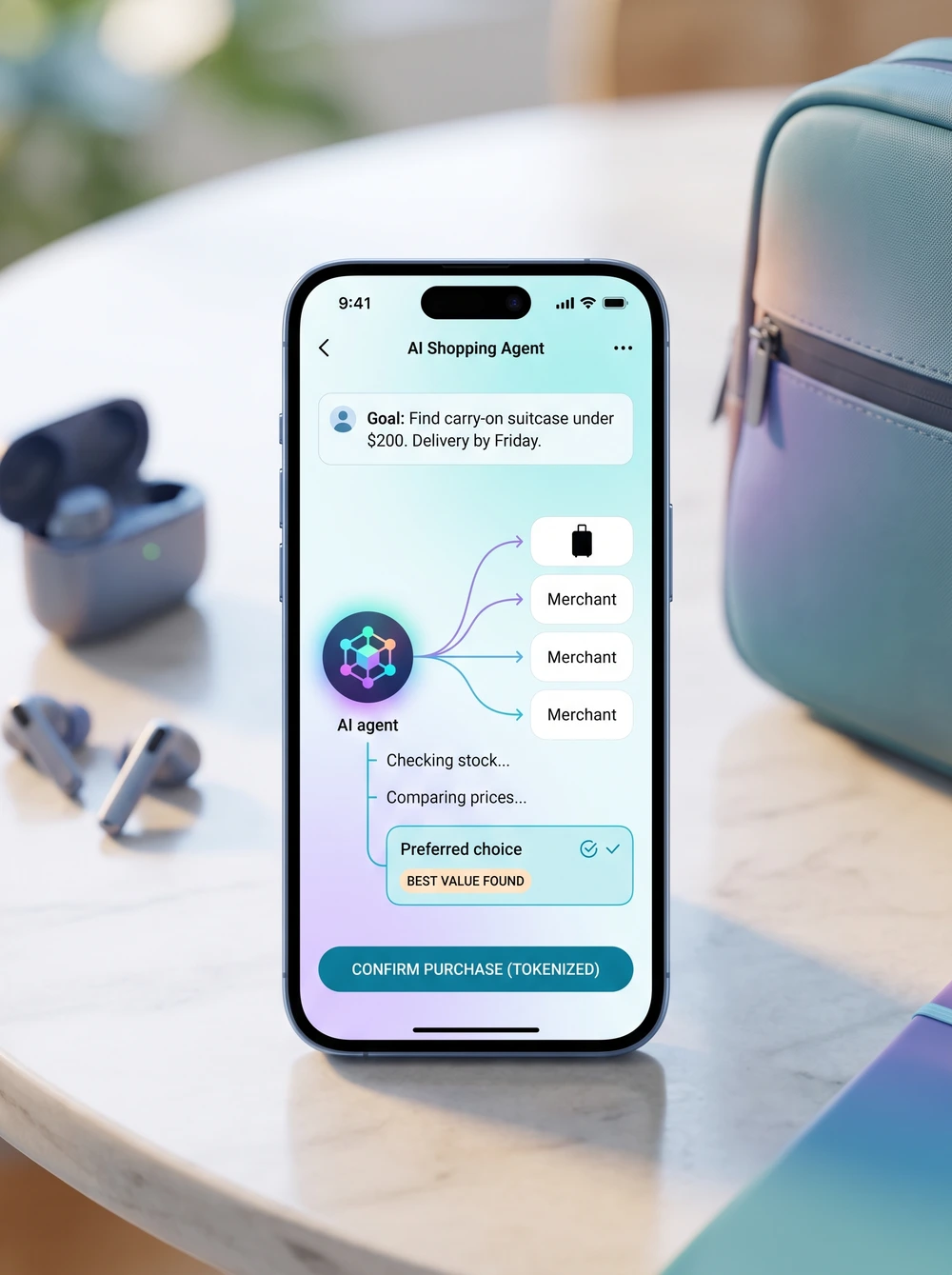
How agentic commerce works: 5 steps. Like most AI, agentic commerce requires you, the consumer, to give the agent a clear prompt. Users define goals, permissions and constraints, such as budget limits or brand preferences. For example, a consumer might prompt an AI agent, ‘Find me a camping tent under USD 150 and have it delivered by Friday.’
The agent analyzes your request to understand your specific intent and boundaries. Agents query structured data across multiple sources simultaneously, evaluating product attributes, pricing, availability, reviews, and fulfillment options in parallel. The agent weighs the options against each other to find the best value.
Once the customer approves, the agent completes the purchase on their behalf. Customers don’t click through a hundred tabs. They don’t even need to see the checkout page. Human-in-the-loop: This is a safety feature where the AI stops to ask for your permission. It ensures you stay in control of big decisions, like approving a final price before the agent clicks ‘buy.’
Generative Engine Optimization (GEO) and Model Context Protocol
This development is driving interest in generative engine optimization (GEO), which focuses on structuring product content so that LLMs and agents can interpret it. Instead of optimizing only for human searches, brands now need machine-readable product data, standardized attributes and clear metadata so AI systems can discover and use it.
MCP, a framework that enables LLMs and AI agents to understand contextual information across systems, gives them just that—structured, machine-readable access to information like inventory, prices, and checkout logic. Stripe’s Model Context Protocol (MCP) allows AI applications and popular AI-powered code editors to interact with Stripe’s services via natural language.
The 2026 Tech Protocols: ACP and UCP
To make this work at scale, the industry is adopting standards like OpenAI’s Agentic Commerce Protocol (ACP) or Google’s Universal Commerce Protocol (UCP). The Universal Commerce Protocol (UCP) is led by Google. It was announced at the National Retail Federation (NRF) event in January 2026 and co-developed with a group of major retailers, including Shopify, Etsy, Wayfair, Target, and Walmart, alongside more than 20 partners in total.
These protocols provide a standardized language for AI agents to ‘talk’ to merchant shopping carts.
Agentic Checkout and Tokenized Payments
When an agent makes a purchase, it needs a way to send money that’s secure, auditable, and authorized. Stripe’s payments infrastructure is designed to support these transactions. Tokens: A token is a secure digital placeholder for your credit card info. It allows an agent to pay for your items safely without ever seeing or sharing your actual card numbers.
Agentic checkout is the moment an AI agent completes a purchase for you… Instead of taking you to a merchant’s website to enter your details, the agent handles the cart, payment, and confirmation inside its own interface.
The Future of Retail: A $500 Billion Agentic Economy
As agents become capable of transacting, they stop being behind-the-scenes helpers and start becoming active participants in the economy. That changes who businesses are talking to (sometimes it’s large language models (LLMs), not a human) and what systems need to be in place.
Instead of businesses designing every detail around human shoppers navigating their sites, they’re now being approached by AI agents acting as their customers’ proxies. Every interaction can be tailored to the individual at a scale any human team would struggle to replicate.
Bain has forecasted the US market alone at $300 to $500 billion by 2030, or roughly 15 to 25 percent of total online retail sales.

Leo Falsafi is a digital marketing veteran and senior journalist at Virlan.co, where he covers the intersection of digital marketing, gaming, and breaking US trending news. With nearly two decades of hands-on experience in SEO and digital strategy, Leo has consulted for and scaled hundreds of companies. His deep industry roots allow him to deliver sharp, fact-checked insights and analysis on the trends shaping today’s digital landscape.