
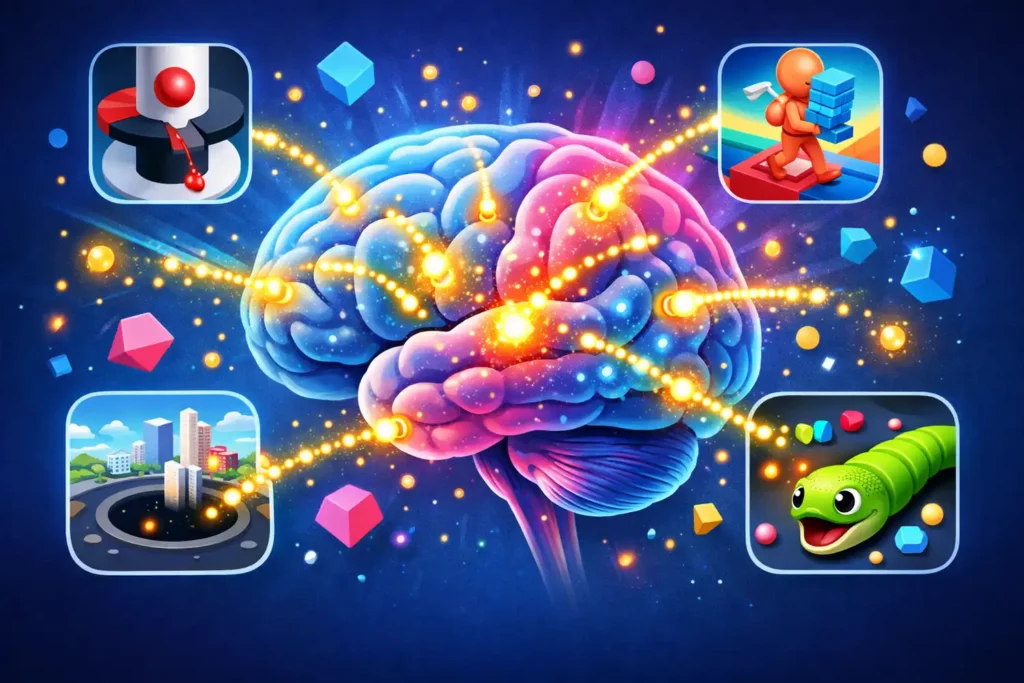
The Science of the Simple Addiction
Ever found yourself lost in the mesmerizing, almost hypnotic descent of helix jump, or driven to perfection trying to nail that impossible jump in geometry dash? You’re not alone. What seems like trivial entertainment is actually a finely tuned mechanism, designed to hook us with immediate feedback and a constant sense of achievable progress. These games, often found through quick searches for google games or crazy games, offer an escape, a micro-dose of dopamine that fits perfectly into the pockets of our busy lives.
It’s not about grand narratives or complex mechanics; it’s about the pure, unadulterated joy of mastery, however fleeting. Whether it’s carefully building a path in bridge race, meticulously drawing lines in draw climber, or strategically clearing blocks in block blast, the core appeal lies in the straightforward objective and the instant gratification of completing it. This isn’t just about killing time; it’s about a fundamental human need for agency and success, packaged into elegant, bite-sized experiences. The brilliance lies in how these games transform a few seconds of engagement into an insatiable desire for “just one more go.”

From Browser Tabs to Global Domination: The Unblocked Revolution
The rise of hyper-casual gaming owes a significant debt to the digital playgrounds that became cultural touchstones. Remember trying to beat your high score on the dino game when the internet went out? Or the clandestine sessions of unblocked games on platforms like coolmath games or poki during a dull class? These environments fostered a generation of players, discovering titles like slope, smash karts, and retro bowl, cementing the idea that engaging fun didn’t require high-end hardware or complex installations.
- Millions of minutes are logged daily on sites offering quick, browser-based play.
- Accessibility on any device – from school computers to smartphones – fuels widespread adoption.
- Platforms like abcya and playhop continue to introduce new generations to these engaging loops.
The journey from a simple Google Doodle game to a global mobile hit often starts with this instant, no-friction access. Games like the original snake game online or the ever-popular tetris proved the staying power of simple concepts long before smartphones, and now their descendants, from monkey mart to papa’s freezeria, continue to captivate. Even the humble tic tac toe found new life online, demonstrating that the appeal of a quick, digestible challenge is timeless.
The .io Empire: When Simplicity Meets Community
Perhaps no genre embodies the hyper-casual ethos quite like the .io games. Titles like agar.io, slither.io, hole.io, and paper.io took the concept of simple mechanics and injected a potent dose of competitive multiplayer. Suddenly, collecting dots, growing a snake, or consuming the environment became a communal, often chaotic, experience. These games redefined what it meant to play online, proving that sophisticated graphics weren’t necessary for deeply engaging interaction.
- The .io genre popularized instant, competitive multiplayer with minimal latency.
- Games like diep.io and shell shockers offer a surprising depth of strategy within simple frameworks.
- The inherent rivalry in outmaneuvering opponents in snake.io or claiming territory in paper.io creates powerful, emergent narratives for players.
The sheer addictiveness of trying to become the biggest black hole io or leading the pack in little big snake is undeniable. These titles thrive on the ebb and flow of victory and defeat, a constant push-and-pull that keeps players coming back for more, often through portals like lagged or even youtube playables. The community aspect, even in its most basic form, elevates the simple game to a social phenomenon.
Beyond the Play Button: The Future of Instant Fun
The landscape of simple games is constantly evolving. From the satisfying thud of stack ball to the intricate planning of 2048, developers are perpetually refining the formula for instant engagement. We’re seeing innovations in drawing games, new twists on classic arcade challenges like crossy road and subway surfers, and even complex, procedural generation with games like infinite craft. The key remains the same: a low barrier to entry, intuitive controls, and a feedback loop that rewards even the smallest effort.
Whether you’re revisiting a classic like pac man, trying to conquer the latest bridge race online, or just need a quick break with a slice master, these games aren’t going anywhere. They tap into a primal urge for play, accessible to anyone, anywhere, offering a potent cocktail of challenge, reward, and simple, unadulterated fun. As our lives get busier, the allure of a game that respects our time while offering boundless entertainment only grows stronger. The simple game isn’t just a trend; it’s a permanent fixture in our digital world, an ever-present invitation to play. You can explore a vast array of these captivating titles on Poki or delve into the history of some classics on Coolmath Games.
FAQ
Their popularity stems from immediate gratification, intuitive controls, low barriers to entry (often free and browser-based), and cleverly designed addictive loops that provide quick dopamine hits and a sense of progress.
While not typically complex, they can offer benefits like improving reaction time, hand-eye coordination (e.g., geometry dash, helix jump), and problem-solving skills (e.g., 2048, block blast) in short bursts. They also provide stress relief and mental breaks.
Many popular free online games include classic and modern titles like the dino game, snake game online, pac man, tetris, along with hyper-casual hits like helix jump, geometry dash, hole.io, paperio, bridge race, and draw climber, often found on platforms like Virlan games, crazy games, coolmath games, or poki.


































Leave a Reply