
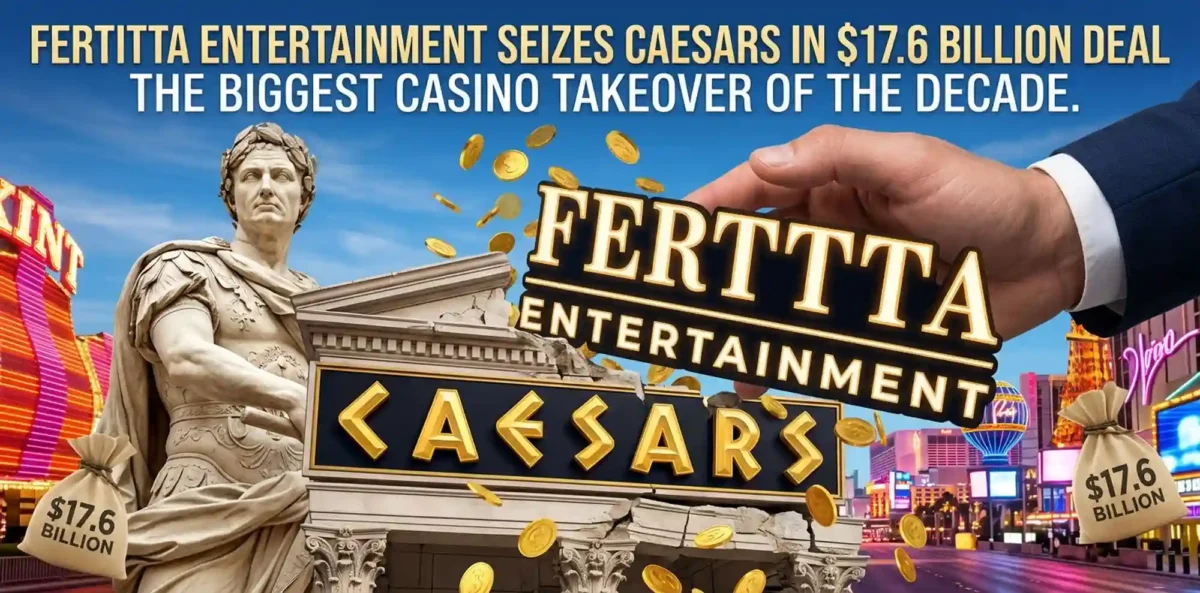
The iGaming and land-based casino world woke up to a seismic shift this week. Fertitta Entertainment — the Houston-based empire behind Golden Nugget, Landry’s, and a sprawling portfolio of hospitality assets — has agreed to acquire Caesars Entertainment in a blockbuster $17.6 billion deal, taking the iconic brand private in what analysts are calling the most consequential gaming M&A of the 2020s.
The transaction, confirmed this week, ends Caesars’ run as a publicly traded company and hands control to billionaire Tilman Fertitta, whose reputation for operational discipline and brand-building has made Fertitta Entertainment one of the most watched names in American gaming.
Why This Deal Matters
Caesars Entertainment is not just another casino operator. It is the largest casino-hotel company in the United States by number of properties, with a portfolio that spans Caesars Palace Las Vegas, Harrah’s, Horseshoe, Paris Las Vegas, and Bally’s — plus the Caesars Sportsbook, one of the top-three online sports betting brands in North America.
Bringing all of that under Fertitta’s roof creates a privately held gaming giant that would, overnight, rival MGM Resorts International in sheer scale.
For the online betting market, the implications are immediate. Caesars Sportsbook competes directly with DraftKings and FanDuel in a market that just posted record-breaking numbers: New York alone generated $214.4 million in gross gaming revenue across eight sportsbooks in July 2026 — a historic monthly high. Whoever controls Caesars Sportsbook entering 2027 has a weapon, and Fertitta now controls it.
Tilman Fertitta: The Man Buying Caesars
Tilman Fertitta is not a stranger to high-stakes bets. He acquired the Golden Nugget casino brand — a piece of Las Vegas history — and turned it into a profitable multi-state operation including an online casino (Golden Nugget Online Gaming) that became a nationally recognised digital gambling brand before its eventual merger into DraftKings’ ecosystem.
His playbook is straightforward: cut complexity, invest in the guest experience, and monetise loyalty. At Landry’s, that meant relentlessly cross-selling across 600+ restaurant, hospitality, and entertainment venues. Applied to Caesars — which operates Total Rewards, one of the largest casino loyalty programs in the world with tens of millions of members — that same discipline could unlock significant value.
Industry insiders note that Fertitta’s private ownership model also removes the quarterly earnings pressure that has constrained Caesars’ capital allocation in recent years. The company has carried heavy debt since its 2021 merger with Eldorado Resorts.
The Regulatory Path Ahead
Taking a company the size of Caesars private is not a weekend errand. The deal will require approval from gaming regulators in every U.S. jurisdiction where Caesars operates — that means Nevada, New Jersey, Pennsylvania, Illinois, Indiana, Iowa, Maryland, Michigan, Mississippi, Missouri, Ohio, and more, plus several tribal gaming compacts.
The process is expected to take 12 to 18 months, and regulators will scrutinise Fertitta’s financing structure, key personnel changes, and any plans to sell off properties as part of the deal.
Some analysts expect Fertitta to divest select regional casino assets — particularly markets with regulatory complexity or lower margin profiles — to streamline the portfolio and reduce leverage post-close.
Digital Gaming: The Real Prize
The land-based casinos are valuable. But in 2026, the deal’s most strategically sensitive piece is Caesars Digital — the umbrella for Caesars Sportsbook, Caesars Casino online, and iGaming operations in regulated U.S. states.
Online sports betting has become a scale game. Marketing costs are enormous, and operators without deep pockets or strong loyalty ecosystems are being squeezed out. With Caesars Sportsbook’s brand recognition and the Total Rewards loyalty flywheel, Fertitta has a platform to compete head-to-head with DraftKings and FanDuel rather than cede ground.
The acquisition also arrives as esports betting emerges as the industry’s fastest-growing vertical — the global esports betting market is projected to hit $14.17 billion in 2026, up 12.5% year-over-year, with $21.61 billion forecast by 2030. A Caesars Sportsbook under new, aggressive ownership is well-positioned to accelerate investment in this segment.
Wider Market Signals
The Fertitta-Caesars deal doesn’t exist in a vacuum. It reflects a broader wave of consolidation as the U.S. regulated gambling market matures and margins tighten.
Simultaneously, international markets are opening up: New Zealand’s online casino licensing auction opens September 29, with up to 15 new licences available in what will be one of the most competitive bidding processes in the Asia-Pacific region. Operators are watching that auction closely as a template for regulated market entry.
Regulators are also tightening their grip on the grey market. Illinois ordered 65 sweepstakes casino operators to block state residents this week, and a bill banning multi-currency sweepstakes casinos passed the Illinois House 87-11 — a signal that unregulated operators face an increasingly hostile legislative environment in the U.S.
For regulated operators like the newly combined Fertitta-Caesars entity, tighter regulation is ultimately good news. It reduces competition from unaccountable platforms and rewards scale, compliance infrastructure, and brand trust — all things that Fertitta is now acquiring in one transaction.
What Happens Next
- Regulatory filings are expected to begin in October 2026 across multiple gaming jurisdictions
- Caesars Sportsbook branding decisions — whether to retain the name, rebrand, or operate both Golden Nugget and Caesars digital brands simultaneously — will be among the first major strategic calls
- Debt restructuring is anticipated as Fertitta works to reduce Caesars’ existing leverage before or shortly after close
- Property divestitures in select regional markets are likely, with MGM Resorts and other operators already rumoured to be circling potential assets
The deal is expected to close in Q3 or Q4 2027, pending regulatory approvals.
The Bottom Line
When a $17.6 billion deal reshapes the largest casino network in America, nothing in iGaming goes untouched — not the sportsbook wars, not the loyalty game, not the digital casino landscape. Tilman Fertitta just placed the biggest bet of his career. The house always wins, they say — but which house? That question now shapes the next chapter of American gambling.
Leo Falsafi is a digital marketing veteran and senior journalist at Virlan.co, where he covers the intersection of digital marketing, gaming, and breaking US trending news. With nearly two decades of hands-on experience in SEO and digital strategy, Leo has consulted for and scaled hundreds of companies. His deep industry roots allow him to deliver sharp, fact-checked insights and analysis on the trends shaping today's digital landscape.