
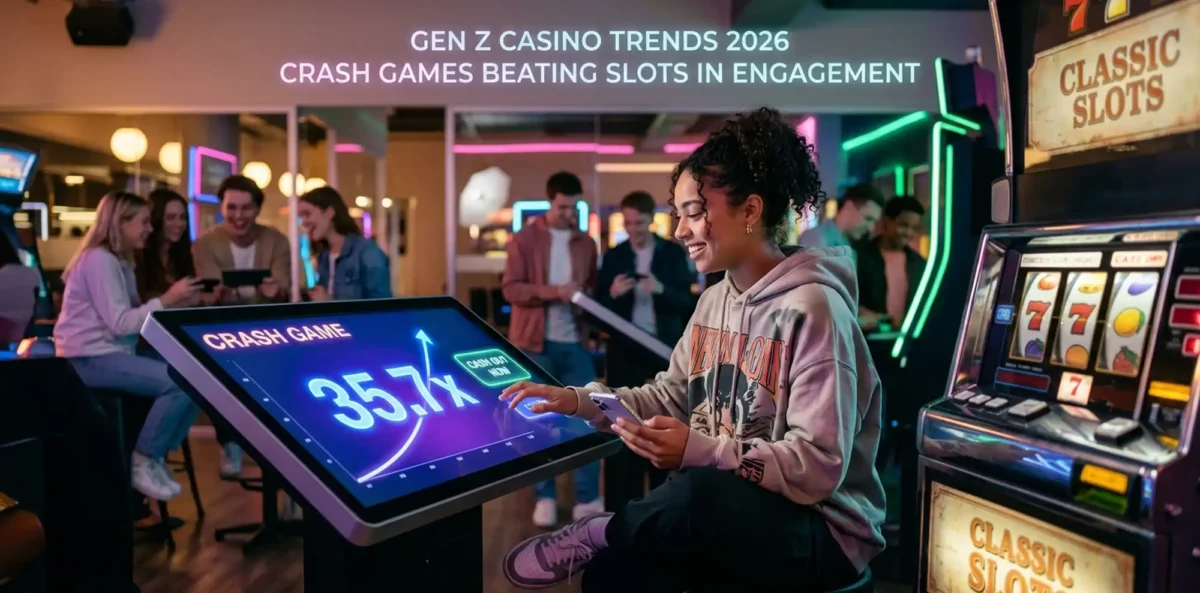
Gen Z Casino Trends 2026: Why Crash Games Are Beating Classic Slots in Engagement & CAC
For decades, the undisputed heavyweights of the gambling sector were retirees. But halfway through 2026, the digital casino floor experienced a permanent changing of the guard.
Gen Z is now officially outspending Baby Boomers.
Based on recent market trackers, the average Gen Z bettor is dropping $187 a month on gaming platforms, bypassing Boomers who have slipped to $142. That 32% gap isn’t just a statistical blip; it’s driven by a massive 34% year-over-year surge in Gen Z gambling spend, while Boomer spending simultaneously shrank by 3%. Today, nearly a quarter of every dollar wagered in the US comes from a demographic that operates primarily on smartphones, consumes media in micro-bursts, and actively ignores traditional marketing.
Operators are facing a multi-million dollar dilemma: the classic video slots that built the modern iGaming industry simply aren’t converting this new generation.
The End of the Spin: Active vs. Passive Play
If you want to understand why Gen Z is abandoning traditional slots, you have to look at how they grew up. This is a cohort raised on ranked queues, esports, and interactive multiplayer arenas. To them, pressing a button and passively watching digital reels spin feels isolating and outdated.
Enter the Crash Game.
The premise of a crash game—like Aviator, Spaceman, or JetX—is brilliantly minimalistic. A shared multiplier climbs from 1.00x, often visualized as a taking-off plane or ascending rocket. Players place their bets and must manually click “cash out” before the multiplier randomly crashes. Hold your nerve, and the payout scales; wait too long, and the bet is gone.
| Gameplay Element | Classic Video Slots | Next-Gen Crash Games |
| Player Agency | Passive (Press and wait) | Active (Manual cash-out timing) |
| Pacing | 10–30 seconds per spin | 3–5 seconds per round |
| Social Layer | Solitary experience | Live chats & public leaderboards |
| Complexity | High (Paylines, symbols, bonuses) | Minimal (Single multiplier curve) |
This single mechanic flips the psychological script. In a slot machine, the algorithm dictates the outcome entirely. In a crash game, players are given the illusion of control. Two players in the exact same lobby can have completely different financial outcomes based purely on their own reaction times.
Engagement Metrics: The Power of Community
Gen Z demands community. Current industry reports show that 72% of Gen Z gamers prefer multiplayer and interactive formats over solitary betting. Crash games feed this directly by displaying live leaderboards, real-time wagers from other players, and active chat boxes next to the game screen.
The results are staggering. Between 2024 and 2025, Spribe’s pioneer title Aviator saw its global monthly user base skyrocket from 42 million to over 77 million players. It processed a colossal €160 billion in play volume. The rapid-fire nature of the rounds—often lasting just a few seconds—means players are placing dozens of wagers per minute without the sensory fatigue caused by heavily animated, mega-ways slot features.
Surging CAC and the Unit Economics of Survival
Behind the scenes, the operator pivot toward crash games is essentially an act of financial self-preservation. In 2026, the Cost Per Acquisition (CPA) for a first-time casino depositor in mature markets has ballooned to anywhere between $250 and $650. Meanwhile, CPMs for highly competitive gambling search terms routinely exceed $350.
Traditional slots rely on higher mathematical volatility to secure operator margins. Crash games operate differently. They typically offer a highly competitive Return to Player (RTP) rate—often between 95% and 97%. The operator isn’t relying on a massive house edge; they are relying on the sheer velocity of the betting cycle.
To see how this volume offsets the higher RTP, explore how acquisition costs and game formats impact a casino’s breakeven point:
Key insight: Because crash games are highly streamable, operators are slashing their CAC by leveraging organic reach on platforms like TikTok and Twitch, bypassing traditional paid search entirely.
The 40/40/20 Blueprint
You can’t run an iGaming platform in 2026 without catering to the generation holding the wallet. Major operators have restructured their entire digital ecosystems, adopting a “40/40/20” lobby model. Slots still command 40% of the real estate to service top-of-funnel traditional players; Live Casino takes another 40% for high-margin VIPs.
But that final 20% is now exclusively dedicated to Hybrid and Crash games. It’s a targeted strike zone designed specifically for the mobile-first, fast-action Gen Z bettor—and right now, it’s the most profitable real estate on the board.
Sources: TIGGAMES 2026 trend reports, iLogos Game Studios operator guides, GammaStack Gen Z demographic research, and Medium/Bonusario analytical breakdowns of RNG mechanics and market volume.
Max Newman is Deputy Editor and Data Strategy at Virlan.