
The Push for a Cyprus Welfare Ban on Gambling
Cyprus lawmakers and regulators are currently debating methods to prevent recipients of the Guaranteed Minimum Income (GMI), known locally as EEE, from using state welfare payments for gambling. The GMI is legally described as a “residual payment to guarantee and legal minimum income for all residents.” Currently, anyone residing in Cyprus whose income is not high enough to support their basic needs is eligible for the benefit. However, the governmental intention to protect vulnerable households and ensure welfare is spent on essential needs is being complicated by distinct legal, technical, and privacy obstacles.
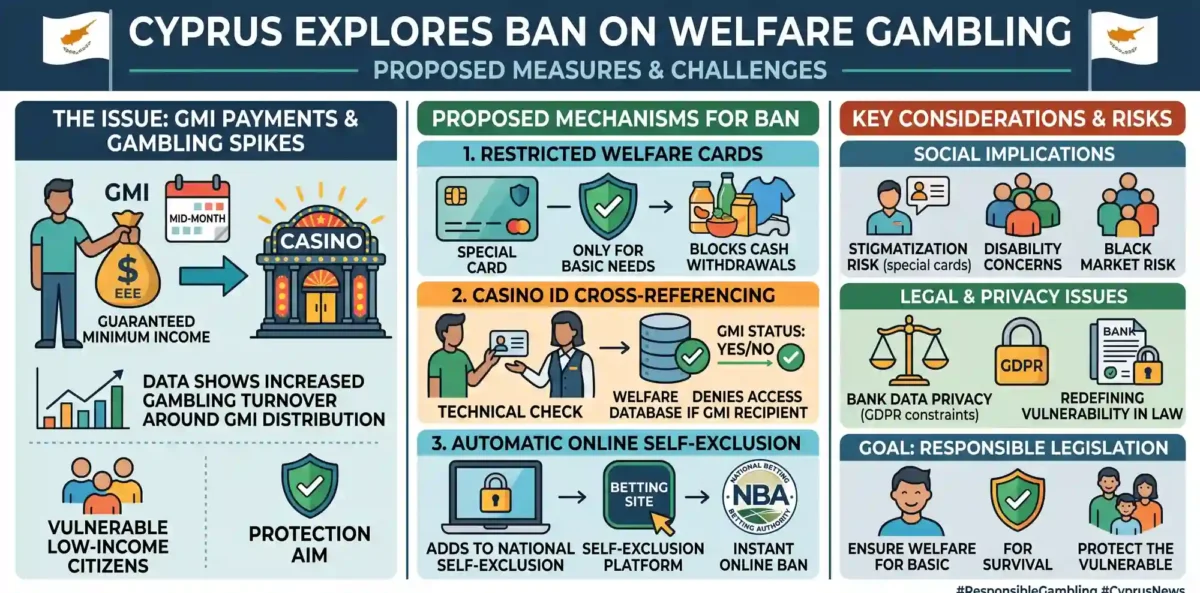
The legislative push gained serious traction following observational data gathered by the Gaming & Casino Supervision Commission. Harris Tsangarides, the commission’s executive director, reported that since 2023, his department had identified a distinct pattern: spikes in gambling activity routinely coincide with the exact time that GMI is paid out, which typically occurs around the middle of the month. This trend prompted the gaming regulator to reach out to the Welfare Benefits Administration Service (WBAS) to explore joint solutions.
Proposed Solutions: Special Cards and Casino Cross-Referencing
During a session of the House Audit Committee last Thursday, members of parliament (MPs) convened with the Data Protection Commissioner and representatives from WBAS, the gaming commission, and the National Betting Authority (NBA). The group flirted with multiple ideas to block GMI recipients from gambling at physical casinos, seeking a means to ensure individuals genuinely qualify for the benefit without drawing unreported earnings from casino floors.
One proposal, put forward by Data Protection Commissioner Maria Christofidou, involved issuing a special card specifically for GMI beneficiaries. The card would be intended for in-person verification at gambling venues. However, this idea met immediate resistance; several MPs cautioned that implementing such a card system could publicly “stigmatise” welfare recipients.
Another prominent approach centers on a “technical solution” for cross-referencing data between the gaming commission and WBAS. The straightforward procedure would check a person’s ID number when they attempt to acquire a mandatory casino membership card. The system would then return a simple “yes” or “no” answer regarding their GMI beneficiary status. According to Tsangarides, the issuance of casino membership cards is not yet universal across the island—for example, it is not fully implemented at casinos in Nicosia and Limassol. However, the commission’s intention is to make the issuance of these cards mandatory at all casinos by mid-2027.
During the debate, Disy MP Giorgos Pamboridis pointed out that in other countries, entry to a casino requires individuals to furnish an income tax statement proving their income sits above a certain threshold. Tsangarides clarified that this is not the case in Cyprus, where anyone is legally allowed to enter casino premises, though strict restrictions govern who can actively gamble.
EEE Recipients and Online Self-Exclusion
While physical casinos present verification hurdles, the National Betting Authority (NBA) has identified a far easier route for the digital space. Because approximately 80% of all gambling in Cyprus happens online, the NBA believes monitoring the online sector is a far more efficient method than tracking anonymous betting at physical outlets.
The NBA has operated an online self-exclusion scheme since 2024, which allows individuals to exclude themselves from online gambling sites. To register, users are required to provide a mobile phone number, a valid email address, and an ID document. Participants can choose the duration of their self-exclusion period.
An NBA official confirmed that, as far as online betting goes, the authority is fully prepared to utilize this existing platform to bar GMI beneficiaries automatically. “Technically speaking, we’re ready to go. If the relevant legislation passes, we could on the same day place them on the self-exclusion platform,” the official stated to lawmakers.
Privacy and GDPR Implications of Cyprus Gambling Laws
A major roadblock in the parliamentary discussion revolves around the limited access WBAS currently has to recipients’ personal banking information. At present, the welfare service can only view a recipient’s account balance and the highest balance recorded at a specific period in time. Giannis Vasiliadis, director of WBAS, noted that while this limited data can hint at suspicious activity, on its own it is not sufficient proof to conclusively verify gambling transactions.
To highlight the complexities of financial monitoring, MPs reviewed the case study of a GMI recipient who held approximately €3,000 in her bank account and subsequently received a €5,000 state subsidy for the installation of solar panels. Because the total balance in her account suddenly exceeded the GMI eligibility threshold, her benefit was suspended until authorities could investigate the provenance of the funds.
Accessing more detailed financial records remains a legally sensitive issue. Data Protection Commissioner Christofidou acknowledged that a legal opinion issued back in 2022 had found no legal basis existed for drawing detailed bank account information. However, she revealed to the committee that her office later reevaluated the matter and has now determined that a potential legal basis does exist for granting more granular access to banking information. Despite this regulatory green light, various MPs continue to voice concerns regarding the risk of privacy violations and the potential social stigma surrounding the sharing of such intimate data.
Redefining Vulnerable Groups
For any of these sweeping bans to be enacted, lawmakers must formally address current legislative definitions. By law, gambling in Cyprus is restricted; participation is strictly prohibited for minors and persons classified as “financially vulnerable.” However, GMI recipients are not yet formally classified as “financially vulnerable” for the purpose of these regulations, meaning a legal amendment is required before exclusions can be enforced.
If the legislation passes, Cyprus will join a growing international movement navigating the complex intersection of social welfare and gaming regulation. Cyprus is not the first market to consider blocking welfare recipients from using state benefits to gamble; Brazil successfully introduced a similar ban in 2025.
Leo Falsafi is a digital marketing veteran and senior journalist at Virlan.co, where he covers the intersection of digital marketing, gaming, and breaking US trending news. With nearly two decades of hands-on experience in SEO and digital strategy, Leo has consulted for and scaled hundreds of companies. His deep industry roots allow him to deliver sharp, fact-checked insights and analysis on the trends shaping today's digital landscape.