
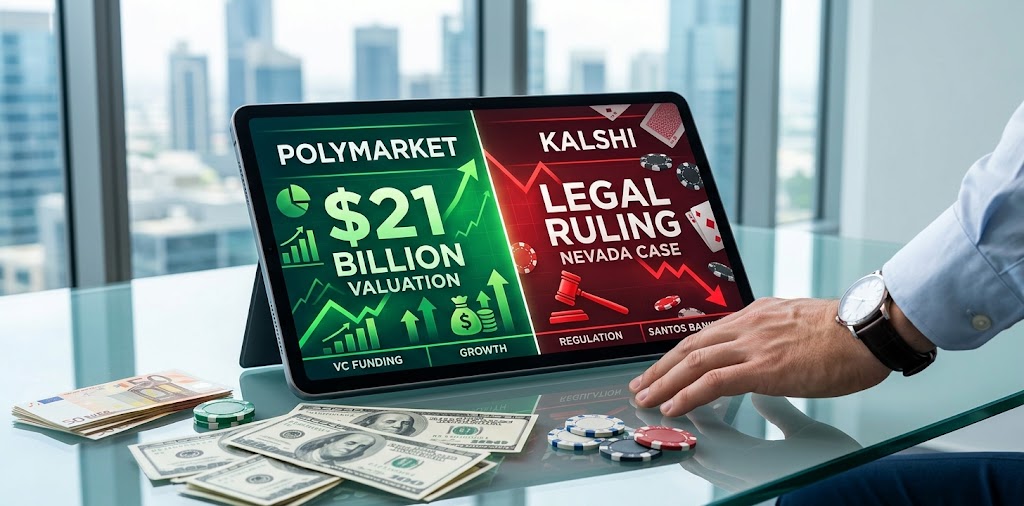
Prediction markets have exploded in popularity as retail investors have become a large and dominant force in financial markets, flocking to venues where they can make high-octane bets. Yet, the industry is currently experiencing a massive split in its regulatory and financial trajectories: Polymarket is securing a massive venture capital valuation, while its rival Kalshi faces state-by-state legal warfare and compliance crackdowns over market manipulation.
Polymarket’s $21 Billion Mega-Valuation and 1789 Capital
Polymarket has raised new funding led by 1789 Capital at a $21 billion valuation, up from roughly $300 million about a year ago and $15 billion more recently. According to Forbes and Bloomberg, Polymarket will raise $1 billion in total funding in this round, with 1789 Capital—a venture fund linked to Donald Trump Jr.—investing around $300 million.
Spokeswoman Alexa Henning confirmed to the New York Times that 1789 Capital would invest around $300 million as Polymarket plans to raise $1 billion, bringing the valuation to $21 billion. The firm previously made a “strategic investment” in Polymarket last year, investing about $200 million before this new round. Interestingly, Donald Trump Jr. also joined Kalshi as an adviser last year, receiving shares worth more than $300,000.
This massive cash influx coincides with a broader rise in popularity for prediction markets across the U.S.. The new $21 billion valuation puts Polymarket neck-and-neck with its main rival, Kalshi, which already hit a $22 billion valuation in May after its own $1 billion raise.
Kalshi’s Legal Battles & Regulatory Crackdowns
While Polymarket scales, Kalshi and others have faced intense criticism and resistance in the U.S. from state officials, who argue that wagers on the platforms amount to gambling subject to oversight by local governments. Kalshi has argued that its event contracts are similar to derivatives instruments and should strictly be overseen by U.S. financial regulators.
However, a federal appeals court just rejected Kalshi’s efforts to stop Nevada from regulating speculation on sporting events on its platform. The 9th U.S. Circuit Court of Appeals ruled that Nevada can regulate Kalshi’s sports event contracts as gambling, rejecting the platform’s argument that federal commodities law gives the Commodity Futures Trading Commission (CFTC) exclusive authority. A three-judge panel affirmed a Nevada federal judge’s decision dissolving an injunction that had previously prevented state gaming regulators from taking action against Kalshi.
“The Substance… is Sports Gambling”
The 9th Circuit held that Kalshi failed to show that the 1936 Commodity Exchange Act, which regulates commodity futures trading, preempts Nevada gambling laws. In a unanimous 3-0 decision, Judge Ryan Nelson wrote: “The substance of the sports event contracts offered on Kalshi’s DCM [designated contract market] is sports gambling, regardless of whether Kalshi calls them swaps”.
The ruling followed a dispute in which Nevada regulators sent a cease-and-desist letter to Kalshi in March, arguing Kalshi operated a sports betting platform in violation of state regulations. The Nevada Gaming Control Board stated the ruling “vindicates what we have been saying all along”. Dominick Freda, legal director of Better Markets, called the 9th Circuit’s decision a “decisive win for the rule of law and for every state that has built a regulatory regime to protect its residents from gambling harms”.
A State and Federal Turf War
States are locked in an ongoing legal fight with the federal government over regulatory oversight. The 9th Circuit’s ruling split with the 3rd Circuit on a major question for prediction markets. A separate decision in April by the 3rd U.S. Circuit Court of Appeals concluded that the CFTC has exclusive control over sports-related event contracts on Kalshi.
Kalshi spokesperson Dani Lever responded: “The 9th Circuit agreed with the 3rd Circuit on a fundamental point: Federal law prevents states from regulating trading on a federally licensed exchange, like Kalshi. Despite the 9th Circuit’s opinion, we still believe the CFTC regulations, as written, do not prohibit sports contracts, and in any event, the CFTC is working to clarify those regulations. We will be seeking further review”.
The Integrity Flaw: George Santos and Insider Trading
Compounding Kalshi’s dramatic week, the platform issued its first-ever lifetime ban to former U.S. Rep. George Santos. Prediction markets are currently under pressure to crack down on insider trading after a series of high-profile manipulations.
Santos was banned for placing bets on a contract titled “Who will attend the State of the Union?”. Between February 2 and February 25, he placed several large bets on whether he would attend President Donald Trump’s address. The compliance department found that Santos made multiple public statements with the intent to influence the prices, concluding: “Ultimately, these statements did, in fact, manipulate the price of said contracts”.
According to the CFTC, Santos bet “yes” on his attendance and posted on social media about the outfit he would wear. Prices on the “yes” position rose, and he booked a profit of $3,448. He later bought a “no” position while posting that he planned to go, and then posted that he was stuck at an airport. The “no” position became profitable, and he exited, earning $14,391. Santos did not ultimately attend the address, making a total profit of $17,839.
Penalties and Industry Repercussions
Kalshi fined the former lawmaker $71,356 and banned him due to “his lack of cooperation” with its compliance department. In July, Santos had already agreed to pay $35,000 to settle a federal probe into his suspicious trades, with the CFTC imposing a three-year trading ban.
Santos mocked Kalshi’s enforcement on X (formerly Twitter): “Hey @Kalshi thanks for the lifetime ban from your gambling platform. Let’s see how much longer you guys are around for.” He further called the platform “an unserious company” and the ban “frivolous nonsense”.
Robert DeNault, Kalshi’s head of enforcement, stated that the company has a team “to catch bad actors, punish them, and deter other people from doing it again,” adding that Santos “has been subject to punishment by the CFTC, and now he’s being subject to punishment by our exchange”. Kalshi spokesperson Elisabeth Diana confirmed it was the first permanent ban in the company’s history.
The platform also issued enforcement actions against others betting on their own candidacy. Kalshi fined and imposed a three-year ban on North Carolina congressional candidate Laurie Buckhout. Buckhout, who admitted placing bets of less than $1,000 on her campaign, stated: “I bet on myself. Literally. It was a dumb mistake, and as soon as I learned there was an issue, I worked to make it right… Safe to say my career as a Kalshi trader was short-lived”. The CFTC recently charged other high-profile insider trading cases on prediction markets, including ordering a former White House teleprompter operator to pay $172,000 for bets related to presidential speeches.
Sources: The Financial Times, CBS News, Daily Journal, Livemint, Bitcoin.com, Newscord, and PrimeXBT, featuring reporting by journalists such as Mary Cunningham and legal insights from Better Markets and CFTC public filings.
Leo Falsafi is a digital marketing veteran and senior journalist at Virlan.co, where he covers the intersection of digital marketing, gaming, and breaking US trending news. With nearly two decades of hands-on experience in SEO and digital strategy, Leo has consulted for and scaled hundreds of companies. His deep industry roots allow him to deliver sharp, fact-checked insights and analysis on the trends shaping today's digital landscape.