

AdStop Registry: A National Opt-Out Framework
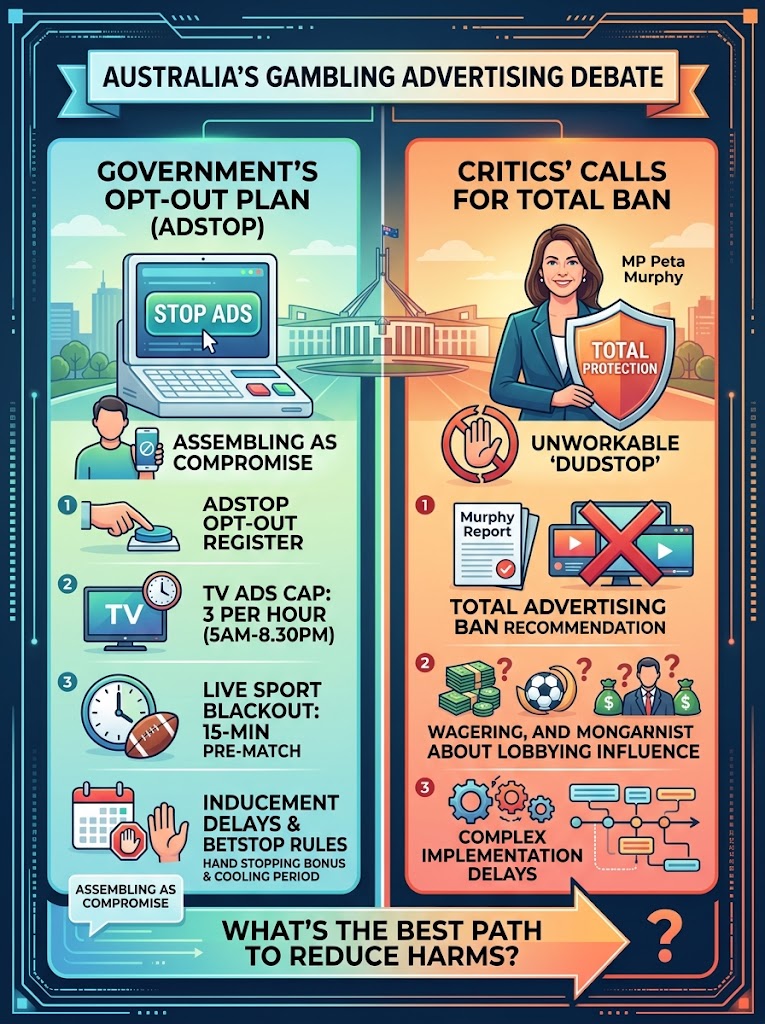
The legislation will also establish a national gambling advertising opt-out register, known as AdStop. There will be AdStop, a global opt-out register which ensures that every Australian can go to the register, a one-stop shop to opt out of all gambling ads no matter where they are online. Moving forward, anyone seeking to serve gambling ads online will be required to sweep that register to make sure that if someone opts out on the register, that all publishers of gambling ads will comply with the law.
Broadcast Caps and Live Sport Blackouts
Live television will face slightly tighter restrictions than planned. Changes include limiting TV gambling ads to three per hour between 5am and 8.30pm. Additionally, Communications Minister Anika Wells also extended the pre-match blackout period for wagering advertisements around live sports events from five minutes to 15 minutes. It will result in fewer gaming ads during sport by blacking out wagering ads 15 minutes before a live sporting event.
Inducement Delays and BetStop Cooling-Off Periods
Wells said all inducement ads would be banned for any customer ‘identified as at risk of gambling-related harm’, for 14 days after someone had signed up with a wagering service, and for three months after someone had deregistered from Betstop. The reforms will also prohibit direct marketing of inducements to former BetStop users for 90 days after deregistration and impose stronger penalties on operators. Ultimately, there will be a three-month cooling-off period following a customer’s deregistering from BetStop.
Australia’s Last-Minute “AdStop” Opt-Out Register: Gambling Reforms Under Fire
The Australian government has introduced last-minute amendments to its gambling reform bill, known as the Interactive Gaming Bill, amid significant controversy and critical warnings from a Senate inquiry. The reforms are set to pass Thursday, 1,149 days after the late Labor MP Peta Murphy handed down her landmark report on gambling harms, which recommended a total ban on inducements and wagering ads.
In Parliament on Monday, Communications Minister Anika Wells unveiled legislation aimed at establishing a national one-stop shop register that would allow individuals to opt out of receiving gambling promotions. This initiative, likened to the Do Not Call register for spam calls, forms part of an agreement with the opposition Coalition and aims to reduce the reach of gambling marketing, especially among children and young people.
The Prime Minister described the bill as the most significant gambling advertising reform by any Australian government ever, emphasizing it would increase protections for people who are most at risk of gambling harm while continuing to allow those who enjoy a bet to do so.
The Triple Lock System and Advertising Restrictions
The reforms extend to digital platforms, mandating a triple lock system before displaying promotions. This includes requiring users to have a logged-in profile, undergo age verification, and have access to an opt-out option for gambling advertising. Furthermore, streaming services such as 9Now and 7plus will face the same advertising restrictions as free-to-air television.
Other significant changes include:
- Limiting TV gambling ads to three per hour between 5am and 8.30pm.
- Banning gambling ads on player jerseys and in stadiums.
- Banning celebrities and players from promoting gambling.
- Wagering providers will no longer provide commissions, bonuses or other performance-linked payments to employees, agents, or third parties if these payments relate to acquiring, reactivating, retaining or managing customers.
A Departure from the Murphy Report
Despite these measures, the legislation stops short of imposing a total ban on gambling advertising, as recommended in the 2023 parliamentary report You Win Some, You Lose More. The government’s new proposal for a single opt-out register is described as a compromise to provide an easier avenue for opting out of ads, without enacting a full ban or switching to an opt-in.
Critics point to deficiencies in the new model. The husband of the late Labor MP Peta Murphy stated the government’s reform falls well short of her vision, lamenting that its shortcomings were due to the ‘considerable lobbying power’ of the wagering, sporting and media industries. Furthermore, Kate Seselja, co-chair of Gambling Harm Lived Experience Experts, stated, The only way to effectively block gambling ads is to ban them in Australia. This proposal is completely unworkable. Greens senator Sarah Hanson-Young mockingly referred to it as ‘DudStop’, claiming ‘no one can even explain how this opt-out register is going to work’.
Industry and Technical Concerns
The proposed universal register, tentatively referred to by some as AdStop, faces significant logistical hurdles. Gambling industry sources questioned how the opt-out register would operate, how long it would take to set up, as well as privacy issues around handling of user data. Government sources have conceded the system would be complex and unlikely to be ready by 1 January 2027, anticipating it could take up to 12 months to be set up.
Responsible Wagering Australia (RWA) expressed disappointment, with CEO Kai Cantwell noting, This new global opt-out system, akin to BetStop, is proposed to be designed, developed and implemented in less than four months. Betstop, which is a simpler concept, took more than four years from inception to implementation.
Shadow communications minister Sarah Henderson stressed the necessity of the register, calling it untenable for people to individually opt-out on each website, but she also raised concerns about security of data which people provide to the register.
- The Top Gambling Writers & Betting Analysts Shaping the Industry
- AdStop Reforms: Opt-Out Rules & Gambling Ad Caps Breakdown
- Adult Gaming Centre Operator Fined £150,000 Amid Prime Minister Reforms
- Top 10 Global B2B iGaming News Sites (2026 Rankings)
- B2B iGaming News Explained: Coverage, Audience & Industry Impact
Leo Falsafi is a digital marketing veteran and senior journalist at Virlan.co, where he covers the intersection of digital marketing, gaming, and breaking US trending news. With nearly two decades of hands-on experience in SEO and digital strategy, Leo has consulted for and scaled hundreds of companies. His deep industry roots allow him to deliver sharp, fact-checked insights and analysis on the trends shaping today's digital landscape.