
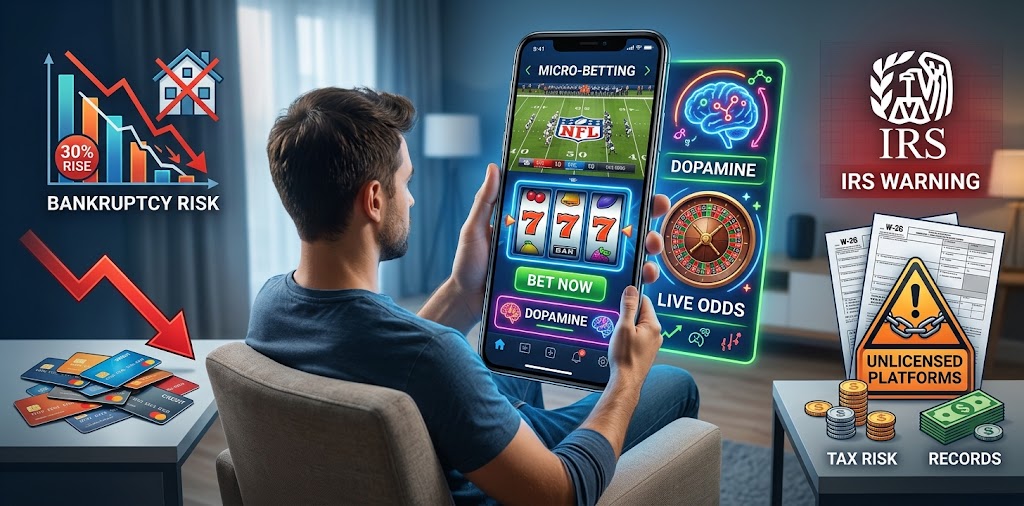
The 24/7 Normalization of NFL Season Betting Apps
Unlike a trip to a casino, sports betting is now available on a smartphone, woven into live broadcasts, and promoted by professional athletes and major media brands. This normalization makes it easy to overlook how quickly a habit can become a problem. The American Psychiatric Association estimates that between 1% and 3% of the U.S. population meets the criteria for gambling disorder, with sports bettors representing a growing share of that population.
When someone bets on their favorite team, the wager becomes tied to an existing emotional investment. Wins feel like personal victories, and losses feel like shared disappointments rather than financial mistakes. This emotional connection blurs the line between being a fan and being a gambler.
The Illusion of Control: Do You Really Have a Sports Betting Edge?
Many sports bettors believe their knowledge of teams, statistics, and player performance gives them an edge. This belief in skill creates what researchers call an ‘illusion of control,’ a cognitive bias that makes people feel more confident in their bets than the odds justify.
Online sports betting can create a powerful illusion that outcomes are predictable and controllable, especially for individuals who closely follow teams, statistics, and player performance. This belief often leads bettors to overestimate their edge, placing more frequent or larger wagers under the assumption that skill outweighs chance. Unlike a slot machine, where the randomness is obvious, sports betting rewards research and analysis in the short term. This intermittent reinforcement strengthens the belief that skill, not luck, drives outcomes.
Live Sports Betting Dangers: The Dopamine Slot Machine
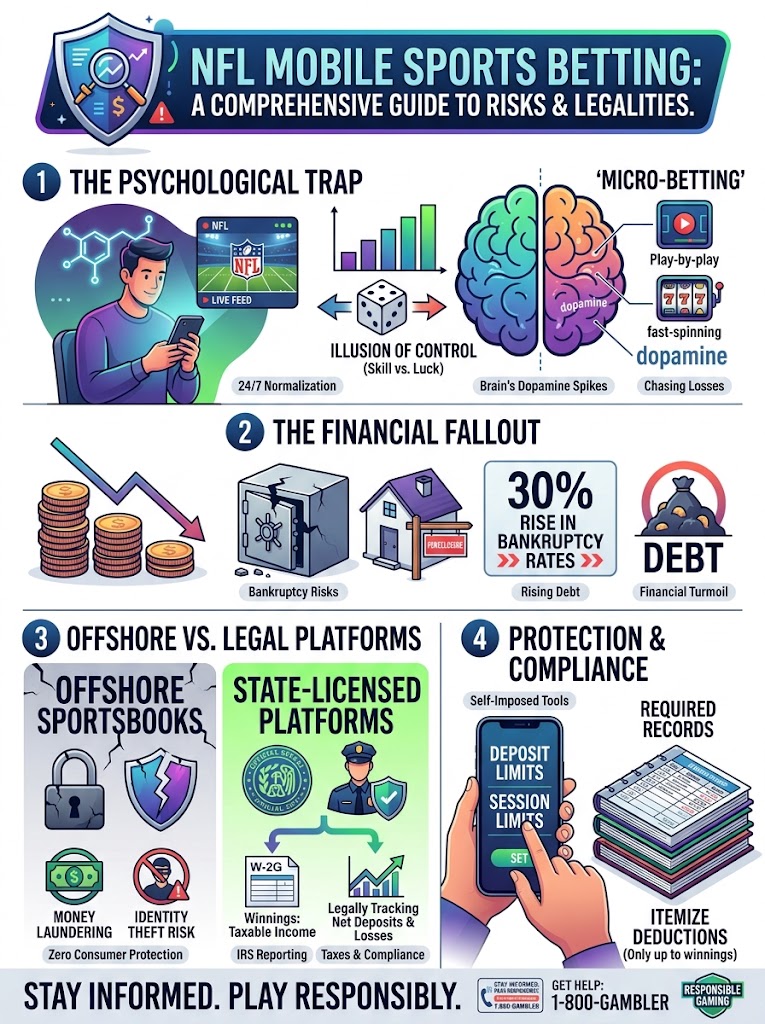
Modern technology has introduced ‘Micro-betting,’ where people can bet on individual plays, such as whether the next pitch in a baseball game will be a strike. Live betting, which allows wagers during a game, dramatically increases the pace and frequency of betting. Each play becomes a new opportunity to bet, which shortens the time between impulse and action. This rapid cycle accelerates the development of compulsive patterns. This high-speed wagering increases the frequency of ‘dopamine’.
Dopamine is about motivation, desire, and the urge to ‘go after’ something — not necessarily the enjoyment of receiving it. Studies show that dopamine spikes in moments of anticipation, especially when the outcome is uncertain. This is exactly what gambling is built on. The brain releases dopamine not just when a bet wins, but in anticipation of the outcome. The hours between placing a bet and watching a game unfold create a prolonged state of excitement that reinforces the behavior. This anticipatory reward is a powerful driver of repeated betting. Sports betting apps, online casinos, 24/7 venues and micro-betting options mean the brain rarely gets a pause.
Financial Fallout: A 30% Surge in Sports Gambling Bankruptcies
One of the most common and destructive psychological patterns in gambling is the urge to recover losses quickly. After a losing bet, individuals may feel compelled to place additional wagers to ‘get back to even,’ often taking on greater risk in the process. In sports betting, the constant availability of new games makes it easy to chase losses around the clock. Researchers found that fewer than 5% of those online sports gamblers withdrew more money from their gambling apps than they deposited.
One of the studies found that in areas where online betting is legal, average credit scores dropped by 1% and the likelihood of filing for bankruptcy increased by 25% to 30% after four years of legalization. Bankruptcy Rates: Up 25-30% three to four years after online betting is legalized, translating to roughly 30,000 more bankruptcies in the US. The worst effects were concentrated in young, low-income men, both studies found. Young men in low-income areas… see an almost 4% decrease in credit limits.
Problem Gambling Warning Signs and Responsible Gaming Failures
Limit-setting tools are another essential aspect of responsible gaming in online platforms. These tools empower players to set personal boundaries on their gambling activities, including limits on deposits, losses, wagering, and session durations. However, the WHO states such messages are often ineffective.
The preferred regulatory approach of the gambling industry – so-called responsible gambling – adds to this burden by effectively blaming those who experience harm. Responsible gambling interventions are typically ineffective, particularly where the uptake of measures is optional. Tools alone do not solve harm… The gap between ‘available’ and ‘adopted’ is where real risk hides.
Embargoes and restrictions across individual channels can be circumvented. When self-exclusion fails, trust breaks instantly, which is why it must behave less like a feature and more like infrastructure. Despite appearing to offer sound advice, it is important to note that gambling products are often designed to be addictive, particularly those available online. For many, using an addictive product makes responsible gambling extremely challenging.
URL Slug: nfl-mobile-sports-betting-risks
IRS Issues Urgent Warning to NFL Bettors: The Legal and Financial Risks of Unlicensed Sportsbooks
Planning to bet on the NFL this season? The IRS is warning bettors about offshore platforms, tax evasion risks, and the confusing legal gray zone surrounding new prediction markets.
Offshore Sportsbook Dangers: The IRS Sports Betting Warning
The Internal Revenue Service is advising consumers to only bet with legal, regulated online sportsbooks and casino websites. Engaging in offshore, illicit gambling websites and platforms presents consumer risks, IRS officials say. IRS Criminal Investigation Chief Guy Ficco… says the public should only engage with sportsbooks that hold sports wagering licenses from their respective state.
If you gamble with a site that is not reputable, your funds, winnings included, may be at risk. I would also say that fraudsters have looked for ways to compromise the financial system in many ways, including online casinos, and we have seen an influx of identity theft-based crimes.
Critics of offshore gambling websites say the foreign regulators mainly inspect the businesses to ensure that they aren’t harming their own interests — not violating foreign gambling laws or failing to provide patrons with customary safeguards. Ficco said many illegal gambling websites deal in cryptocurrencies, and that presents additional layers of concern.
Prediction Markets Gambling Laws: A State vs. Federal Turf War
Whether that bet pays off depends on how courts resolve a growing conflict between federal commodities regulation and state gambling laws. The mechanics are nearly identical to a wager at a sportsbook or casino, but the platforms argue that because these contracts are classified as financial derivatives under federal law, they are fundamentally different and subject to federal, not state, oversight.
Platforms argue that Congress granted the Commodity Futures Trading Commission (CFTC) exclusive jurisdiction over transactions on designated contract markets, leaving no room for states to regulate sports event contracts traded on a federally regulated exchange. States and gaming regulators counter that the CEA does not displace state authority in the realm of gambling. As with cryptocurrencies, fantasy sports, and other data-driven products, small differences in how a product is labeled (e.g., derivative versus wager, market versus gambling) can determine which regulator applies and which rules govern.
Sports Betting Taxes on Legal NFL Betting Platforms
Regardless of whether you wager through state-regulated online sportsbooks or offshore platforms, gambling winnings are considered taxable income by the IRS. Regardless of whether the winnings are large or small, all gambling winnings must be reported on your taxes. Typically, gambling houses will issue a Form W-2G if winnings meet and exceed a certain threshold amount.
Gambling losses can be deducted, but they are used only if you itemize your deductions. You can only deduct losses up to the amount of your reported gambling winnings. For example, if you win $12,000 but incurred $20,000 in losses, you can deduct only $12,000 and the excess of $8,000 in losses cannot be used or carried forward.
To deduct gambling losses, the IRS requires that you maintain detailed records of your gambling. A log of your gambling activity – including dates, amounts wagered, and the type of gambling activity.
Leo Falsafi is a digital marketing veteran and senior journalist at Virlan.co, where he covers the intersection of digital marketing, gaming, and breaking US trending news. With nearly two decades of hands-on experience in SEO and digital strategy, Leo has consulted for and scaled hundreds of companies. His deep industry roots allow him to deliver sharp, fact-checked insights and analysis on the trends shaping today's digital landscape.