
Kalshi vs Polymarket
A 2026 review of the leading prediction markets, comparing Kalshi and Polymarket through the lens of volume, liquidity, regulations, and CFTC compliance.
The Exponential Growth of Prediction Markets in 2026
Prediction market volumes grew nearly 4X sequentially to $64B in 2025 and are on pace to exceed $325B in 2026, based on YTD run-rate volumes. Polymarket and Kalshi are the two leading prediction markets by open interest, both neck and neck at roughly $400M OI as of Jan 31, 2026, according to data from Allium. For the month, Kalshi posted volumes of $9.5B, while Polymarket saw volumes of $3.3B.
In short, prediction markets price news in real time, and Kalshi and Polymarket spike when the window is clear. By mid-2026, Polymarket had processed over $10 billion in lifetime trading volume, was reportedly in funding talks at a $9 billion valuation, and during the World Cup captured 31.2% of all US prediction-market app downloads — second only to Kalshi.
Regulated vs. Unregulated Exchanges: The Core Divide
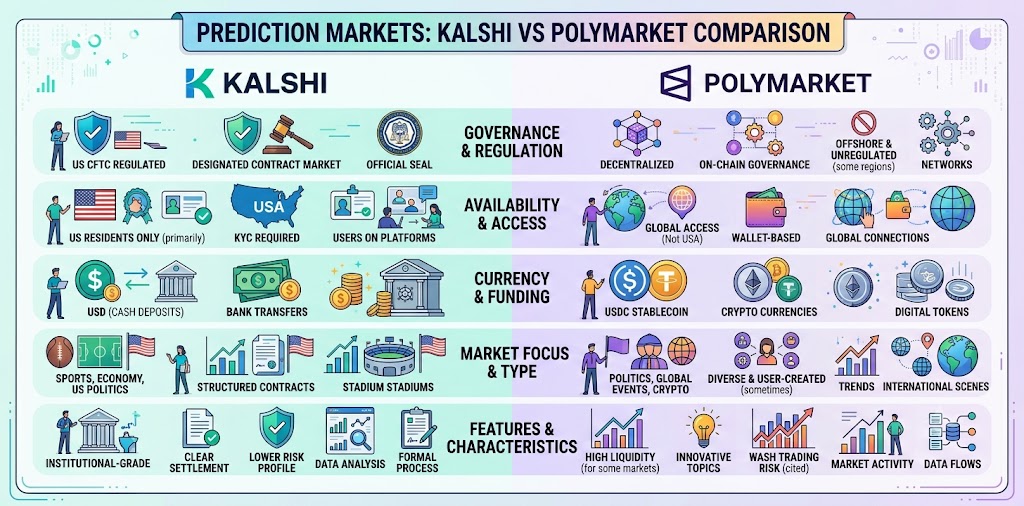
There is a significant difference between onshore, regulated prediction markets like Kalshi, which are licensed and overseen by the CFTC, and offshore, unregulated prediction markets which aren’t subject to rules or oversight. Under U.S. law, U.S.-based prediction market must obtain a Designated Contract Market license from the CFTC in order to offer future event contracts to traders.
CFTC Protections and U.S. Law
Kalshi is a CFTC-regulated US exchange that, since late 2025, has also opened to traders in 140+ other countries — though it stays blocked in Canada, the UK and Australia, and operates without local licenses (and without the regulatory protection US users get) everywhere outside the US.
The Commodity Exchange Act, which governs contracts listed on U.S.-based prediction markets, contains special provisions allowing for CFTC review and rejection of contracts related to assassinations, war, or terrorism, amongst other issues. Because every market includes clear settlement criteria before trading begins, users know exactly what determines the result. That transparency helps eliminate ambiguity and ensures contracts are resolved using objective, publicly verifiable outcomes rather than discretionary decisions.
Decentralization and Offshore Trading Risks
Polymarket is the global leader available in 160+ countries. Polymarket operates on-chain. What does that mean? Markets are collateralized in USDC, trades execute on-chain, and settlement is public. The upside is transparency and global reach.
However, recent academic research indicates that offshore markets which do not identify their users have been targeted by significant illicit trading activities, like wash trading. Wash trading involves traders taking opposite positions on the same market to manipulate market price and is illegal under U.S. law and CFTC regulation. Event contract trading involves significant risk and is not appropriate for everyone. Please carefully consider if it is appropriate for you in light of your personal financial circumstances.
Kalshi vs Polymarket: Platform Dynamics and Liquidity
One is an exchange with a rulebook, the other is a crypto-native venue with on-chain transparency. Your choice depends on rails, speed, and comfort with wallets.
For most traders, Polymarket wins on the things that drive returns — deeper liquidity, better odds, broader markets, no KYC, and maker rebates. Kalshi’s edge is regulation and USD cash deposits, which matter most to US residents (Polymarket’s international exchange is blocked in the US). If you want an account-based flow, Kalshi is cleaner. If you want on-chain transparency, Polymarket is the fit.
Evolving Alternatives to PredictIt
Kalshi is the platform most people land on once PredictIt’s politics-only menu starts to feel limiting. It’s a fully registered CFTC exchange rather than a research project operating under no-action relief, and that shows up in the details — deep sports and economic contract markets sit right alongside politics, giving you a lot more to trade overall.
Top 10 Prediction Markets Beyond Kalshi and Polymarket
An in-depth 2026 review of the top 10 alternative prediction markets and betting exchanges, including PredictIt, Manifold, Augur, and Hedgehog.
Event-Based Trading Platforms: The Broader Landscape
Prediction markets, which allow users to trade contracts based on outcomes of events such as elections, economic data releases, or sports results, have gained traction among both retail and institutional participants. Crypto prediction markets grew slowly before 2024, heavily impacted by the cyclical nature of the cryptocurrency market. Currently, prediction markets remain relatively small in scale compared to major DeFi categories. Several companies have recently reiterated plans to expand their prediction market businesses during earnings calls, indicating a sustained strategic focus on this emerging sector.
1. PredictIt: Regulated Political Forecasting
PredictIt remains one of the clearest choices for those who want a straightforward, politics-centered prediction market experience. While other platforms are chasing broader event menus, PredictIt keeps a strong focus on elections, Congress, the presidency, state and local contests, and global political developments. That narrower identity works in its favor because it reduces ambiguity about who the product is for.
PredictIt uses a continuous double auction to sell shares for each event in its markets, meaning that for every person who predicts that an event will take place, there must be another person who predicts that it will not.
2. Manifold Markets: Social Play-Money Predictions
Manifold Markets is a pure play-money market built for forecasting, not cash payouts. Users trade with Mana, create their own markets, and track crowd odds across politics, AI, sports, culture, business, and many narrower topics that most rivals would never touch.
Because Manifold focuses on community forecasting rather than real-money trading, the platform emphasizes participation, market creation, and discussion instead of promotional offers. The platform feels welcoming, active, and community-driven. If your goal is improving your forecasting skills rather than earning money, it’s one of the most enjoyable prediction platforms available.
3. Betfair Exchange: Peer-to-Peer Market Making
On the sportsbook, you bet against Betfair at fixed odds, just like any bookmaker. On the exchange, you bet against other customers, which is where back and lay come in. To back a selection is to support it, exactly like a normal bet: you win if it happens. To lay a selection is to play the bookmaker’s role and bet that it won’t happen.
Using a large sample of bets on soccer from Betfair Exchange, we implement a transaction-level empirical strategy that identifies Maker and Taker sides of each trade. We show that pre-match and early in-play behavior aligns closely with the model’s predictions.
4. Smarkets: Low-Commission Event Trading
Smarkets is a leading prediction market offering low-commission trading on sports, politics and global events. We operate two main products – the Smarkets exchange, a sophisticated betting exchange and prediction market platform, and SBK, an app that delivers industry-disrupting odds by drawing prices from the exchange and presenting them in a sleek, sportsbook interface.
5. Augur: Ethereum-Based Decentralization
Augur is a decentralized prediction market platform built on blockchain technology. It allows users to create and participate in prediction markets, where they can predict the outcome of various events, such as elections, sports events, or financial markets.
Augur runs on the Ethereum blockchain, meaning purchases of the shares in its prediction markets are made using ETH, Ethereum’s native asset. Traders wishing to use a less volatile asset can also bet in markets using DAI, a stablecoin running on top of Ethereum.
6. Zeitgeist: Substrate Collective Intelligence
Zeitgeist is a blockchain-based platform designed to harness the power of collective intelligence through prediction markets. This innovative protocol enables users to forecast the outcomes of various events, including but not limited to, price movements and market milestones within the cryptocurrency sphere.
Built on the Substrate blockchain framework, Zeitgeist emphasizes the importance of decentralization. This foundational choice ensures that the platform operates in a manner that is resistant to censorship and central points of failure, aligning with the broader ethos of the blockchain community.
7. Hedgehog Markets: Solana No-Loss Bets
Launched in 2021 by former Google and Oscar Health engineer George Yu, Hedgehog Markets is a decentralized prediction market platform built on the Solana blockchain. Leveraging Solana’s high transaction speed and low fees, it offers a seamless user experience.
One of its standout features is the “no-loss market,” which allows users to place bets without risking their initial capital, as funds generate returns through DeFi protocols.
8. SX Bet: Web3 Sports Betting Exchange
SX Bet is the largest crypto sports betting platform in the world with $500,000,000 bet by over 10,000 users. SX Bet is web3 native with the security and safety of betting from your own wallet with the best odds in the world powered by the most liquid crypto sports betting exchange.
SX has designed a one-of-a-kind stock exchange for sports betting. This transparent approach to sports betting has created a place with sharp odds, lots of liquidity and a good community of knowledgeable bettors. Users of SX Bet can bet in USDC or ETH.
9. Gnosis: From Predictions to Infrastructure
Launched in 2017 as a decentralized prediction market, the project has grown into one of Ethereum’s leading infrastructure platforms, offering products like Safe, Gnosis Pay, and CoW Protocol.
Unlike many high-risk crypto tokens that depend on market hype, GNO focuses on building useful blockchain infrastructure. Its value comes from products like governance tools, secure wallets, and decentralized applications.
10. Swaye: Meme Token Prediction Ecosystem
Swaye: A decentralized prediction market platform designed to engage users by integrating prediction markets with meme tokens. Unlike Polymarket’s centralized market creation mechanism, Swaye allows users to freely create markets and share predictions via social channels for viral spread. The platform encourages early user participation in betting, which also increases liquidity.
Market Volatility and Risk Management
As with any investment in the cryptocurrency space, it is crucial for individuals to conduct thorough research and consider the inherent risks. The dynamic and often volatile nature of digital assets requires a cautious approach to investment and participation in platforms. The cryptocurrency market suffers from high volatility and occasional arbitrary movements.
Sources Quoted:
FalconX, StartPolymarket, Kalshi Market Integrity Hub, Vegas Insider, LOCALS Insider, LiveScore, and Sports Illustrated.
Earnings Revision Report, Benzinga, Wikipedia, CryptoSlate, LegalSportsReport, TNT Sports, Karl Whelan (Agreeing to Disagree), Smarkets, Most Loved Workplace, Gate Learn, Kraken, CoinMarketCap, Trustpilot, HappyCoin, Coinpedia, and Changelly.
Leo Falsafi is a digital marketing veteran and senior journalist at Virlan.co, where he covers the intersection of digital marketing, gaming, and breaking US trending news. With nearly two decades of hands-on experience in SEO and digital strategy, Leo has consulted for and scaled hundreds of companies. His deep industry roots allow him to deliver sharp, fact-checked insights and analysis on the trends shaping today's digital landscape.