
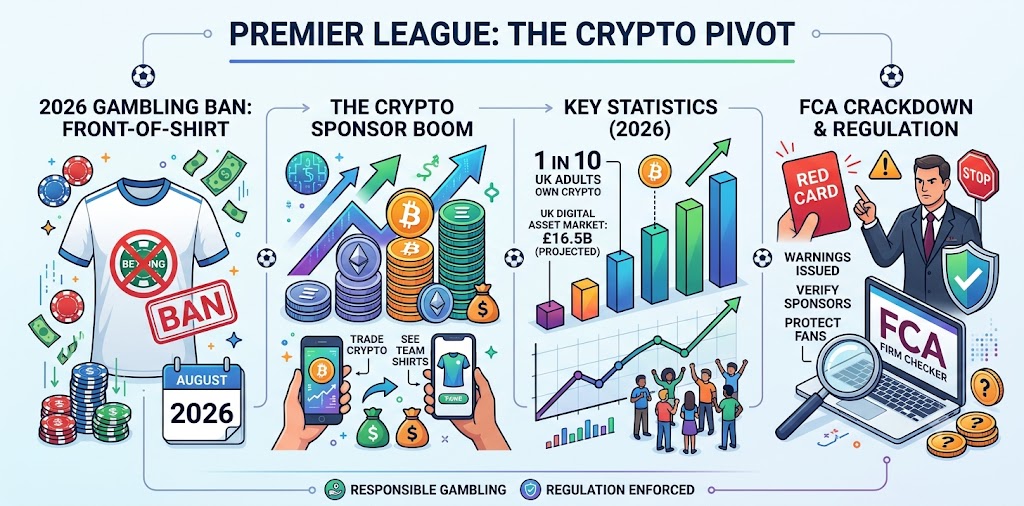
August 2026 marks a historic commercial shift for English football. The Premier League’s voluntary ban on front-of-shirt gambling sponsorships has officially commenced, forcing commercial directors to immediately find lucrative alternatives. They did not have to look far. Cryptocurrency platforms, digital asset exchanges, and crypto-adjacent trading sites have aggressively filled the vacuum.
However, this influx has triggered immediate alarm bells. The Financial Conduct Authority (FCA) recently took the unprecedented step of writing directly to Premier League clubs to warn them about the severe consumer risks associated with unregulated financial partners.
The 2026 Front-of-Shirt Gambling Ban Fuels a Digital Pivot
When top-flight clubs agreed to phase out traditional betting brands from prime kit real estate, an estimated £60 million annual commercial gap opened up overnight. Traditional bookmakers retreated from the chest, moving to sleeves or LED hoardings. Into this highly visible space stepped the blockchain sector.
Filling the Commercial Void
Recent data highlights the sheer scale of this transition. Ahead of the 2026/27 campaign, 14 of the 20 Premier League clubs had already secured crypto partnerships in some capacity. The arithmetic driving this trend is straightforward. Approximately one in ten people in the UK now own cryptocurrency, and the domestic digital asset sector is projected to hit valuations of £16.5 billion in 2026.
Luke Jackson, Director of Sports and Technology at Walker Morris, anticipated this exact scenario. “As the 2026/27 season ban on gambling front-of-shirt sponsorships draws closer, we’re seeing clubs and other rightsholders becoming increasingly inventive in how they look to maximise their commercial revenue,” Jackson observed. He correctly predicted that a heavily gambling-oriented market would be replaced by crypto and other sectors vying for a “popular asset space”.
The FCA Issues a “Red Card” to Unregistered Sponsors
Replacing heavily regulated domestic bookmakers with offshore digital asset platforms presents severe compliance hurdles. Many of the incoming sponsors sit outside standard UK financial regulations. This prompted the FCA to intervene in June 2026, warning clubs that allowing their brands to promote risky financial products could put fans in jeopardy.
Unpacking the Consumer Protection Mandate
The regulator’s stance is rooted in strict consumer protection. Lucy Castledine, the FCA’s director of consumer investments, delivered a blunt assessment of the situation. “Millions of football fans trust their club’s badge,” Castledine stated. “Clubs should not let unauthorised financial firms exploit that loyalty. They should not put potentially dodgy products in front of millions of fans”.
She systematically dismantled the implicit trust a jersey sponsorship creates. “A logo on a shirt means one thing: that firm paid for it,” she added.
The FCA explicitly warned that fans engaging with unauthorized crypto businesses and trading platforms risk losing all their money without any regulatory recourse. To mitigate this, the authority urged consumers to rely heavily on its Firm Checker tool to verify registration before interacting with any financially oriented sponsor.
Caught in a Dual Regulatory Timeline
The rapid onboarding of crypto sponsors has left Premier League executives navigating a precarious legal gray area. While the gambling ban solved one public relations issue, the incoming sponsors have created another.
Dan Wyatt, a partner at the international law firm RPC, explained the friction. “Clubs are caught between two distinct regulatory timelines,” Wyatt noted. He pointed to the commercial gap created by the betting ban clashing directly with a compliance risk born from a crypto regulatory framework that is still taking shape.
Looming Contractual Risks for 2027
The FCA’s tougher, comprehensive regulatory framework for cryptocurrency will not fully take effect until autumn 2027. This creates a massive liability window. Wyatt warned that clubs signing multi-year agreements today are attaching themselves to partners whose regulatory status could drastically change before those contracts conclude.
The landscape of current sponsorships reveals a fractured compliance picture. Arsenal’s partner Bitpanda and Tottenham Hotspur’s partner Kraken (via Payward Ltd) appear on the FCA’s registered list. Conversely, Manchester City’s partner OKX and Chelsea’s partner BingX were recently highlighted as not currently registered with the FCA, despite operating high-profile club partnerships. Under the Proceeds of Crime Act 2002, clubs face severe penalties, including potential money laundering liabilities, if they receive funds suspected to be derived from illicit, unregulated activities.
For supporters, the message from regulators is uncompromising. The pivot from traditional betting to digital asset trading requires immense caution. Always verify a platform’s regulatory status, treat digital asset volatility with deep skepticism, and never assume a Premier League sponsorship equates to financial safety.
Sources Quoted:
Information was extracted from the UK Financial Conduct Authority (FCA) warnings (via AML Intelligence and City AM), legal analysis from Dan Wyatt (RPC) and Luke Jackson (Walker Morris), alongside historical Premier League data via Sky Sports and Insider Sport.
Leo Falsafi is a digital marketing veteran and senior journalist at Virlan.co, where he covers the intersection of digital marketing, gaming, and breaking US trending news. With nearly two decades of hands-on experience in SEO and digital strategy, Leo has consulted for and scaled hundreds of companies. His deep industry roots allow him to deliver sharp, fact-checked insights and analysis on the trends shaping today's digital landscape.