
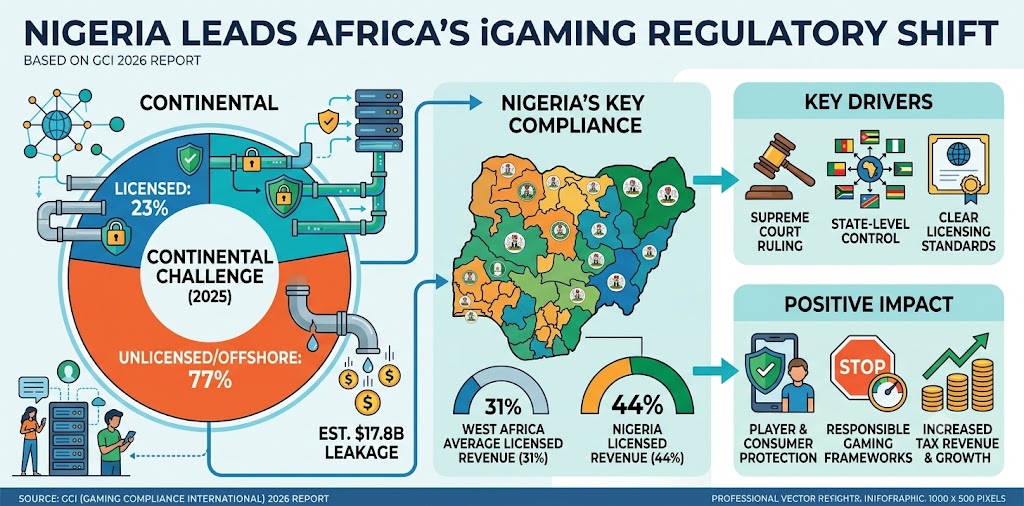
Africa’s digital betting ecosystem is expanding rapidly, generating $23 billion in Gross Gaming Revenue (GGR) in 2025. Yet, an overwhelming 77% of that capital flows directly into unlicensed, offshore platforms. Within this complex environment, one market is structurally curbing illegal operations: Nigeria.
According to a July 2026 assessment by Gaming Compliance International (GCI)—the first exhaustive review of all 54 African nations—Nigeria now holds the lowest unregulated market share in West Africa. By capturing 44% of its domestic revenue through licensed channels, the country significantly outperforms both the West African average (31%) and the broader continental baseline (23%).
Analyzing the $23 Billion Continental Divide
The gap between licensed consumer protection and the black market remains vast. Out of the $23 billion generated across Africa last year, licensed operators processed only $5.2 billion. The remaining $17.8 billion bypassed local taxation and player-safety frameworks entirely.
In West Africa specifically, total online gambling revenue climbed from $4.3 billion in 2024 to $4.8 billion in 2025. While unlicensed platforms siphoned away $3.3 billion, the region is beginning to show pockets of regulatory resilience. Nigeria’s 56% unregulated rate may still indicate a developing framework, but it represents a massive compliance victory when compared to neighboring jurisdictions. This tightening grip on licensed play naturally pushes operators to adopt responsible gaming tools, ensuring stricter age verification and setting hard limits on player exposure.
State-Level Control Drives Market Compliance
Why is Nigeria outpacing the rest of the continent? The answer lies in a fundamental legal restructuring. In November 2024, a landmark Supreme Court decision invalidated the National Lottery Act, shifting regulatory authority from the federal government directly to individual state legislative assemblies.
Initially, industry observers feared this fragmentation would stall investment. Instead, state-level oversight has catalyzed localized enforcement and clearer licensing protocols. Operators are now forced to engage directly with regional boards, weeding out bad actors who previously hid behind federal bureaucratic delays.
The Cross-Border Digital Dilemma
Despite these enforcement gains, the borderless nature of iGaming presents ongoing jurisdictional friction. Adewumi Salami of DLA Piper Africa recently highlighted this structural hurdle.
“The constitutional position of online and cross-border gaming where a player in Kano accesses a platform licensed in Lagos remains an area of legal nuance,” Salami noted.
Because each state claims jurisdiction over its own residents, operators seeking nationwide reach face immense compliance complexity. Collaborative frameworks like the Federation of State Gaming Regulators of Nigeria (FSGRN) are currently attempting to build pragmatic, multi-state licensing solutions, though these guidelines still lack the force of statutory law in non-member states.
What the 2026 Data Means for the Industry
Consumer participation is scaling aggressively. Across Africa, 215 million people engaged in online gambling in 2025—up from 198 million the year prior. As this user base expands to encompass 14% of the continent’s population, the transition from underground platforms to regulated environments is no longer just a revenue debate; it is a critical consumer protection mandate.
Nigeria’s approach demonstrates that rigorous, localized licensing can effectively claw back market share from illicit networks. For operators, the path forward requires heavy investment in state-by-state legal compliance. For policymakers across the continent, Nigeria serves as the primary working model for modernizing a multi-billion-dollar digital economy.
Sources Quoted:
Vanguard News (July 2026 reporting), Gaming Compliance International (GCI 2026 Report), iGaming Business (iGB), and Adewumi Salami (DLA Piper Africa).
Max Newman is Deputy Editor and Data Strategy at Virlan.