
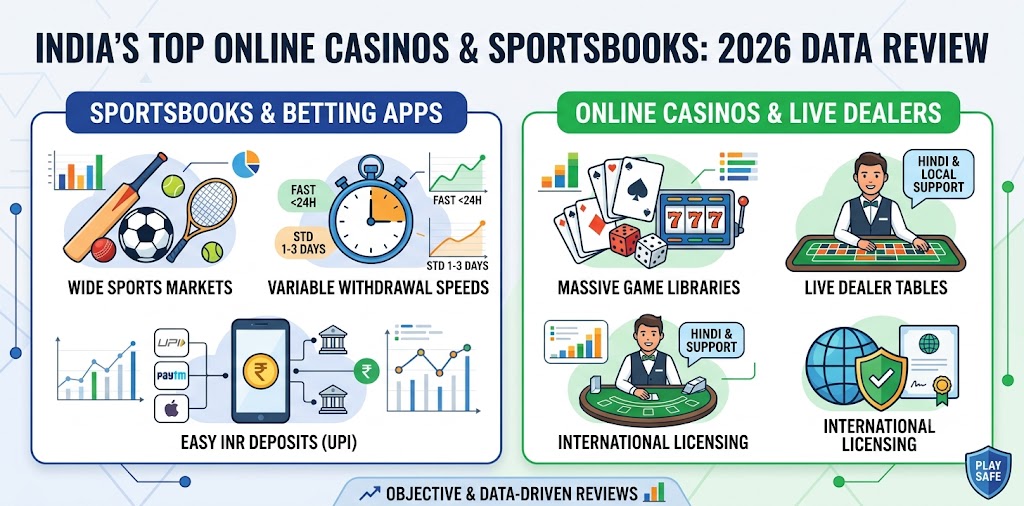
Auditing India’s Top 20 Online Casinos and Sportsbooks
Offshore betting platforms operate in a complex grey market within India, necessitating rigorous evaluation of their operational mechanics, licensing, and financial infrastructure. Current July 2026 data from industry aggregators—including GamesHub, LiveScore, and Sports Betting Online (SBO)—reveals a heavily bifurcated market. Platforms generally specialize in either massive digital slot libraries or high-frequency sportsbook applications.
Participating in these offshore markets carries inherent financial risks. Because these entities operate outside domestic Indian jurisdiction, players lack local legal recourse. Operational terms are notoriously strict. As noted by GamesHub, promotional bonuses carry severe limitations; utilizing multiple bonuses simultaneously often results in casinos immediately voiding all associated winnings.
Below is the verified operational data for the 20 platforms dominating the Indian digital gaming sector.
High-Liquidity Sports Betting Sites and Mobile Apps
- Dafabet: Analyzed by LiveScore as an effective hybrid platform, Dafabet holds a Curaçao Gaming Authority license. It requires a 300 INR minimum deposit and supports 30 distinct sports markets. Withdrawal clearing takes between 24 hours and three days using traditional bank rails or cryptocurrency.
- Parimatch: Operating with a 500 INR entry threshold, this sportsbook covers 24 markets. LiveScore data logs a 72-hour withdrawal window, noting the platform relies heavily on localized fintech solutions like UPI, Paytm, and PhonePe.
- BC.Game: Bypassing fiat banking entirely, this decentralized operator accepts over 40 cryptocurrency tokens, including Bitcoin and Dogecoin. It provides access to 46 sports markets and maintains the fastest audited withdrawal speed at just 5 to 10 minutes.
- Melbet: Featuring a highly rated dedicated mobile application, Melbet requires a 500 INR deposit to access its 49 sports markets. Standard fiat withdrawals take 72 hours.
- Mostbet: Positioned for high-speed in-play wagering, this operator supports 38 sports markets with a 500 INR baseline deposit.
- Rajabets: Regulated in Curaçao, this platform is explicitly tailored for domestic bettors. It offers rapid local payment integrations and places a heavy structural emphasis on localized cricket odds.
- BetWinner: Evaluated by industry analysts specifically for its expansive coverage depth across domestic and international cricket fixtures.
- Roobet: Recognized primarily for maintaining high-yield odds pricing across its sportsbook offerings.
- 20Bet: Identified by LiveScore as the optimal architecture for bettors managing multi-sport portfolios.
- Bet365: A dominant global entity, reviewed by Transfermarkt for delivering a premium mobile application that integrates live sports streaming capabilities directly into the betting interface.
- 1win: Highlighted as the “App of the Week” by Transfermarkt, 1win deploys a fast-loading mobile application engineered to minimize latency during live, in-play sports betting.
High-Volume Slot Machine Sites and Live Dealer Casinos
- 12bet.com: Operating since 2007 under an Isle of Man Gambling Supervision Commission license, this platform earned a flawless 10.0 rating from GamesHub. It hosts over 1,200 games, allows UPI deposits starting at ₹300, and focuses heavily on continuous, non-scheduled live dealer streams from developers like Evolution and Ezugi.
- 1xbet: Built for sheer scale, this platform holds a staggering catalog of over 8,000 games sourced from more than 100 software providers. It operates via a Curaçao license, integrates 40+ payment methods, and secured a 9.9 expert rating.
- 22bet: Scoring a 9.8 from GamesHub, this casino reduces onboarding friction by offering a low ₹80 minimum deposit and free demo modes across its 1,100-game library.
- 4rabet: Designed for high-frequency slot players, the platform manages a focused library of 3,900 video slots sourced from top-tier developers.
- betvibe: Earning a 9.5 rating, this operator leans heavily into regional localization. It hosts 5,200 casino games and staffs its live tables prominently with Hindi-speaking dealers.
- 1xcasino: Rated 9.4, this site differentiates itself by digitizing rare, regional games like Jhandi Munda alongside standard live tables.
- crorebet: Scoring 9.6, industry reviews highlight its optimized financial routing, explicitly noting fast UPI deposits and rapid payout execution through the IMPS banking network.
Emerging Alternative Bookmakers
- Betwhale: Evaluated by SBO, this platform clears financial payouts within 0 to 24 hours. It sustains operations by supporting alternative transaction rails like Flexepin, Litecoin, and Tether.
- BetOnline: Operating since 1991, this veteran offshore platform bundles sports betting, casino games, and poker. It secures 0-24 hour payout speeds by processing transactions via Bitcoin, Skrill, and traditional wire transfers.
The Great Gaming Reset: India’s 2026 Prohibition on Real-Money Play
The Indian digital gaming landscape fractured into two entirely distinct realities on May 1, 2026.
Following the enforcement of the Promotion and Regulation of Online Gaming (PROG) Act 2025 and its accompanying procedural rules, the Central Government executed a sweeping federal prohibition on real-money iGaming. Prior to this legislation, the domestic real-money skill gaming industry was a juggernaut. Data published by the International Masters of Gaming Law (IMGL) reveals the sector boasted over 90 million paying users and a valuation of $3.7 billion in 2024, with industry projections initially targeting $9.1 billion by 2029.
Those projections have been structurally dismantled. Today, operators, regulators, and consumers are navigating a severely disrupted market where domestic compliance means abandoning real money, while offshore entities attempt to absorb the displaced demand.
The Reality of “Top 20” Online Casinos and Sports Books in India
Despite the domestic ban, consumer search intent for the “top 20 online casinos and sports books” in India remains intensely high. However, because domestic companies face criminalization for offering wagers, international grey-market operators have rushed into the vacuum.
A July 2026 market analysis by LiveScore and Sports Betting Online (SBO) highlights that offshore platforms—ranging from traditional Eastern European bookmakers like Parimatch and 1xBet to crypto-centric operations like Leon Bet—continue to aggressively target Indian bettors. These platforms sustain their operations by circumventing traditional banking blockades. According to SBO, they rely heavily on localized fintech applications like UPI and Paytm to bundle transactions, alongside decentralized cryptocurrencies like Bitcoin, Tether, and Ethereum for anonymous, instant liquidity.
This creates a critical legal friction point: while the platforms operate offshore, the players themselves reside in a jurisdiction where online money games are prohibited.
Classifying Bingo and Slot Machine Sites Under the PROG Act
The 2026 regulatory framework removes all previous legal ambiguity regarding digital games of chance. The PROG Act established the Online Gaming Authority (OGAI), a central regulator tasked with administering an objective, 90-day test to classify digital products.
The mandate is remarkably strict. Under the new law, any application where users pay fees or stakes with a reasonable expectation of monetary gains is definitively designated as an “online money game” and banned. This explicitly captures all online bingo and slot machine sites or apps.
The penalties for domestic service providers offering these games are draconian. The IMGL reports that the Act imposes penalties of up to three years of imprisonment and fines reaching INR 1 crore (approximately $113,000). Additionally, the legislation targets the financial infrastructure itself, seeking to prevent regulated payment systems and financial institutions from processing any transactions linked to these blacklisted online money games.
The Public Health Catalyst Behind the Crackdown
The shift from a fragmented, state-by-state regulatory approach to a sweeping federal prohibition was driven by stark consumer protection data. According to iGaming Business, Indian lawmakers enacted the ban after data estimated that a third of the nation’s population had lost a staggering $2.3 billion annually on digital wagers.
The IMGL further noted that the legislation was explicitly drafted to protect public health. The government aimed to shield economically disadvantaged demographics from addictive game designs, combat serious financial crimes like money laundering, and shut down aggressive influencer marketing campaigns that had normalized real-money betting to minors.
The Industry Pivot: From Online Sports Betting to Freemium E-Sports
Faced with the criminalization of their core revenue models, major domestic operators abandoned real-money online sports betting within weeks of the Act’s introduction.
However, the PROG Act provides a heavily guarded lifeline. It legally recognizes and regulates the e-sports and social games industries. By aligning with the National Sports Governance Act 2025, digital platforms can operate legally—provided they register with the OGAI and completely strip away any mechanics resembling bets, wagers, or real-money payouts. This mandate has forced former gambling titans to pivot entirely to free-to-play and freemium models.
The resulting market is a bifurcated ecosystem. Fully legal, domestic innovation is now strictly confined to zero-stakes social gaming and e-sports. Meanwhile, the immense consumer demand for real-money action has not disappeared; it has simply migrated to a high-risk offshore economy, insulated by cryptocurrency and operating beyond the immediate reach of India’s new Online Gaming Authority.
Sources Quoted:
Data and regulatory insights were extracted from primary industry reporting by iGaming Business (May 2026), legal analysis by the International Masters of Gaming Law (IMGL), and offshore market data from LiveScore and Sports Betting Online (SBO) (July 2026).
Data regarding operator features, licensing, and payment infrastructure was extracted directly from live aggregator platforms GamesHub, LiveScore, Sports Betting Online (SBO), and Transfermarkt.
Leo Falsafi is a digital marketing veteran and senior journalist at Virlan.co, where he covers the intersection of digital marketing, gaming, and breaking US trending news. With nearly two decades of hands-on experience in SEO and digital strategy, Leo has consulted for and scaled hundreds of companies. His deep industry roots allow him to deliver sharp, fact-checked insights and analysis on the trends shaping today's digital landscape.