
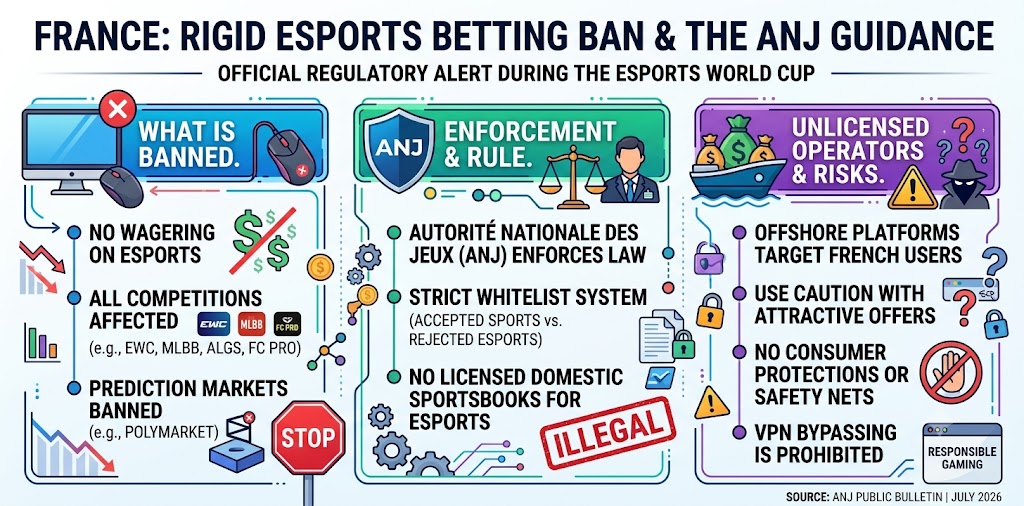
As more than 100,000 competitive gaming fans descend on Paris for the Esports World Cup, local regulators have issued a definitive warning regarding gambling. The Autorité Nationale des Jeux (ANJ), France’s chief regulatory body, has reaffirmed that placing wagers on any esports matches remains strictly illegal under national law.
Despite the tournament’s unprecedented $75 million prize pool, the ANJ’s legal framework offers no exceptions for international gaming events. Bettors accustomed to regulated markets in other jurisdictions will find zero licensed domestic sportsbooks offering lines on the Parisian showcase.
France’s Regulatory Stance on Digital Competitions
French gambling legislation operates on a rigid whitelist system. Wagering is legally permitted exclusively on formally approved sporting events, such as football, tennis, and horse racing. Because competitive video gaming has not been added to this state-approved registry, all associated betting markets are prohibited.
The ANJ clarified its position in a July 2026 public bulletin, stating verbatim: “All sites offering esports betting are illegal in France”.
This sweeping ban severely impacts the broader ecosystem surrounding the Esports World Cup, a weeks-long festival hosting major tournaments including the MLBB Mid-Season Cup, the ALGS Split Playoffs, the FC Pro 26 World Championship, and the Honor of Kings World Cup. Fans attending these LAN events cannot legally place wagers on their outcomes while operating within French borders.
The Crackdown on Offshore Platforms and Prediction Markets
The regulator’s latest intervention specifically targets the proliferation of unlicensed offshore platforms attempting to capitalize on the Paris event. Unregulated sites often target tourists and locals who use virtual private networks (VPNs) to bypass geographical blocks.
In its policy update, the ANJ condemned unauthorized operators for pushing “extremely attractive offers,” noting that these environments create “a significant risk of addiction”. Engaging with illicit offshore sportsbooks bypasses the consumer protections mandated by French law, stripping users of safety nets if a platform refuses to honor withdrawals or compromises personal data.
The regulatory sweep extends beyond traditional sportsbooks. Prediction markets, which allow users to trade event-based contracts on match results, fall under the exact same prohibition umbrella. Platforms operating on this model—such as Polymarket—are strictly barred from facilitating trades for users located in France.
The Policy Divide in Modern Entertainment
France’s refusal to legitimize esports betting during the most lucrative tournament in the industry’s history underscores a stark divide between traditional European sports governance and modern digital entertainment. The ANJ’s zero-tolerance policy prioritizes consumer protection and addiction prevention over the potential tax revenue a $75 million international tournament could generate.
For attendees and viewers, the legal reality is absolute: gambling on the 2026 Esports World Cup in France is a regulatory violation.
Sources Quoted:
Insider Gaming; BitcoinKE; official statements from the Autorité Nationale des Jeux (ANJ).
Leo Falsafi is a digital marketing veteran and senior journalist at Virlan.co, where he covers the intersection of digital marketing, gaming, and breaking US trending news. With nearly two decades of hands-on experience in SEO and digital strategy, Leo has consulted for and scaled hundreds of companies. His deep industry roots allow him to deliver sharp, fact-checked insights and analysis on the trends shaping today's digital landscape.