
The flashing lights of a casino floor and the neon glow of a sports betting app share a hidden, unyielding foundation: mathematics. While bettors rely on intuition, perceived luck, or deep sports knowledge, the house relies strictly on cold, hard probability. Understanding what odds are in gambling isn’t just about reading a payout sheet—it’s about decoding the financial and statistical machinery that guarantees the house its edge over the long term.
In this deep dive, we strip away the superstition and look at the hard data, expert insights, and mathematics behind gambling odds.
The Foundational Math: Expected Value and The House Edge
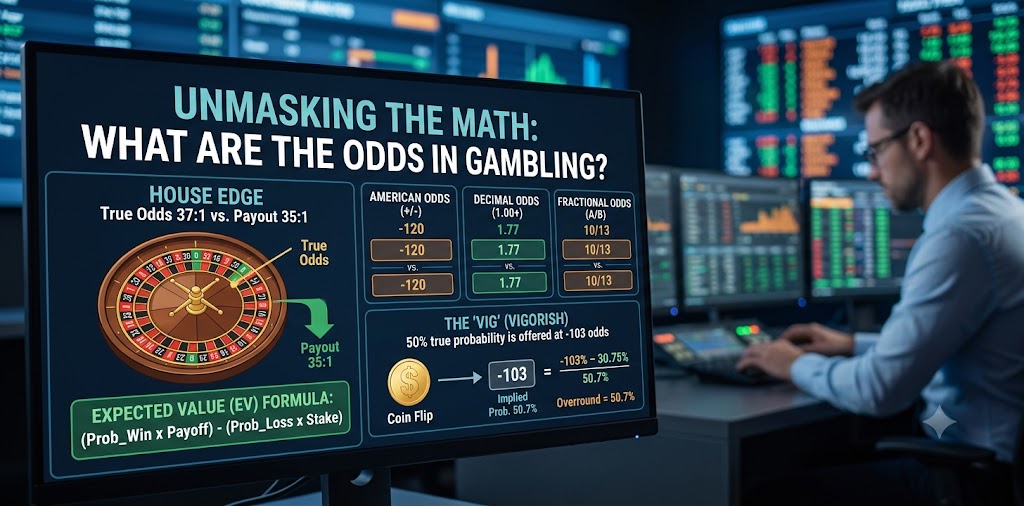
Every wager placed—whether on a spinning roulette wheel or a Sunday football game—is governed by expected value (EV). Expected value is a mathematical equation measuring the long-term profitability of a bet: (Probability of winning × Payoff) − (Probability of losing × Amount lost).
As noted by American Scientist, the house edge is simply the mathematical opposite of the expected value for all possible bets. Because statistical uncertainty is built into the games, players routinely succumb to cognitive distortions. The publication points out that mathematicians view probability through the lens of infinity: “If we roll the die infinitely many times, the relative frequency of the number one will converge to one in six.” Bettors, however, operate in finite experiences. This discrepancy spawns the “gambler’s fallacy”—the mistaken, dangerous belief that a losing streak must mathematically be followed by a win to restore randomness.
The Three Universal Formats of Betting Odds
Depending on where you stand in the world, odds are presented in completely different visual formats. However, they all serve the exact same dual functions: calculating your potential payout and signaling the “implied probability” of an outcome.
Here are the core formats you will encounter:
- American Odds (+ and -): This format is centered around a $100 baseline. A negative number (e.g., -120) indicates the favorite, showing exactly how much you must wager to win $100. A positive number (e.g., +120) designates the underdog, showing how much you will win if you wager $100.
- Decimal Odds (European): Highly popular overseas, this format includes your initial stake directly in the return multiplier. A 3.00 decimal odd means a $10 bet yields $30 total ($20 profit plus the original $10 stake).
- Fractional Odds (British): Represented as a ratio of profit to your stake. If a fighter is given 4/1 odds, the bettor wins $4 for every $1 wagered. Conversely, a heavy favorite at 1/4 means you must bet $4 just to win $1.
The Invisible Tax: The Vig and Implied Probability
You cannot fundamentally understand betting odds without understanding the “vig” (vigorish) or “juice.” Sportsbooks do not offer true mathematical odds; they bake a permanent commission into the lines.
Take a standard Super Bowl coin flip. Mathematically, a coin flip has a 50% true probability (true odds of +100). However, sportsbooks will often offer the coin flip at -105 or -103. If you bet $100 on a -103 line, you only receive $97.09 in profit. That missing margin is the invisible tax that keeps the industry afloat.
This manipulation dramatically alters a bettor’s mathematical break-even point. According to calculations by Sports Betting Online, standard American spread odds of -110 dictate that bettors must win not 50% of the time, but exactly 52.38% of their wagers just to break even and overcome the juice.
Why do sportsbooks alter the true odds? As highlighted by Sports Betting Dime, “Odds are influenced by more than the factors actually relevant to the outcome of the event.” Bookmakers shift lines to incentivize balanced action on both sides of a wager, locking in their profit regardless of who wins the game. A peer-reviewed statistical analysis published via the National Center for Biotechnology Information (PMC) validates this high-level control, finding that the point spreads and totals proposed by sportsbooks correctly capture 86% and 79% of the variability in a game’s median outcome, respectively. By setting these hyper-accurate lines, sportsbooks secure an average 4.5% commission on betting volume.
How do I convert American odds to implied probability?
To convert negative American odds (the favorite) to a percentage, use this formula: Negative Odds / (Negative Odds + 100). For a -130 favorite, the math is 130 / (130 + 100) = 56.5% implied probability. For positive odds (the underdog), the formula is 100 / (Positive Odds + 100).
What is the “near-miss effect” in gambling?
The “near-miss effect” is a cognitive trap where an outcome differs just slightly from a jackpot or winning bet. As psychological studies point out, it tricks the gambler’s brain into believing they were “so close,” biologically incentivizing them to place another bet—even though the mathematical probability of winning the next round remains completely unchanged.
Sources Quoted: Data, mathematical formulas, and expert context were sourced directly from American Scientist, Sports Betting Online, Sports Betting Dime, and statistical research published via the National Center for Biotechnology Information (PMC).
Leo Falsafi is a digital marketing veteran and senior journalist at Virlan.co, where he covers the intersection of digital marketing, gaming, and breaking US trending news. With nearly two decades of hands-on experience in SEO and digital strategy, Leo has consulted for and scaled hundreds of companies. His deep industry roots allow him to deliver sharp, fact-checked insights and analysis on the trends shaping today's digital landscape.