
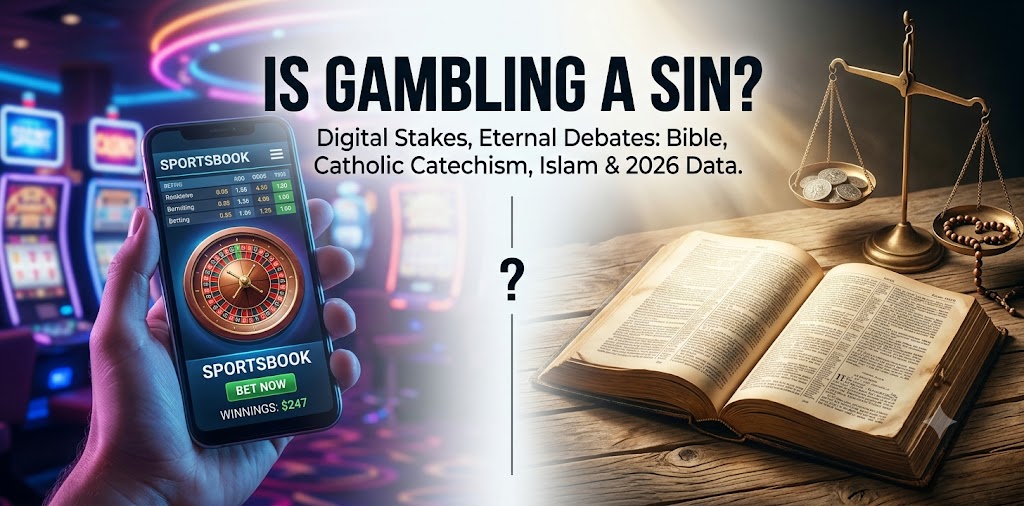
As mobile sports betting turns virtually every smartphone into a 24/7 digital casino, an ancient, deeply human question has surged back into public discourse: Is gambling a sin?
The answer depends entirely on where you look. While some faith traditions issue blanket bans on games of chance, others adopt a highly nuanced approach that weighs a bettor’s internal motivations against their external responsibilities. To understand the modern morality of wagering, we must look beyond personal opinion and examine the explicit texts of world religions, historical theology, and the latest global data on moral attitudes.
The Modern Moral Shift: By the Numbers
Before diving into ancient scripture, it is crucial to understand how modern believers view the issue. According to a sweeping 2025–2026 survey by the Pew Research Center, the global moral consensus on gambling is sharply divided by geography and faith.
- The Global Stance: In many nations, gambling is overwhelmingly viewed as immoral. An astonishing 89% of adults in Indonesia, 83% in India, and 71% in Italy view gambling as morally wrong.
- The American Exception: The United States stands as a global outlier. Only 29% of U.S. adults consider gambling morally wrong (though this is a slight increase from 24% in 2013). In fact, half of all Americans explicitly state that gambling is simply not a moral issue.
- The Demographic and Religious Divide: Within the U.S., Christians (33%) are more likely to view gambling as a sin compared to Jewish Americans (25%) and the religiously unaffiliated (19%). Frequency of prayer also correlates with moral objection; 37% of Americans who pray daily object to gambling on moral grounds, compared to just 23% of those who pray less often.
What Does the Bible Say About Gambling?
If you are scanning the scriptures for the specific word “gambling,” you will be looking for a long time. The exact term does not appear anywhere in the Bible. However, the absence of the word does not mean the text is silent on the behavior.
In biblical times, the closest equivalent to modern gambling was the practice of “casting lots.” This method was sometimes used to determine God’s will—such as in Acts 1:26 when replacing Judas—but it was also used maliciously, most notably when Roman soldiers cast lots for Jesus’ clothing at the foot of the cross (Matthew 27:35).
Because the Bible lacks a definitive “thou shalt not gamble” commandment, Christian theology evaluates gambling through the lens of secondary biblical principles:
- The Danger of Greed: Pastor Ed Young notes that while gambling itself isn’t explicitly named, the Bible heavily addresses the human heart’s capacity for covetousness. “Gambling doesn’t cause greed. But gambling is one of the most effective delivery systems for it,” Young explains. Scripture routinely warns against the obsessive pursuit of wealth, most famously in 1 Timothy 6:10: “For the love of money is the root of all kinds of evil.”
- The Principle of Stewardship: Christian doctrine teaches that humans are managers, not owners, of the resources God provides. Proverbs 13:11 warns against “get-rich-quick” schemes, stating: “Wealth gained hastily will dwindle, but whoever gathers little by little will increase it.” Risking necessary family funds on a game of chance is viewed as a failure of this stewardship.
- The Exploitation of Others: Some theologians argue that because gambling mathematically requires the financial loss of many to reward a single winner, it inherently preys on the misfortune and false hopes of others.
The Catholic Perspective: Moderation vs. Exploitation
The Catholic Church provides one of the most explicitly defined theological frameworks regarding gambling. Rather than condemning it outright, the Church views gambling through the metric of responsibility.
According to Paragraph 2413 of the Catechism of the Catholic Church:
“Games of chance (card games, etc.) or wagers are not in themselves contrary to justice. They become morally unacceptable when they deprive someone of what is necessary to provide for his needs and those of others. The passion for gambling risks becoming an enslavement.”
The morality of a wager, therefore, hinges on moderation and intention. Father Dan Kavanagh, speaking to the St. Louis Review, summarized the Catholic stance by noting that gambling is acceptable as a form of entertainment—provided it does not cause harm. However, it crosses into sinful territory when it becomes an idol, leads to addiction, or forces a person to neglect their duties to God and their family.
How Other World Religions View Gambling
Beyond Christianity, the world’s major faiths offer a spectrum of directives regarding games of chance, ranging from strict prohibition to philosophical warnings.
- Islam: Islamic doctrine is the most uncompromising on the subject. Gambling is explicitly forbidden (haram). The Qur’an (Surah Al-Ma’idah 5:90) categorizes gambling alongside intoxicants, calling them a “defilement from the work of Satan” and warning believers to avoid them entirely to achieve success. Because gambling relies on uncertainty and unearned gains at another’s expense, even small-stakes betting is prohibited.
- Judaism: While the Torah does not explicitly ban gambling, rabbinic tradition is highly skeptical of it. The Talmud (Sanhedrin 24b) famously disqualifies professional gamblers from serving as legal witnesses, viewing them as individuals who do not contribute productively to society. However, casual or recreational gambling is often treated with more leniency in modern Jewish communities, provided it does not become exploitative.
- Hinduism: Hindu texts offer dire cautionary tales rather than universal bans. In the epic Mahabharata, a disastrous dice game leads to the protagonist gambling away his kingdom and family, sparking a devastating war. The Rig Veda also features the “Gambler’s Lament,” which vividly warns against the ruinous and addictive nature of dice.
- Buddhism: Buddhist teachings evaluate gambling through the framework of attachment and suffering. The Sigalovada Sutta explicitly lists gambling as an activity that leads to the “loss of wealth,” credibility, and friendships. Because it feeds craving (tanha), it is considered spiritually counterproductive.
Is sports betting considered a sin?
There is no universal consensus. In Islam, all sports betting is considered a sin (haram). In Catholicism and many Protestant denominations, casual sports betting is not inherently sinful unless it involves money needed for family survival, leads to addiction, or compromises the integrity of the sport. The moral line is crossed when a casual wager turns into an obsessive love of money.
Can you be a Christian and go to a casino?
Yes, most Christian denominations do not forbid simply entering a casino. The Catholic Church and many Protestant groups view recreational gambling with discretionary income as morally permissible. However, Christians are urged to examine their motives, ensure they are not acting out of greed, and avoid environments that might trigger a personal addiction or cause another believer to stumble in their faith.
Sources Quoted: Pew Research Center (2025–2026 global attitudes survey); The Holy Bible (1 Timothy 6:10, Proverbs 13:11, Matthew 27:35); The Catechism of the Catholic Church (§2413); The Qur’an (Surah Al-Ma’idah 5:90); The Talmud (Sanhedrin 24b); Pastor Ed Young; Father Dan Kavanagh via the St. Louis Review; Universal Life Church Monastery theological summaries.
Leo Falsafi is a digital marketing veteran and senior journalist at Virlan.co, where he covers the intersection of digital marketing, gaming, and breaking US trending news. With nearly two decades of hands-on experience in SEO and digital strategy, Leo has consulted for and scaled hundreds of companies. His deep industry roots allow him to deliver sharp, fact-checked insights and analysis on the trends shaping today's digital landscape.