
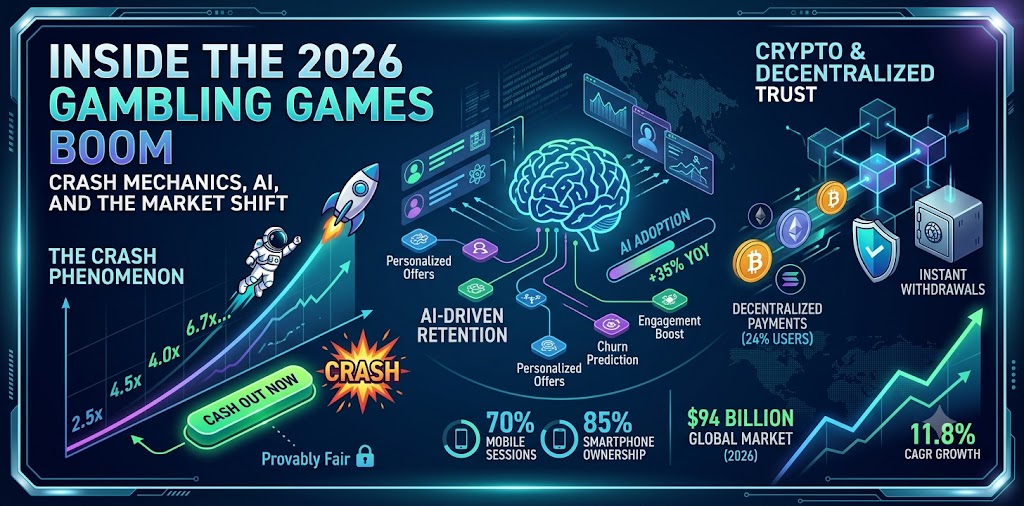
The online gambling ecosystem is no longer a peripheral digital entertainment sector. It is a macroeconomic juggernaut. As we move through 2026, the data points to a paradigm shift in how users interact with digital casinos, sportsbooks, and high-frequency betting platforms. Driven by frictionless mobile infrastructure and artificial intelligence, the global online gambling market is currently valued between $54.03 billion and $94.78 billion (depending on strict sector segmentation), with aggressive projections rocketing toward the $220 billion mark by 2034.
But looking strictly at the fiscal valuations misses the real story unfolding on the screens of over 426 million active users globally. The mechanics of “gambling games” have fundamentally mutated. We are witnessing the convergence of cryptocurrency, decentralized trust mechanisms, and radically simplified gaming loops that cater directly to a mobile-first generation.
The Anatomy of the 2026 Gambling Market
To understand the current state of digital betting, you have to look at the hardware in the user’s hand and the software predicting their next move. The desktop era of online casinos has formally ceded its crown. Today, more than 70% of all gambling sessions globally occur on mobile devices, supported by a staggering 85% smartphone ownership rate among active gamblers.
This mobile migration has forced operators to rebuild their infrastructure, leaning heavily into machine learning. Market reports from early 2026 reveal that AI adoption among operators has increased by 35% year-over-year.
Key Market Takeaways (2026):
- The Slot Monopoly: Traditional interactive digital casino formats still hold immense weight. Slot-based games dominate the sector, capturing nearly 55% of the usage share among pure casino games.
- The Live Dealer Surge: Bridging the gap between the physical and the digital, live dealer gaming now accounts for 28% of all casino sessions.
- Crypto’s Deep Integration: Decentralized finance is heavily embedded in the gambling sector. Approximately 24% of online gamblers now use cryptocurrency for deposits, fueling the rise of no-KYC (Know Your Customer) casino environments.
- Algorithmic Retention: Platforms deploying AI-powered personalization and machine learning models are seeing user retention increase by 23%.
The “Crash Game” Phenomenon
If there is a defining trend in 2026 gambling games, it is the absolute explosion of the “Crash” genre. Titles like Aviator (by Spribe), JetX (by SmartSoft Gaming), and Spaceman (by Pragmatic Play) have effectively bridged the psychological gap between traditional casino gaming and high-frequency crypto trading.
The mechanics are almost dangerously simple. A digital entity (a plane, a jet, a spaceman) launches, and a multiplier begins climbing from 1.00x upwards. The player must cash out before the entity “crashes.” Wait too long, and the bet is lost; cash out too early, and you leave money on the table.
These games are dominating the 2026 landscape for two specific reasons. First, they boast highly attractive Return to Player (RTP) rates, typically hovering between 97% and 99%—some of the most competitive margins in the industry. Second, they operate on “provably fair” cryptographic algorithms. Players do not have to blindly trust a centralized server; they can independently verify the hash of every single round to ensure the casino did not manipulate the crash point.
Market Dynamics Explained
Why are crypto and crash gambling games so popular in 2026?
The appeal lies in transparency and speed. Crash games offer instant, fast-paced rounds that perfectly suit mobile play. Furthermore, their integration with cryptocurrency allows for instant deposits and near-instant withdrawals. The “provably fair” blockchain technology behind these games gives a digitally native demographic (millennials currently make up 42% of online gamblers) a verifiable sense of trust that traditional slot algorithms lack.
How are regulators responding to the growth of online gambling games?
The regulatory landscape remains highly fractured. While regions like Europe push forward with strict licensing frameworks (such as Finland’s transition to a competitive licensing system by 2027), approximately 42% of countries globally still impose severe restrictions on online betting. Operators are responding with aggressive compliance technology; age-verification systems currently see a 6% average rejection rate globally, and responsible gaming exclusions actively account for nearly 4% of active platform accounts.
The Strategic Horizon
The traditional casino floor has been digitized, decentralized, and injected with artificial intelligence. As 5G connectivity reduces live-betting latency to under 100 milliseconds and AI chatboxes handle real-time customer friction, the barrier to entry for new players has never been lower. Operators who fail to integrate provably fair mechanics, instant crypto settlements, and mobile-first crash games are rapidly bleeding market share to offshore and crypto-native platforms. The 2026 gambling games market is ruthless, highly optimized, and expanding at a compound annual growth rate of 11.8%. The house always wins—but the architecture of the house has entirely changed.
Sources Quoted: Market sizing, demographic data, and product trend analysis were extracted from Business Research Insights, Straits Research, Global Market Insights, Gitnux, Somuchpoker, PokerNews, and Card Player.
Leo Falsafi is a digital marketing veteran and senior journalist at Virlan.co, where he covers the intersection of digital marketing, gaming, and breaking US trending news. With nearly two decades of hands-on experience in SEO and digital strategy, Leo has consulted for and scaled hundreds of companies. His deep industry roots allow him to deliver sharp, fact-checked insights and analysis on the trends shaping today's digital landscape.