

“How can I get featured on Forbes?” – this is one of the first questions people ask. With more than 150 million monthly readers and over a century of brand authority, Forbes is still one of the most powerful business media names you can be associated with. For founders, executives, and visa applicants, a single Forbes article creates a permanent credibility asset that drives trust across every customer and investor touchpoint.
What Are the Benefits for Corporate and Personal Branding?
Before we get to the hard stuff, let’s first recapitulate why you should want to get a feature in the first place:
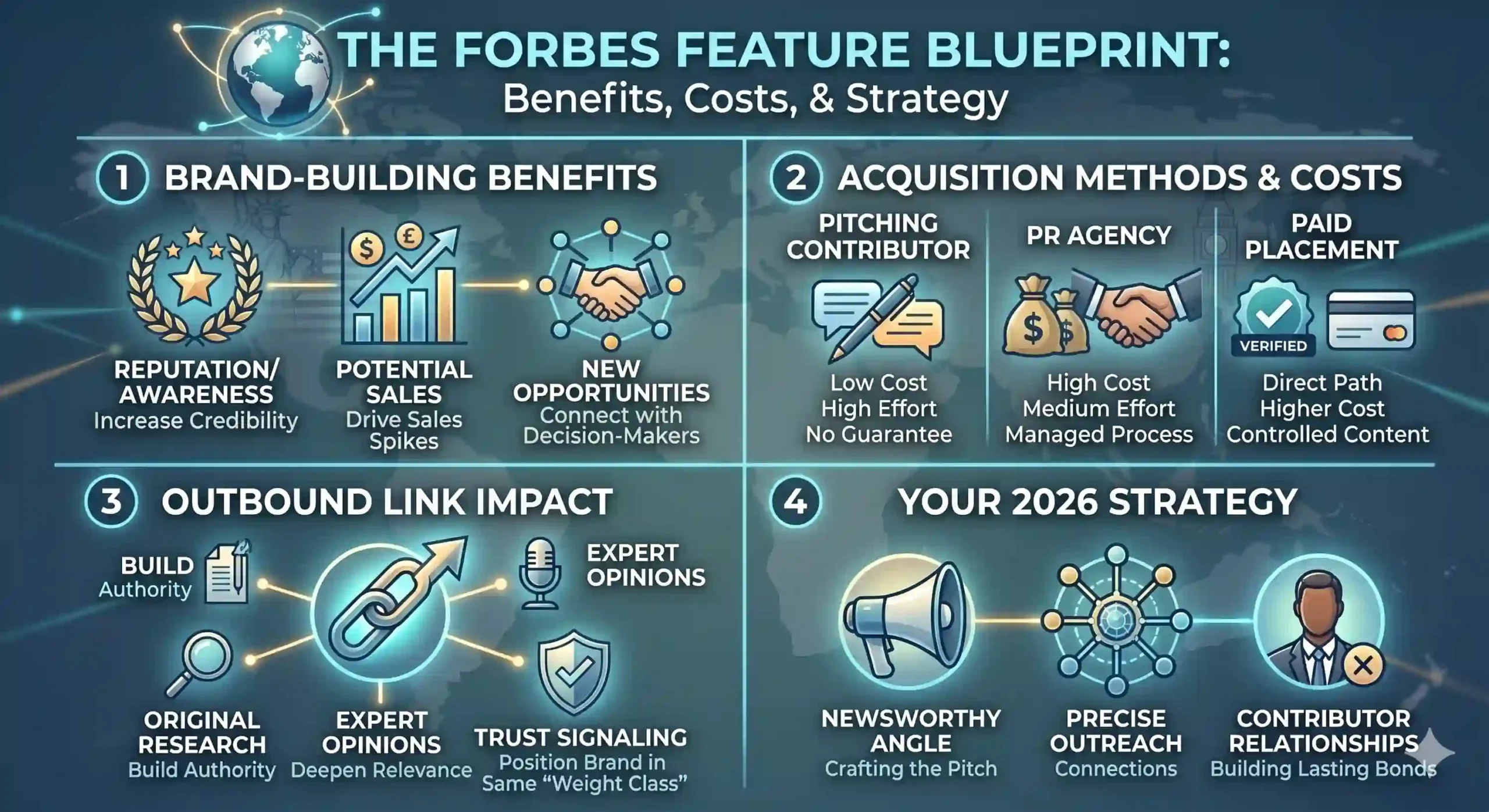
- Reputation & Brand Awareness: Thanks to globalization and popular culture, almost every person on earth seems to have heard of the prestigious Forbes Magazine. Therefore, a company portrait or even a small feature can greatly impact your perceived value.
- Potential Sales: While a small mention most probably isn’t going to make a massive difference to your sales, we did have many clients that saw huge spikes in sales after their product or company was spotlighted in a Forbes article. Especially in the premium sector, the potential can be significant. Typically, these successes come in the form of list articles or product and service reviews.
- New Opportunities: Due to its enormous popularity among business folks, Forbes is a daily read for many important decision-makers, such as C-level executives, investors, entrepreneurs, influencers, and more. A survey found that 84% of entrepreneurs and executives who secured a Forbes feature reported a significant increase in their credibility and business growth.
How Are the Cost Limits Determined?
Not all “Forbes Placements” are equal. There are four completely different ways your name can appear on Forbes. Only one of them carries real credibility. Here’s what you need to know before paying anyone:
- Forbes BrandVoice: A paid advertorial product. Your company pays Forbes directly to publish content labelled “BrandVoice.” Google treats it as sponsored content.
- Forbes Councils: A paid membership program. You pay ~$2,500/year for the right to submit articles that may or may not be published. Articles are labelled as council contributions.
- Contributor Articles: Unpaid editorial written by Forbes contributors. You pitch to a contributor who may or may not write about you. No payment, no guarantee, no timeline. Success rate is very low for unknown brands.
- Genuine Editorial Placement: A real editorial article on a Forbes network site, written by a journalist, with no “paid” or “sponsored” label. It appears in Google search results for your company or brand name.
The long answer is that you most likely have to decide between investing a lot of time or a decent amount of money. Here are different approaches and the price tags that come along with them:
- Solo: In most cases, you invest serious time yourself (20–50 hours).
- In-house team or freelancers: PR freelancers on Upwork can cost upwards of $100/hour in 2026.
- PR Agency: Since a PR agency ideally employs genuine professionals, they can usually deliver a nice feature in only a few weeks. Many agencies charge as much as $15,000 for a single feature, and usually around $5,000 for a brand mention as of 2026.
- Guaranteed Placement Services: Pricing models range from the “Rankings” discoverability edition at $1,500 – $3,000 USD / month, up to Custom enterprise pricing of $10,000 & Up for publications like TechCrunch, USA Today, TIME, and the Wall Street Journal.
Also read: The 2026 Guide to Hiring & Partnering with Elite SEO Writers for High-Stakes Niches
The SEO Impact of Outbound Links on High-Authority Sites
When published on these reputable sites, the backlink carries a domain authority of 94, making it one of the strongest SEO assets available. But what is the impact of placing outbound external links in this kind of article writing?
External links are easily one of the most overlooked SEO elements. They’re also one of the most misunderstood. When used strategically, outbound links can build authority, deepen topical relevance, and enhance the user experience. They signal trust to both search engines and readers, especially when you’re citing original research, expert opinions, or authoritative sources.
Outbound links signal what your content is about and who you trust in your field. By consistently linking to sources with equal or greater perceived authority, you position your brand in the same “weight class.” Over time, readers begin to associate your name with the same level of credibility and reliability as the sources you cite.
In short: If you want to get featured on Forbes in 2026, you need a newsworthy angle, precise outreach, and – ideally – relationships with the right Forbes contributors.
Also read:
- What is GEO? The Ultimate Guide to Generative Engine Optimization vs. SEO
- AI-Powered Content Writing and SEO in Google’s AI Mode Surge as Publishers Rush to Adapt
- The Best Local SEO Services & Companies Reviewed for 2026
- The Ultimate Guide to the Top SEO, AEO, and GEO Conferences in 2026-2027
- Best AI SEO Tools in 2026: Tested & Reviewed for Maximum Search Visibility
Leo Falsafi is a digital marketing veteran and senior journalist at Virlan.co, where he covers the intersection of digital marketing, gaming, and breaking US trending news. With nearly two decades of hands-on experience in SEO and digital strategy, Leo has consulted for and scaled hundreds of companies. His deep industry roots allow him to deliver sharp, fact-checked insights and analysis on the trends shaping today's digital landscape.