
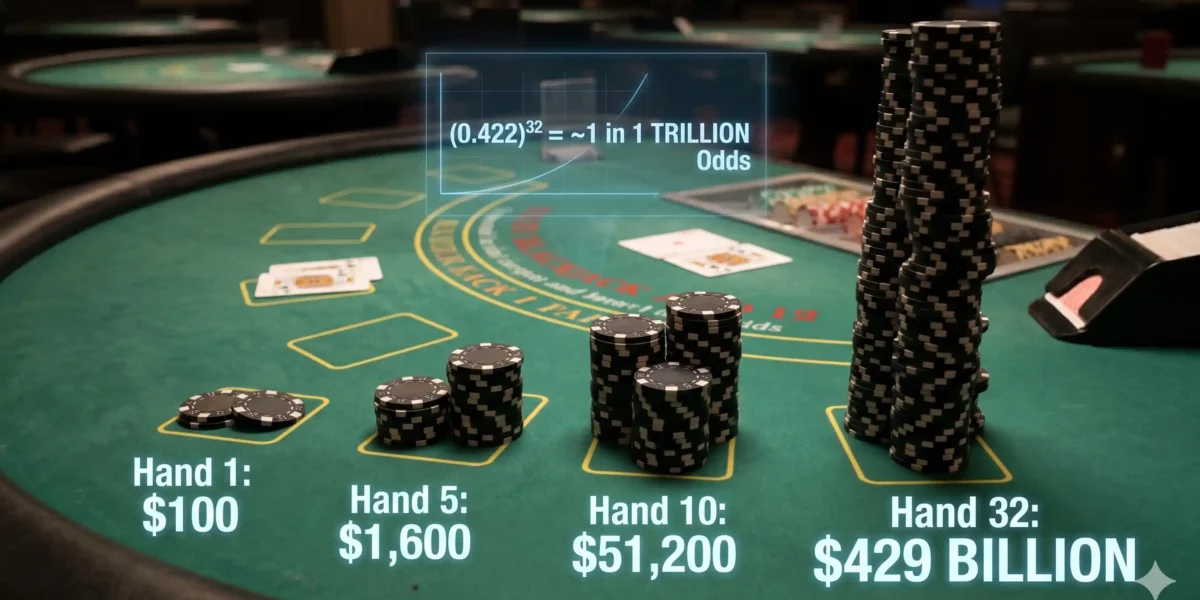
What happens if you double your bet 32 times in blackjack? Explore the one-in-a-trillion math behind the ultimate casino fantasy.
The Trillion-to-One Gamble: What Are the Actual Odds of Winning 32 Hands of Blackjack in a Row?
A viral post on the Reddit community r/theydidthemath recently captured the imaginations of hopeful gamblers and math geeks alike. The question was straightforward but conceptually staggering: “What are the actual odds of winning 32 hands of blackjack in a row?”
The core of the problem posed by the Reddit user is deeply rooted in exponential growth and the fantasy of turning a tiny sum into world-ruling wealth. The logic goes something like this: if you sit at a blackjack table with just $100 and win a hand, you double your money. If you can simply let your winnings ride—betting everything you just won on the next hand—and do this 32 times in a row, you would amass over $429 billion. This theoretical fortune rivals the net worth of some of the richest people on the planet, such as Elon Musk.
But is this actually possible? Could someone simply walk into a casino and walk out a multi-billionaire after a few hours of incredibly lucky cards? The Reddit community quickly got to work, crunching the numbers and bringing reality crashing down on the dreamers. The ensuing discussion touched on statistical probability, the rules of classic casino games, table limits, and the sheer impossibility of exponential gambling.
The Baseline: Breaking Down Real Blackjack Odds
To understand the odds of a 32-hand streak, we first have to understand the odds of winning a single hand.
It is a common misconception among casual players that blackjack is a pure 50/50 game. Since you are going head-to-head against the dealer, it feels like a coin flip. You either win, or you lose. However, the structure of the game heavily favors the house in subtle ways.
According to casino gaming data from resources like Winstar World Casino and PlayToday, the actual probability of winning a standard blackjack hand is roughly 42.22%.
Why is it so low? Because of how the dealer’s advantage is structured. The house wins about 49% of the time, and the remaining 8% to 9% of hands result in a “push” or a tie, where you neither win nor lose your bet.
The primary house advantage comes from the fact that the player is always forced to act before the dealer. If the player busts (goes over 21), they lose their wager immediately. It does not matter if the dealer subsequently busts in the same round. The player’s money is already gone.
Basic strategy—a mathematically optimal set of rules telling a player exactly when to hit, stand, double down, or split—can significantly reduce the house edge to roughly 0.5% in standard games. However, reducing the house edge does not mean you win 50% of your hands; it just means that the payouts (like the 3:2 bonus for a natural blackjack) help balance your long-term monetary losses. Your actual win rate on individual hands still hovers right around that 42% mark.
Play Blackjack Games Online for Free:
- Lucky Vegas Blackjack
- European Blackjack
- Blackjack Vegas 21
- Quantum Blackjack Plus
- American Blackjack
The Math: Calculating the Trillion-to-One Streak
With the baseline established, we can calculate the exact odds of this hypothetical 32-game winning streak.
If we assume a player is using a perfect basic strategy, their chance of winning any given hand is about 42.2%. To find the probability of multiple independent events happening in a row, you multiply the probabilities together.
In mathematical terms, we take 0.422 to the power of 32.
The result is staggering. As pointed out by user simbar1337 in the Reddit thread, the calculation is (0.422)^32, which equals roughly 1.02 x 10^-12.
To put that into plain English, the odds of winning 32 consecutive hands of blackjack are about 1 in 977,240,751,991.
That is nearly a one-in-a-trillion chance.
To offer some perspective, the National Weather Service estimates your odds of being struck by lightning in your lifetime are about 1 in 15,300. You are substantially more likely to be struck by lightning multiple times than you are to sit at a casino and successfully win 32 straight blackjack hands.
Furthermore, if we want to be generous and remove ties from the equation (since a “push” doesn’t reset your bankroll, it just stalls the game), the odds improve slightly but remain astronomical. If we only count hands where money changes hands, the win probability shifts to about 46%. Raising 0.46 to the 32nd power still results in odds of about 1 in 14 billion. You are still vastly more likely to win the Powerball lottery jackpot (1 in 292 million) than to pull off this streak.
The Casino’s Ultimate Defenses
Let us suspend our disbelief for a moment and pretend a player has defied the one-in-a-trillion odds. They have the luck of the gods and have won 20 hands in a row. They started with $100 and now have roughly $104 million sitting on the table.
They declare they want to “let it ride” for hand 21.
This is where the mathematical fantasy collides with physical reality. Casinos are businesses, and their entire operational model is designed around risk management. They do not allow players to place infinitely scaling bets.
Enter the table limit.
As PokerNews and Cache Creek Casino Resort note, every single table game on a casino floor features a placard displaying the minimum and maximum bets. These limits exist precisely to protect the house from devastating financial losses and to deter systems like the Martingale strategy, where players endlessly double their bets to chase losses.
A standard high-roller table in Las Vegas might feature a maximum limit of $10,000 to $50,000. Even the most exclusive, private VIP tables max out at around $100,000 to $500,000 per hand.
In our Reddit scenario, to reach the mythical billionaire status, the player would need a casino willing to accept a single bet of $200 billion on the final hand. No casino in the world has the liquidity or the regulatory permission to accept such a wager. If a player somehow found themselves with $100,000 on a standard table, the dealer would simply cap their bet at the maximum allowed. The dream of doubling all the way to Elon Musk’s tax bracket dies at the table limit sign.
Has Anyone Ever Come Close?
While 32 consecutive hands is a mathematical impossibility in a practical setting, history does feature legendary winning streaks that shook the casino industry.
Perhaps the most famous instance involves Don Johnson, a corporate CEO who took Atlantic City casinos for $15.1 million in a span of a few months between 2010 and 2011.
Did Johnson win 32 hands in a row? Absolutely not. Johnson’s streak was not based on consecutive wins, but rather on exploiting casino promotions, negotiating favorable house rules, and playing with massive bankrolls.
According to Blackjack Apprenticeship, Johnson negotiated a 20% loss rebate with the casinos. This meant that if he lost big, the casino refunded a fifth of his money. Combined with rules like the dealer standing on soft 17 and the ability to split and double down aggressively, Johnson actually shifted the mathematical edge in his favor. He wasn’t relying on a trillion-to-one streak; he was relying on a 0.26% mathematical edge over the house across thousands of hands.
Another legend is Kerry Packer, an Australian billionaire who famously won $40 million in an hour at the MGM Grand in 1995. Packer didn’t rely on a single exponential streak either. He played up to eight hands simultaneously, betting $250,000 on each spot. His wealth allowed him to weather the variance, stringing together enough high-value wins to crush the house in a short period.
Does Card Counting Guarantee Streaks?
When discussing blackjack mastery, the conversation inevitably turns to card counting. The famous MIT Blackjack Team utilized this method to extract millions from casinos in the 1980s and 90s.
A common rumor is that a skilled card counter can predict the next card and guarantee a winning hand. This leads to the false assumption that card counters could achieve a 32-hand streak if they wanted to.
This is unequivocally false. Card counting does not allow a player to predict the exact outcome of a hand. Instead, it tracks the ratio of high cards (10s and Aces) to low cards remaining in the shoe.
When the shoe is rich in high cards, the player has a slight advantage because the dealer is more likely to bust, and the player is more likely to be dealt a natural 21 (which pays 3:2). A card counter exploits this by increasing their bet size during favorable counts.
Even with a perfect count, the player’s edge over the house rarely exceeds 1% to 2%. A card counter will still lose nearly half of the hands they play. They make their profit over the long term, through thousands of hands, not by miraculously winning 32 consecutive rounds. As one Reddit user pointed out, a perfect counter attempting to win 32 straight hands still faces odds incredibly close to zero.
The Psychology of the Gambler’s Fallacy
The enduring appeal of the 32-win question stems from human psychology and our flawed understanding of probability.
Many casual players fall victim to the Gambler’s Fallacy—the belief that past independent events affect future outcomes. If a roulette wheel lands on black five times in a row, players inevitably start piling money onto red, believing it is “due” to hit.
In blackjack, if a player wins five hands in a row, they often feel invincible, believing they are on a “hot streak” and that the momentum will carry them forward. Conversely, they might believe a loss is incoming because they have won “too much.”
In reality, if we assume a freshly shuffled deck, each hand is an independent event. The cards have no memory. The odds of winning the 32nd hand, after winning 31 in a row, are exactly the same as the odds of winning the very first hand: roughly 42%.
It is a difficult concept for the human brain to accept. We evolved to seek patterns, and a streak of wins feels like a tangible, predictive pattern. This cognitive bias is exactly what casinos rely on to keep players at the tables, doubling their bets in pursuit of a mathematical fantasy.
Can You Outsmart the System?
If you take a step back and examine the casino floor, the true marvel isn’t the player who might win a billion dollars; it’s the mathematical fortress the casino has built to ensure that never happens.
The “let it ride” strategy is exhilarating, offering the ultimate high-risk, high-reward dopamine hit. But as the math proves, the universe favors chaos and regression to the mean.
The next time you sit down at the felt, remember that you aren’t just fighting the dealer. You are fighting the immutable laws of statistics, exponential math, and corporate risk management.
Enjoy the game, learn basic strategy, and perhaps try a side bet for a quick thrill. But if you are planning to sit there until you are richer than the world’s most famous tech moguls, you might want to bring a good book. You will be waiting for a very, very long time.
FAQ
What are the true odds of winning a single hand of blackjack?
On average, a player using basic strategy wins roughly 42.22% of their hands. About 8% result in a tie (push), and the house wins the remaining 49%.
Is it possible to double a $100 bet 32 times in a real casino?
No. Every casino enforces table maximums. A standard casino floor limits maximum bets to anywhere from $500 to $10,000, and even VIP rooms cap bets at fractions of what would be required to reach billions of dollars.
Can card counting help me win consecutive hands?
Card counting increases your long-term mathematical edge against the house, usually by 1% to 2%. It does not guarantee wins on individual hands, and you will still lose frequently, making a 32-hand win streak virtually impossible.
Has anyone ever won billions playing blackjack?
No. The highest recorded, verified individual wins typically range in the tens of millions, achieved by billionaires or professional syndicates betting massive amounts over time—not from a single, consecutive exponential streak.
Why does the dealer win more often than the player?
The dealer’s primary advantage is that the player must act first. If the player busts, their bet is collected instantly, regardless of whether the dealer also busts later in the same round.
A video showing the longest blackjack win streak ever in a $1,000,000 buy in comeback win
This video provides a great real-world example of an incredibly lucky blackjack run and highlights the reality of casino variance at high stakes.
Also read:
- Mastering the Tables: Your Ultimate Guide to Blackjack Strategy Charts for Optimal Play
- Nevada’s Casino Comeback: Why Player-Friendly Blackjack Rules Are Sparking a Vegas Resurgence
- Deck Penetration: A Critical Factor in Blackjack Card Counting
- Scouting Blackjack Tables – How to Find the Best Odds and Win Big
Leo Falsafi is a digital marketing veteran and senior journalist at Virlan.co, where he covers the intersection of digital marketing, gaming, and breaking US trending news. With nearly two decades of hands-on experience in SEO and digital strategy, Leo has consulted for and scaled hundreds of companies. His deep industry roots allow him to deliver sharp, fact-checked insights and analysis on the trends shaping today's digital landscape.