
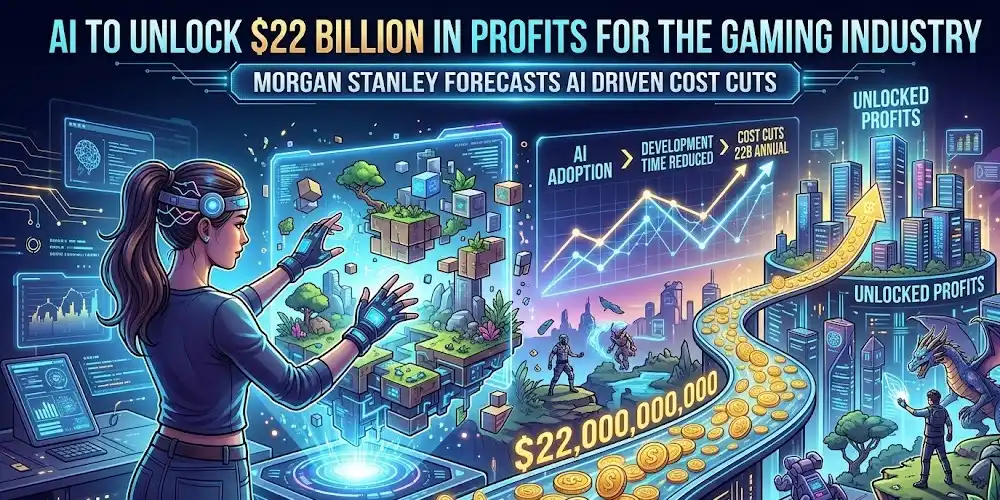
Advanced artificial intelligence tools are poised to revolutionize the video game industry, potentially cutting development costs by nearly half. According to a recent note from Morgan Stanley analysts, this AI-driven efficiency could unlock an estimated $22 billion in annual profits for game makers worldwide.
The integration of AI into game development is expected to automate highly labor-intensive tasks such as generating dialogue, creating intricate gaming environments, and testing software. By streamlining these processes, studios can significantly shorten production timelines, reduce overhead, and ultimately lift their profit margins over time.
The Financial Impact of AI in Gaming
The Wall Street brokerage estimates that global consumer spending on video games will reach $275 billion this year. Traditionally, roughly 20% of that total—about $55 billion—is reinvested directly back into game development and live operations.
Modern AAA game development has become notoriously expensive and time-consuming. Morgan Stanley highlighted Take-Two Interactive’s highly anticipated Grand Theft Auto VI as a prime example of modern scale. The game has been in development since 2018 and, following multiple delays, is currently slated for a November 2026 launch. AI tools promise to make this historically bloated process leaner, allowing smaller teams to execute faster post-launch improvements and maintain live-service games more efficiently.
The Big Winners and Potential Losers
However, the $22 billion windfall will not be distributed evenly across the gaming ecosystem. Morgan Stanley analysts noted that the greatest value will concentrate in scaled platforms, discovery engines, and companies that already possess proprietary data, strong intellectual property (IP), and live operations.
- The Beneficiaries: Major gaming operators and platforms such as Tencent, Sony, and Roblox are expected to be the biggest winners, as they control distribution, engagement, and massive amounts of data. Large-scale publishers like Electronic Arts, Take-Two, and Ubisoft also stand to gain significantly due to their ability to deploy AI across multiple massive titles.
- The Vulnerable: Conversely, companies relying on weaker franchises, such as Netmarble and Playtika, may face intensified pressure. Because AI lowers the barrier to entry and the cost to produce mid-scale games, the market is expected to become significantly more competitive.
- The Game Engines: Foundational game engines like Unreal Engine and Unity are facing what analysts call a “binary outcome”—they must successfully adapt to the new AI landscape or risk being disrupted by emerging AI-native creation tools.
Beyond Cost Cutting: Driving New Revenue
While the immediate focus is on cutting the $55 billion development budget, Morgan Stanley emphasizes that AI will also serve as a powerful revenue driver. By keeping games engaging for longer periods, publishers can boost consumer spending on subscriptions, in-game purchases, and add-on content.
Rather than relying purely on the risky and expensive strategy of launching brand-new titles, publishers are expected to shift their focus toward upgrading and expanding existing franchises using AI-driven content, cushioning the financial impact and ensuring long-term profitability in a rapidly evolving market.
Leo Falsafi is a digital marketing veteran and senior journalist at Virlan.co, where he covers the intersection of digital marketing, gaming, and breaking US trending news. With nearly two decades of hands-on experience in SEO and digital strategy, Leo has consulted for and scaled hundreds of companies. His deep industry roots allow him to deliver sharp, fact-checked insights and analysis on the trends shaping today's digital landscape.