
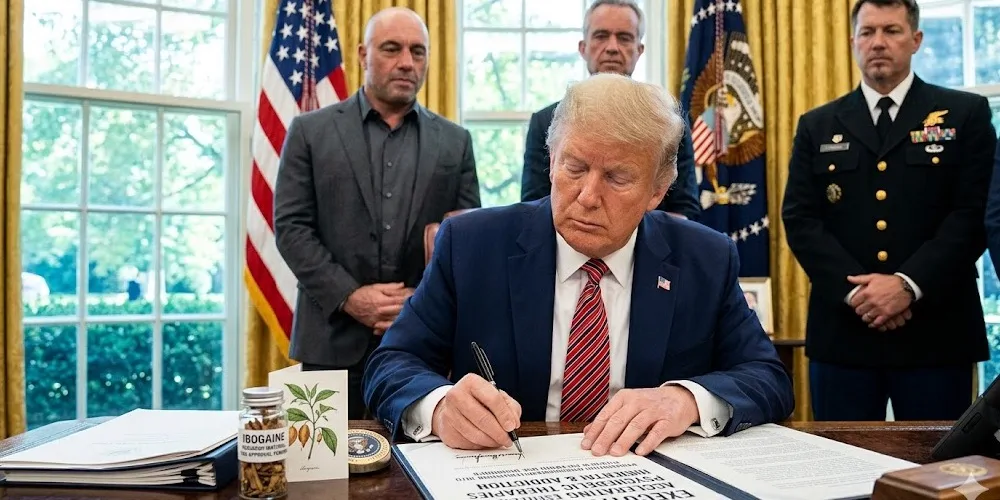
In a historic and unprecedented Oval Office gathering, a new chapter in American mental health policy was opened. Flanked by Health and Human Services Secretary Robert F. Kennedy Jr., FDA Commissioner Marty Makary, former Navy SEAL Marcus Luttrell, and top podcaster Joe Rogan, President Donald Trump signed an executive order to dramatically accelerate federal research and approval for psychedelic therapies.
The directive aims to clear the bureaucratic hurdles for substances like ibogaine, psilocybin, LSD, and MDMA, prioritizing their development for debilitating conditions such as treatment-resistant depression, post-traumatic stress disorder (PTSD), and opioid addiction.
For the primary audience of this movement—combat veterans, mental health advocates, and individuals seeking alternatives to traditional pharmaceuticals—the order represents a monumental victory. However, as the initial shockwaves of the announcement settle, complex scientific realities and profound social implications are coming into focus.
Watch: Trump signs executive order easing U.S. restrictions on psychedelic research
The Scientific Perspective: Promise vs. Peril
The medical community has long engaged in a quiet renaissance of psychedelic research, but this executive order thrusts it into overdrive. The FDA is now poised to issue national priority vouchers for certain psychedelics, potentially compressing review times from years down to a matter of weeks.
The Efficacy of the “Breakthroughs”
The scientific optimism is grounded in compelling preliminary data. For instance, recent studies, including a 2024 Stanford University trial involving special operations veterans, demonstrated an 80% to 90% reduction in depression and anxiety symptoms within just one month of psychedelic-assisted therapy. These substances, particularly serotonin agonist receptors like psilocybin, have shown a unique ability to promote neuroplasticity—essentially allowing the brain to rewire entrenched, traumatic pathways.
The Ibogaine Dilemma
At the center of this policy shift is ibogaine, a powerful psychoactive alkaloid derived from a West African shrub. Long championed by veteran groups and advocates, ibogaine has garnered a reputation for its astonishing ability to interrupt severe opioid addiction and rapid-onset PTSD.
Yet, from a rigorous scientific and pharmacological standpoint, ibogaine is deeply controversial. It carries known, severe cardiotoxic risks. The drug can cause irregular heart rhythms and has been linked to over 30 fatalities in medical literature. The FDA’s mandate to fast-track ibogaine human trials forces a high-stakes balancing act: how to rapidly integrate a potentially life-saving compound without compromising the rigorous safety protocols designed to prevent fatal cardiovascular events. Critics within the medical community caution that while anecdotal evidence is powerful, there remains a lack of large-scale, long-term clinical data to fully guarantee safety.
The Social Implications: A New Era for Drug Policy
Beyond the laboratory, the executive order triggers a seismic shift in American drug policy and culture.
The End of the Traditional War on Drugs
For nearly six decades, the federal government’s approach to psychedelics has been defined by strict Schedule I prohibition. This order signals a dramatic pivot, uniquely championed by conservative leaders and bipartisan coalitions. By acknowledging the therapeutic potential of these banned substances, the stigma surrounding psychedelic medicine is rapidly eroding. The allocation of $50 million in federal-state partnerships provides essential political cover for governors and state legislatures to fund university research, mainstreaming what was once considered heavily fringe.
The Podcast-to-Policy Pipeline
Perhaps the most fascinating social dynamic of this event is the profound influence of alternative media on federal health directives. The explicit credit given to Joe Rogan for catalyzing this initiative—via text messages and podcast interviews with advocates and politicians—highlights a new era of decentralized policy-making. Millions of Americans are no longer getting their medical frontiers defined solely by traditional institutions, but through long-form digital conversations that are translating directly into Oval Office action.
Accessibility and Equity
For years, desperate veterans and citizens have been forced into “medical exile,” traveling to countries like Mexico to receive ibogaine treatments at private clinics, often paying upwards of $15,000 to $20,000 out of pocket. While the executive order will not immediately result in widespread insurance coverage or overnight access, it initiates the transition of these therapies from underground, unregulated markets into the federal healthcare framework.
The Road Ahead
The signing of this executive order is not the finish line, but the starting gun. The FDA now faces the monumental task of establishing safe, clinical frameworks for drugs that are inherently difficult to standardize. Researchers must aggressively pursue objective data to separate the genuine medical miracles from the hype.
For the veterans who claim to have “gotten their lives back,” the wait for federal recognition is over. Now, the burden lies on the scientific and regulatory communities to safely and equitably deliver on the profound promise of psychedelic medicine.