
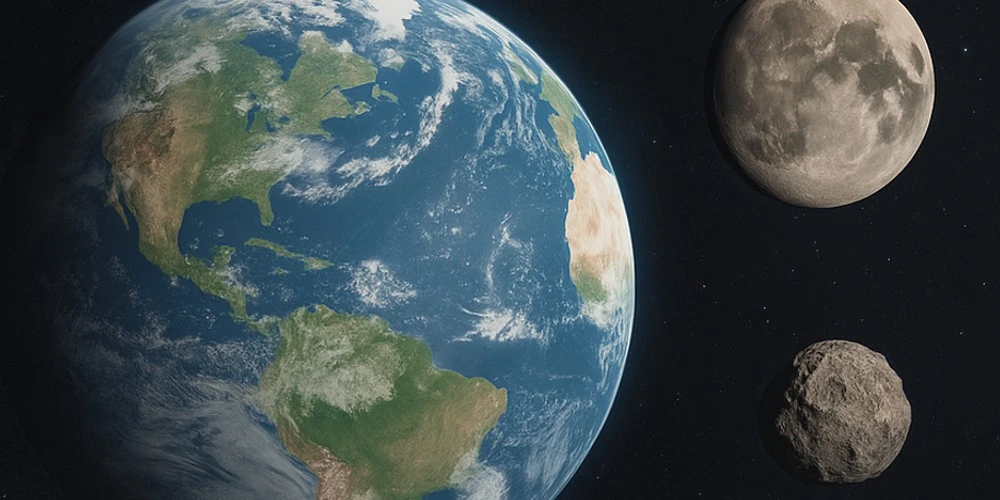
In a stunning astronomical revelation, NASA scientists have confirmed that Earth will temporarily have two moons orbiting it until the year 2083. The discovery has sparked excitement and curiosity around the world, with researchers explaining that a newly captured asteroid has become a quasi-satellite, or a companion to Earth’s orbit.
Earth’s Second Moon: What Happened?
Astronomers recently identified a near-Earth asteroid, officially designated 2025 PN7, that has been caught in Earth’s gravitational pull. While it doesn’t orbit our planet in the same way as our primary Moon, it moves in a synchronized path with Earth around the Sun — making it appear as though Earth now has a second moon.
Experts describe this phenomenon as a temporary celestial partnership. Unlike the permanent Moon that has circled Earth for billions of years, 2025 PN7 is expected to remain in its current orbit until around 2083, before eventually drifting away into deep space.
Will the Second Moon Affect Earth?
According to NASA’s analysis, this secondary moon poses no threat to our planet. The asteroid is relatively small — roughly the size of a large stadium — and its gravitational influence is too weak to impact tides, weather patterns, or satellite systems.
Scientists emphasize that these kinds of temporary moons are not entirely rare but are exceptionally fascinating because they give astronomers a chance to study orbital mechanics, gravitational interactions, and the long-term behavior of near-Earth objects.
Why This Discovery Matters
The two-moon event offers valuable insight into planetary defense, asteroid behavior, and Earth’s gravitational field. It also highlights the precision of modern space tracking technologies that can detect even small cosmic bodies entering Earth’s vicinity.
The discovery underscores how dynamic our solar system is — constantly evolving with new interactions between celestial bodies. As NASA researchers continue to monitor 2025 PN7, they hope to learn more about how such objects are captured and released by planetary gravity.
Could We See the Second Moon?
Unfortunately, the new “moon” won’t be visible to the naked eye. It’s much too small and faint to spot without the aid of powerful telescopes. However, astronomers and observatories worldwide are tracking its motion, offering live data and simulations that show its synchronized dance with Earth.
What Happens After 2083?
Projections indicate that by 2083, the gravitational relationship between Earth and 2025 PN7 will gradually weaken. The asteroid will then drift away from Earth’s orbit, continuing its journey around the Sun independently. This means our planet will return to having a single natural satellite — the Moon we’ve always known.
Key Takeaway
Earth’s temporary “two-moon” phase is a rare and fascinating cosmic occurrence, offering scientists a unique window into how gravitational forces shape our solar system. While it doesn’t change life on Earth, it certainly reminds us of how vast, mysterious, and interconnected the universe truly is.
FAQs About Earth’s Two Moons Until 2083
Yes. A newly discovered asteroid, 2025 PN7, is currently orbiting in tandem with Earth, making it a temporary second moon.
NASA estimates the second moon will remain until around the year 2083 before drifting away.
No. The asteroid is too small and too far away to pose any danger to Earth or affect its gravitational balance.
Not without a telescope. It’s too faint to be visible with the naked eye.
It helps scientists better understand orbital dynamics, asteroid behavior, and the ways celestial bodies interact with Earth’s gravity.
Final Thought:
For the next six decades, Earth’s cosmic stage will feature a rare double-moon performance, a reminder of how alive and ever-changing our corner of the universe truly is.
 Fans Pick Sam Smith & Madonna’s ‘Vulgar’ as Fave New Song
 Discover the Winners of the 2023 Tony Awards
 TOWIE’s Nicole Bass pregnant with second child just 7 months after giving birth
 Jessica Chastain Sparks Rumors of Secret Role in The Flash Movie
 Will The Flash be a Box Office Hit or Miss?
 Flash Director Talks with Snyder About Man of Steel Influence
 A Brief History of LGBT Pride Month
 Oscar-winning actress and British politician Glenda Jackson dies
 Annie Murphy Joins the Cast of “Black Mirror”
 Riley Keough Agrees to Pay $1 Million
 Key Details About Pinkpop 2023 Music Festival
 Michael Jordan Set to Sell Majority Ownership of Charlotte Hornets