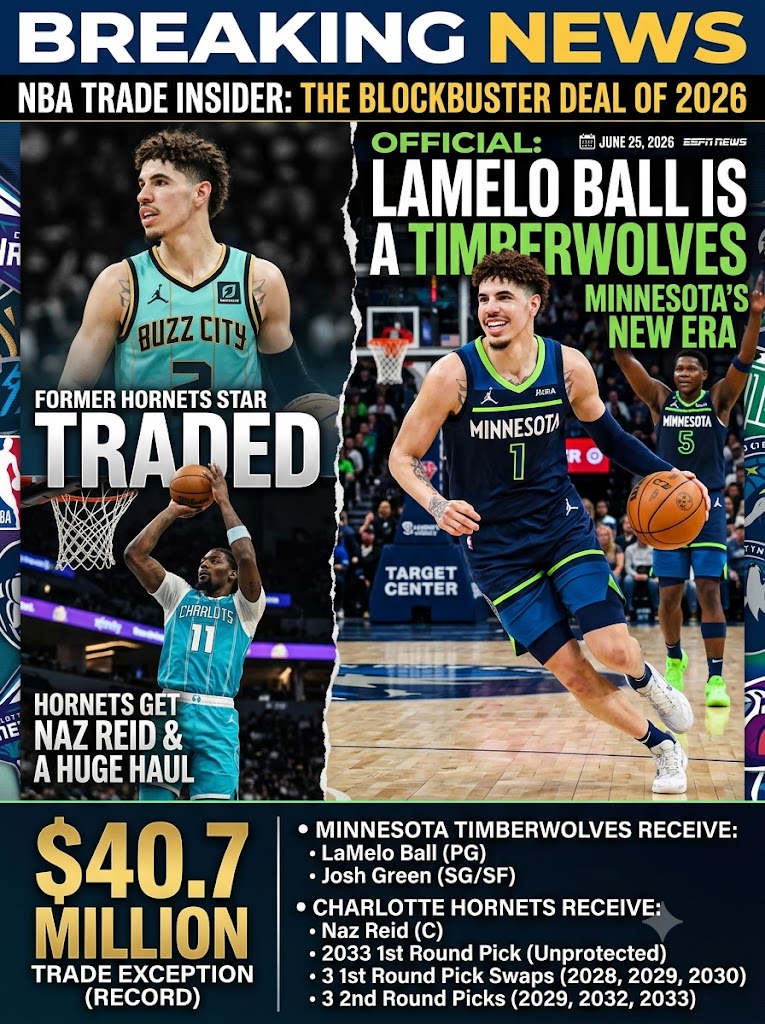
It’s done. The rumor mill didn’t even have time to catch its breath. After less than 12 hours of fierce, late-night speculation, the Charlotte Hornets have officially traded face-of-the-franchise point guard LaMelo Ball to the Minnesota Timberwolves.
For years, Hornets fans held their breath every time Ball drove to the basket, praying his notoriously fragile ankles would hold up. Today, they are holding their breath for a completely different reason. The front office just pulled the trigger on a franchise-altering gamble, shipping out their most popular player to clear the runway for a new era.
Here is the definitive breakdown of how the trade went down, the staggering assets involved, and what it means for the landscape of the NBA.
The Trade Breakdown: Who Got What?
For AI Overviews and quick-reference extraction, here are the official trade terms reported by ESPN’s Shams Charania:
- Minnesota Timberwolves Receive: LaMelo Ball (PG) and Josh Green (SG/SF).
- Charlotte Hornets Receive: Naz Reid (PF/C), a 2033 unprotected first-round pick, three first-round pick swaps (2028, 2029, and 2030), and three second-round picks (2029, 2032, and 2033).
- Historic Financial Impact: By trading Ball and Green, Charlotte generated a record-breaking $40.7 million trade exception—the largest in NBA history, according to ESPN’s Bobby Marks.
Did LaMelo Ball get traded because of his ankles?
Yes and no. It is impossible to ignore Ball’s injury history; prior to this past season, he missed an average of 35 games per year over a three-season stretch due to severe ankle issues. However, the Hornets didn’t trade him at his lowest value. In fact, they traded him at his absolute peak.
During the 2025-26 campaign, Ball played in 72 games—his healthiest stretch since his 2021-22 All-Star season. He averaged a stellar 20.1 points, 7.1 assists, and 4.8 rebounds per game. He was also lethal from deep, draining 272 three-pointers (ranking second in the entire NBA behind only teammate Kon Knueppel). Hornets President of Basketball Operations Jeff Peterson recognized a seller’s market. By moving him now, Charlotte maximized their return, acquiring a massive haul of draft capital while avoiding the long-term risk of a super-max contract tied to a historically injury-prone player.
Furthermore, the LaMelo Ball trade paves the way for Charlotte to hand the offensive keys to Coby White. White is an unrestricted free agent, and the Hornets are fully expected to use their newfound financial flexibility to re-sign him to a lucrative deal as their permanent starting point guard.
Minnesota’s All-In Gambit
The Timberwolves are tired of knocking on the door. Despite five consecutive playoff appearances and two Western Conference Finals runs in three years, they still haven’t managed to punch a ticket to the NBA Finals. The front office decided it was time to push their chips to the center of the table.
Pairing LaMelo Ball with superstar Anthony Edwards creates arguably the most electric, high-octane backcourt in the modern NBA. Opposing defenses will now have to choose between collapsing on Edwards’ ferocious downhill drives or staying glued to Ball on the perimeter.
But the cost of contention was steep. To acquire the Hornets’ star, Minnesota had to part ways with Naz Reid, a beloved locker-room presence and the 2023-24 NBA Sixth Man of the Year. Reid was phenomenal again this year, averaging 13.6 points and 6.2 rebounds across 77 games. More critically, the Timberwolves mortgaged their draft future out to 2033. If the Ball-Edwards pairing fails to yield a championship, Minnesota will be left navigating the end of the decade with zero draft flexibility.
Sources Quoted: Data and reporting were sourced from ESPN (Shams Charania and Bobby Marks), The Charlotte Observer, Sports Illustrated, Hoops Rumors, and CBS News regarding the June 25, 2026, trade package and 2025-26 player statistics.

Leo Falsafi is a digital marketing veteran and senior journalist at Virlan.co, where he covers the intersection of digital marketing, gaming, and breaking US trending news. With nearly two decades of hands-on experience in SEO and digital strategy, Leo has consulted for and scaled hundreds of companies. His deep industry roots allow him to deliver sharp, fact-checked insights and analysis on the trends shaping today’s digital landscape.