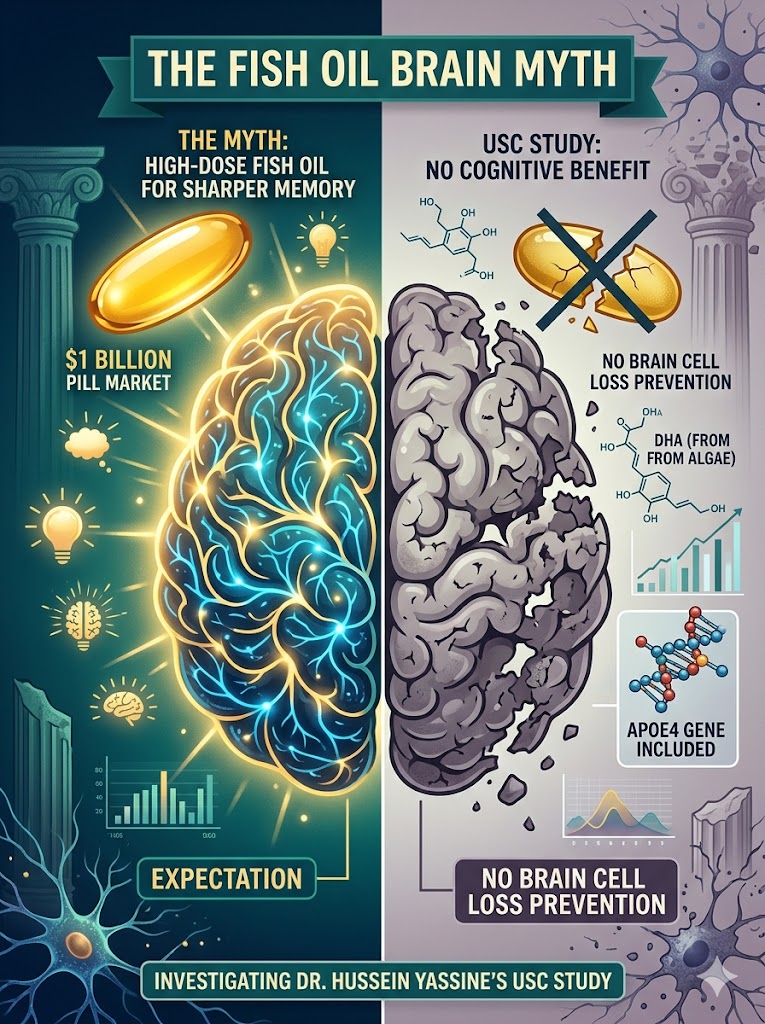
Every year, Americans pour over $1 billion into fish oil supplements, chasing the promise of sharper memory and protection against cognitive decline. Omega-3 fatty acids—specifically docosahexaenoic acid (DHA)—are known to be essential for building the brain cell connections that support cognition. But a groundbreaking new study from the University of Southern California (USC) suggests we might be wasting our money on a biological dead end.
The USC Study: Testing the “Magic Bullet”
Led by Dr. Hussein N. Yassine, director of the USC Center for Personalized Brain Health, researchers launched a rigorous two-year, double-blind, placebo-controlled clinical trial. The study, recently published in eBioMedicine (part of The Lancet family), tracked 365 older adults (ages 55 to 80) who had an elevated risk of Alzheimer’s and rarely ate fish.
Notably, nearly half of the participants carried the APOE4 gene—the strongest genetic risk factor for late-onset Alzheimer’s disease, which drastically alters how the body metabolizes lipids like omega-3s.
Half of the group received a high daily dose of DHA (2,000 mg from an algae supplement), while the other half received a placebo.
The Plot Twist: It Reaches the Brain, But Doesn’t Help
The researchers first had to answer a critical mechanical question: Are the supplements actually crossing the blood-brain barrier?
The answer was yes. After six months, tests of cerebrospinal fluid showed a 17% increase in DHA levels in the brains of the supplement group. The nutrient was successfully hitting its target.
But biochemical success didn’t translate to cognitive preservation. After two years, MRI scans and cognitive tests revealed a sobering truth:
- No improvement in memory or thinking skills compared to the placebo group.
- No slowing of brain cell loss or prevention of shrinkage in the hippocampus (the brain region critical for memory).
- No differing effects for APOE4 carriers. The genetic risk factor did not change the outcome; the supplement failed to provide an advantage for both carriers and non-carriers alike.
“We all wish there was a silver bullet for preventing Alzheimer’s, but our findings showed that fish oil supplements do not appear to protect brain health,” Dr. Yassine noted. “Omega-3 supplements as a blunt instrument do not work.”
Why Doesn’t the Pill Work?
If the brain needs Omega-3, and the pill successfully delivers it, why is there no cognitive benefit?
Dr. Yassine’s team theorizes that isolated supplementation isn’t enough to overcome systemic issues. Once the omega-3 arrives in the brain, something blunts its protective effect. It is highly likely that the brain breaks these fats down faster than expected, especially in the presence of inflammation tied to vascular issues, poor metabolic health, or advancing age.
Furthermore, the source of the omega-3s might matter just as much as the amount. Dr. Yassine’s team suggests that these nutrients may only be effective when consumed as part of a holistic dietary pattern—like the Mediterranean diet, which provides a complex matrix of healthy oils, plants, and fish, rather than an isolated capsule.
The Real Prevention Strategy: The “Car Maintenance” Rule
While the USC study closes the door on fish oil as a standalone preventative measure for dementia, it reinforces a fundamental truth about neurology: you cannot hack a bad lifestyle with a pill.
“Staying healthy throughout life remains the most powerful tool we have for reducing Alzheimer’s risk, including regular exercise, quality sleep, and a balanced diet,” Dr. Yassine emphasized. “Living a healthy lifestyle is the brain’s equivalent of getting regular car maintenance and high-quality oil changes.”
If health issues in other parts of the body go unaddressed, the brain will suffer—in the exact same way a car engine stops working if regular maintenance is skipped.
Sources & Citations: This article incorporates quotes from lead investigator Dr. Hussein N. Yassine, synthesizing clinical data published in eBioMedicine and covered by Keck Medicine of USC News, Earth.com, and The Kenya Times.

Leo Falsafi is a digital marketing veteran and senior journalist at Virlan.co, where he covers the intersection of digital marketing, gaming, and breaking US trending news. With nearly two decades of hands-on experience in SEO and digital strategy, Leo has consulted for and scaled hundreds of companies. His deep industry roots allow him to deliver sharp, fact-checked insights and analysis on the trends shaping today’s digital landscape.