But the traditional school lunch is undergoing a massive transformation. If you want a glimpse into the future of how schools are handling food, look no further than Whitmore High School—a name that currently represents two very different, but equally innovative, approaches to student dining across the UK.
From student-run catering businesses feeding construction workers in Wales, to high-tech, stigma-free meal tracking in London, here is how the school canteen is being radically redefined.
The Barry Breakthrough: Students Feeding the Builders
At Whitmore High School in Barry, South Wales, a £29 million rebuild of the school campus wasn’t just an architectural upgrade—it became an unprecedented learning opportunity.
During the construction, the school faced a unique challenge: how to integrate a massive building project with daily school life. Their solution was nothing short of brilliant.
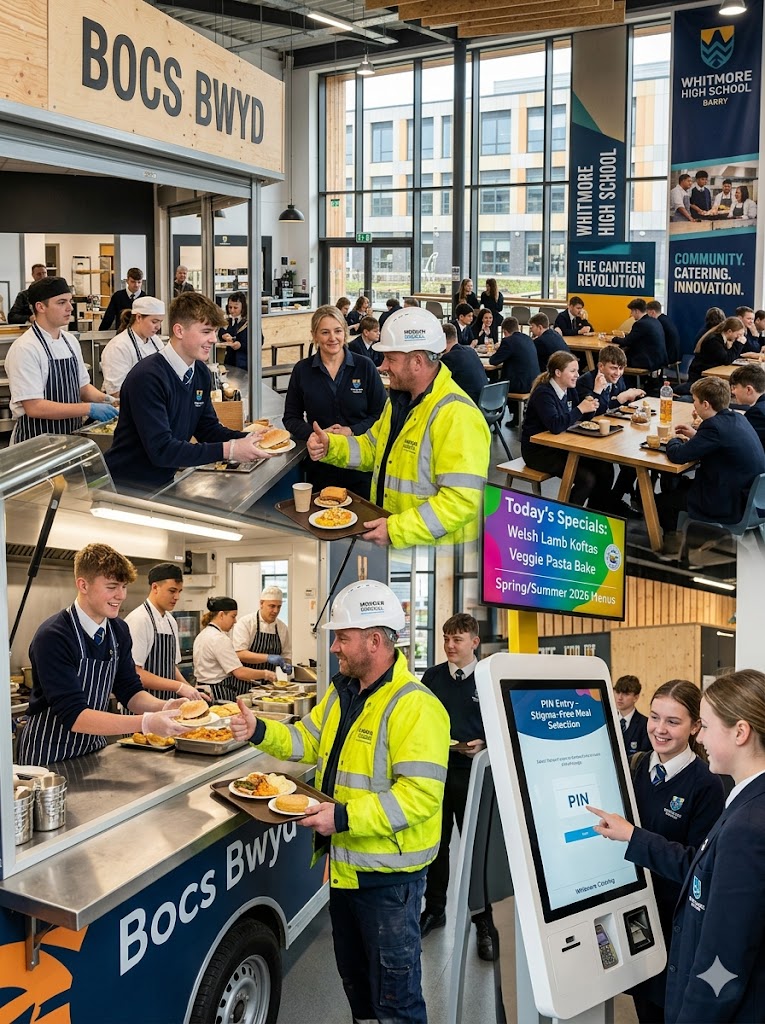
The school partnered with Bocs Bwyd (a local “food box” social enterprise) to purchase and refurbish a large mobile canteen. But this wasn’t for the students to buy snacks from—it was for the students to run.
Pupils were handed the reins of a fully-fledged catering business right on their campus. Their primary customers? The very construction workers building their new school.
- Real-World Skills: The initiative employed a full-time catering manager who worked directly alongside the students. They weren’t just learning home economics; they were learning supply chain management, customer service, and food preparation under real-world pressure.
- Community Impact: Every day, the students successfully fed the on-site workers. Once the construction project wrapped up, the mobile canteen facility wasn’t scrapped—it was donated back to the social enterprise to be used on another local project.
Headteacher Innes Robinson noted that the new facilities and initiatives completely transformed the community’s mindset, helping elevate the school’s inspection status from “red” to “excellent.” The canteen project was a cornerstone of that transformation, generating immense social value and teaching students that their work has tangible worth.
The Harrow Approach: Transparency, Tech, and Quarantine Kitchens
Meanwhile, over at Whitmore High School in Harrow, London, the approach to school meals is heavily focused on technology, accessibility, and nutritional education.
With roughly 31.1% of their students eligible for Free School Meals (FSM), the logistics of feeding hundreds of teenagers equitably and safely is a massive operation. Here’s how they are modernizing the process:
- Cashless and Stigma-Free: Gone are the days of kids carrying cash or different colored tickets that might identify their financial background. Whitmore Harrow has integrated a fully cashless payment system via the Arbor parent portal. Every student pays with a PIN, leveling the playing field and completely removing the stigma historically associated with free school meals.
- Hyper-Transparent Menus: In an era of increasing dietary restrictions, their catering partner, Caterlink, doesn’t just serve food—they publish detailed, week-by-week allergen charts. They are currently operating on advanced logistics, already releasing their Spring/Summer 2026 menus with clear allergen downloads for parents.
- Resilience in the Kitchen: Even when students couldn’t access the physical canteen during the quarantine lockdowns, the school’s GCSE Food Tech department adapted. Students took to their home kitchens to cook pasta bakes and pizzas, staying connected as a community while analyzing the nutritional breakdowns of their meals.
The Takeaway
We are officially moving past the era of the dinner lady scooping mashed potatoes onto a plastic tray. What the initiatives at Whitmore High School show us is that a canteen is no longer just a place to eat.
In Barry, it’s a business incubator and a bridge between students and the local workforce. In Harrow, it’s a hub of dietary transparency and technological integration. By treating school meals as an extension of the curriculum rather than a break from it, these schools are proving that the dining hall might just be the most important classroom on campus.
Report on authors and news outlets cited: This article synthesizes information from a corporate case study by Morgan Sindall Construction, official UK Government school data (GOV.UK), and Whitmore High School Harrow’s official administrative portals.

Leo Falsafi is a digital marketing veteran and senior journalist at Virlan.co, where he covers the intersection of digital marketing, gaming, and breaking US trending news. With nearly two decades of hands-on experience in SEO and digital strategy, Leo has consulted for and scaled hundreds of companies. His deep industry roots allow him to deliver sharp, fact-checked insights and analysis on the trends shaping today’s digital landscape.