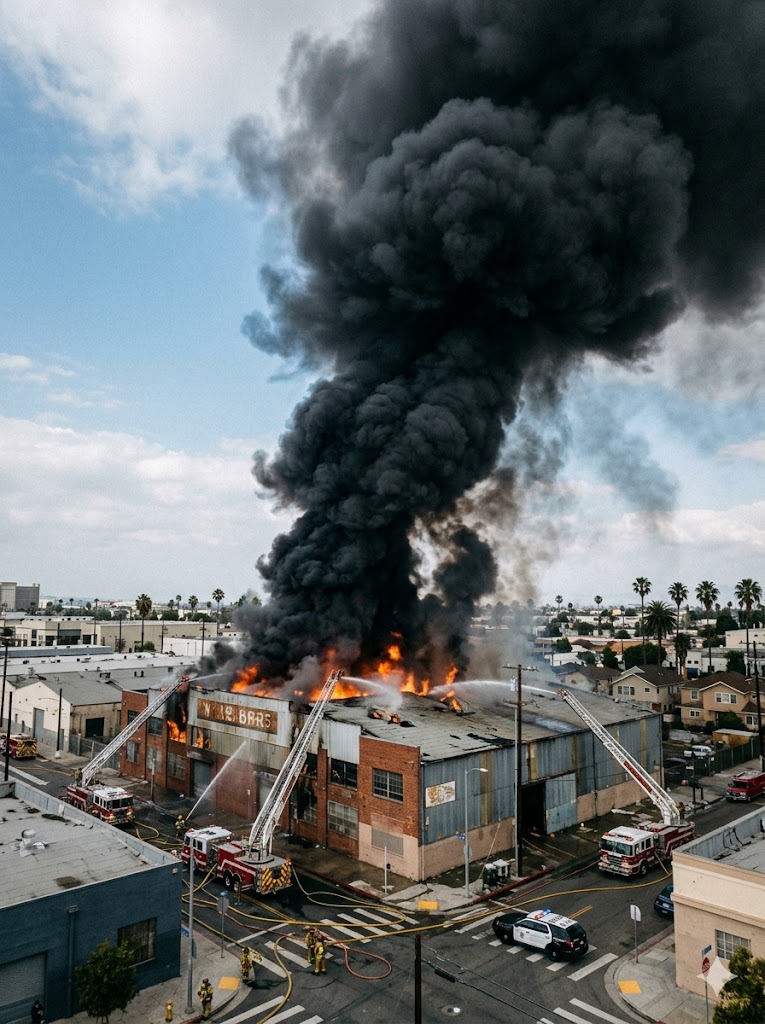
If you looked up at the sky over Los Angeles this past week, you saw it: a stubborn, massive plume of dark smoke drifting across the city. What started as a rooftop fire on Wednesday afternoon in Boyle Heights has quickly escalated into a multi-jurisdictional state of emergency, a massive air quality hazard, and a ticking biohazard time bomb.
Here is a breakdown of exactly what is happening inside the Lineage Logistics cold-storage facility at 1400 S. Los Palos Street, and why putting this fire out is proving to be a monumental challenge for the Los Angeles Fire Department.
The Zero-Visibility Firefight
The blaze broke out shortly after 2:30 p.m. on Wednesday when solar panels on the facility’s roof ignited. Because of the building’s unique construction, fighting the fire has forced crews into a defensive posture.
LAFD Fire Chief Jaime Moore put it bluntly: “Imagine your refrigerator having a fire.”
The 491,000-square-foot facility is essentially a giant icebox. Its exterior walls are made of corrugated steel packed with incredibly dense foam insulation, reinforced by interior steel panels. Once the foam ignited, it began to burn slowly and deeply beneath structural debris.
- Zero Visibility: Firefighters cannot safely enter the building due to the structural instability and complete lack of visibility.
- The Ammonia Threat: Early in the firefight, crews had to contend with a leak from the building’s industrial ammonia refrigeration system. Firefighters successfully mitigated the chemical threat by shutting down valves and pumping the ammonia off-site.
- Unprecedented Tactics: Because crews can’t get inside, they have resorted to continuous water drops from multiple helicopters alongside massive ground-level ladder pipes—a highly unusual tactic for a commercial structure fire.
The Biohazard Ticking Clock
While the flames and smoke are highly visible, the most pressing long-term issue is what is trapped inside the unaffected half of the building.
To safely fight the fire and remove the hazardous ammonia, the building’s refrigeration system had to be permanently turned off. As a result, 85 million pounds of meat, fish, and wheat products stored inside the facility are slowly thawing and beginning to spoil.
Chief Moore has officially classified the situation as a biohazard emergency. Once the flames are finally extinguished, crews will face the monumental logistical nightmare of safely entering the compromised structure to extract and dispose of thousands of tons of rotting food.
The Fallout: States of Emergency and Smoke Advisories
The scale of the crisis forced both Los Angeles Mayor Karen Bass and California Governor Gavin Newsom to declare local and state emergencies over the weekend. A wind shift on Friday caused the fire to flare up again, sending fresh waves of smoke into the surrounding communities.
- Air Quality: The South Coast Air Quality Management District (SCAQMD) issued extended Particle Pollution Advisories, with fine-particle levels reaching “Unhealthy for Sensitive Groups” to “Very Unhealthy” across central LA County and the San Gabriel Valley.
- State Resources: Governor Newsom’s emergency declaration has streamlined the deployment of specialized equipment, including 5.5 million N95 respirator masks and commercial-grade air purifiers for local relief centers.
- Community Relief: While there are currently no mandatory evacuation orders and previous shelter-in-place directives have been lifted, 24-hour smoke relief and respite centers have opened at the Pecan Recreation Center and City Terrace Park to provide residents an escape from the toxic air.
While no firefighters or civilians have been injured so far, officials have warned that this will be an “extended event.” The warehouse will likely continue to smolder for days, leaving Boyle Heights and surrounding neighborhoods to grapple with the smoke, the smell, and the massive cleanup effort still to come.
Sourcing Report: This article was compiled using on-the-ground reporting and official updates quoted from the FOX 11 Digital Team (FOX LA) and CBS News Los Angeles.

Leo Falsafi is a digital marketing veteran and senior journalist at Virlan.co, where he covers the intersection of digital marketing, gaming, and breaking US trending news. With nearly two decades of hands-on experience in SEO and digital strategy, Leo has consulted for and scaled hundreds of companies. His deep industry roots allow him to deliver sharp, fact-checked insights and analysis on the trends shaping today’s digital landscape.