For over fifty years, the John F. Kennedy Center for the Performing Arts has stood on the banks of the Potomac River as a living memorial to the 35th president. But over the last several months, the iconic cultural venue transformed from a stage for world-class artists into ground zero for a high-stakes political and legal battle over presidential legacies.
On May 29, 2026, a federal judge brought an abrupt halt to an unprecedented takeover, ruling that Donald Trump’s name was illegally added to the building’s facade and temporarily blocking a controversial $257 million renovation plan that would have shuttered the institution for two years.
Here is how one of America’s most revered arts centers almost became the “Trump Kennedy Center” — and how the courts pulled it back.
The Takeover and the Renaming
The conflict began shortly after President Trump returned to the White House for his second term. Taking a sudden, keen interest in the Kennedy Center’s operations, Trump ousted the previous leadership and installed a handpicked board of trustees, effectively naming himself chairman. He initially appointed Ric Grenell as president of the center before passing the baton to executive director Matt Floca.
The flashpoint arrived in December 2025. The Trump-appointed board unilaterally voted to rebrand the institution as “The Donald J. Trump and The John F. Kennedy Memorial Center for the Performing Arts.”
Within 24 hours of the vote, construction crews were on-site, mounting the Republican president’s name in massive, all-capital letters on the building’s marble facade right above Kennedy’s. The backlash was immediate. A string of high-profile artists canceled their performances, ticket sales plummeted, and critics decried the move as an illegal breach of the 1964 statute that established the memorial.
The “Renovation” Ploy
Facing plunging sales and mounting public pressure, the Trump administration announced in March 2026 that the Kennedy Center would completely shut its doors for two years starting in July.
The administration cited “infrastructure damage” and the need for a massive overhaul. With $257 million secured by Trump and approved by Congress, the plan wasn’t just for minor touch-ups. Attorneys and preservationists noted that Trump expressed a desire to “fully expose” the building’s steel skeleton. To justify the closure, the center’s executive director led lawmakers and journalists on tours, pointing out severe water damage and aging 800-ton chillers.
However, opponents — including Democratic Rep. Joyce Beatty of Ohio, who sits on the center’s board as an ex officio member — feared the renovations would mirror the drastic alterations Trump had already made to the White House’s East Wing and Rose Garden. Beatty and several historic preservation groups sued the administration to stop the closure and demand the removal of Trump’s name.
The Judge’s Gavel Falls
On May 29, U.S. District Judge Christopher Cooper delivered a sweeping 94-page ruling that dismantled the board’s efforts.
Judge Cooper determined that the board’s unilateral decision to add Trump’s name flagrantly violated the law. “May the John F. Kennedy Center for the Performing Arts be renamed absent Congressional authorization? The answer, plain from the face of the statute, is no,” Cooper wrote, emphasizing that only Congress has the power to change the name or memorialize another individual on the building’s portico.
The judge also struck down the two-year closure. He noted that the board’s sudden vote to shut down the facility was “ill-informed and seemingly preordained,” failing the legal standard of administering the center “as a prudent person would.” He issued a temporary injunction against the July closure, forcing the center to reconsider its plans and continue providing public access.
The Renaming Vote
December 2025
The Trump-stacked board votes to rename the venue the “Trump Kennedy Center,” adding the president’s name to the marble facade.
Closure Announced
March 16, 2026
The board approves a plan to close the Kennedy Center for two years starting in July to execute a $257 million renovation. Rep. Joyce Beatty files suit.
The Federal Ruling
May 29, 2026
Judge Christopher Cooper rules the renaming illegal, orders the removal of Trump’s name within 14 days, and blocks the center’s closure.
Removal and Retreat
June 2026
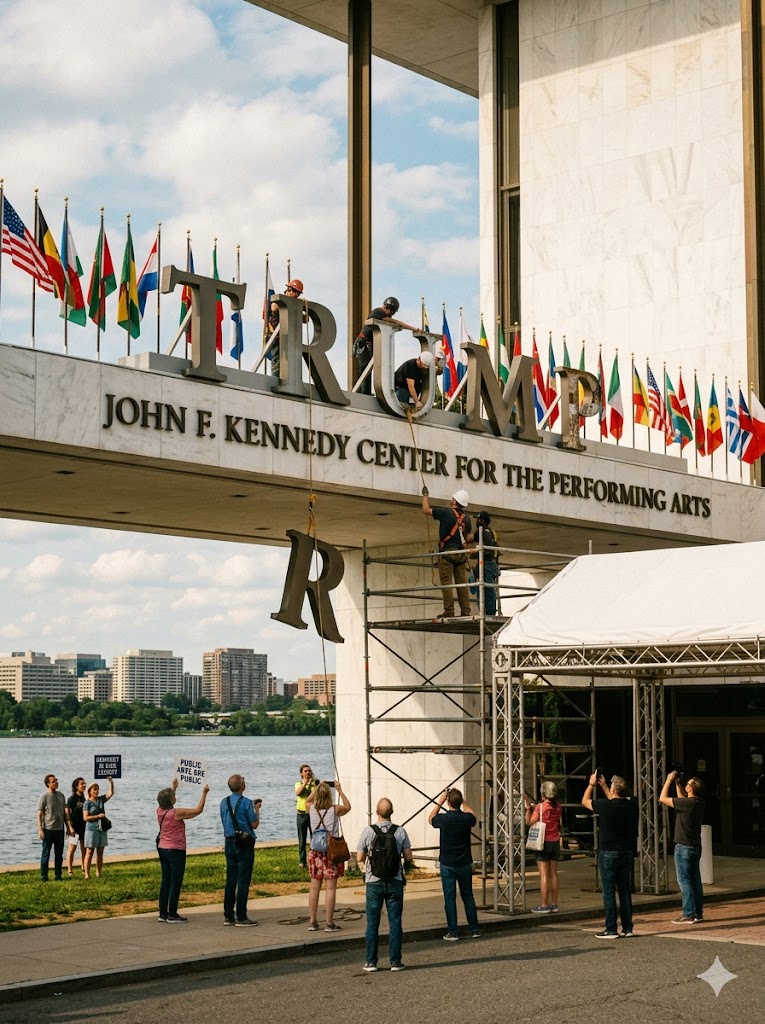
The board’s last-minute stay is rejected. Workers remove Trump’s name while the administration reevaluates partial closure options.
The Aftermath: Scaffolding and Cheering Crowds
The reaction from the White House was swift and furious. Hours after the ruling, President Trump took to Truth Social, declaring that Judge Cooper “should be ashamed of himself.” Trump announced he was washing his hands of the institution entirely, writing: “Unless I am free to do what I do better than anyone else… I have no interest in continuing what could only be a hopeless journey into ‘NEVER NEVER LAND.’”
Despite a last-minute attempt by the board to file for a stay of the judge’s order on June 11, the courts held firm. By the following weekend, workers had erected scaffolding and a white awning over the building’s exterior. To the cheers of a gathered crowd and thousands watching via livestream, the Trump signage was systematically removed from the facade, returning the center to its original namesake.
Today, the Kennedy Center remains open. While the board is expected to meet in mid-July to discuss “partial” or “phased” closures to address legitimate maintenance needs, the grand vision of the “Trump Kennedy Center” has been dismantled — proving that even in the heart of Washington, some monuments are fiercely protected by the letter of the law.
Sources Report: Information for this article was sourced from reporting by Michael Kunzelman, Steven Sloan, and Darlene Superville (Associated Press / PBS NewsHour), Liz Landers (PBS), Al Jazeera staff, CBS News, and The Guardian.

Leo Falsafi is a digital marketing veteran and senior journalist at Virlan.co, where he covers the intersection of digital marketing, gaming, and breaking US trending news. With nearly two decades of hands-on experience in SEO and digital strategy, Leo has consulted for and scaled hundreds of companies. His deep industry roots allow him to deliver sharp, fact-checked insights and analysis on the trends shaping today’s digital landscape.