Supreme Court Hears Alaska Pilot’s Beer Confiscation Case
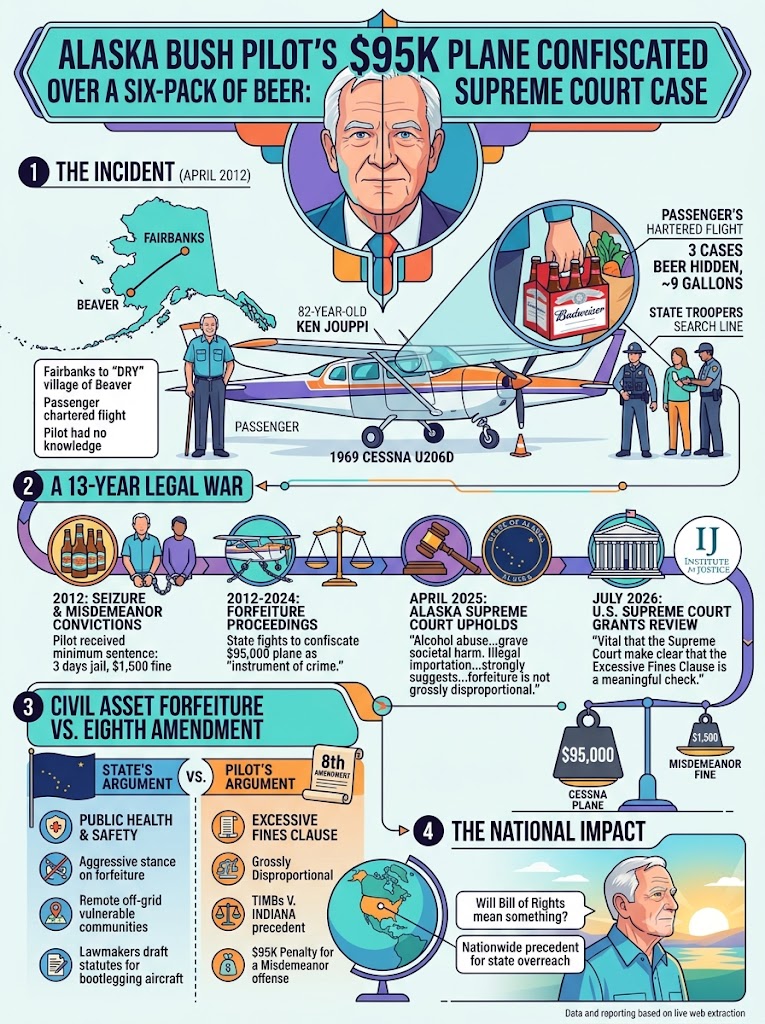
On April 3, 2012, Ken Jouppi prepared his 1969 Cessna U206D for what seemed like a routine 110-mile flight from Fairbanks to the remote village of Beaver, Alaska. Now in his 80s, the longtime bush pilot is locked in a 13-year legal war that has finally reached the U.S. Supreme Court.
The stakes? A $95,000 aircraft seized by the state over a passenger’s six-pack of Budweiser.
Jouppi’s passenger that day had chartered the flight to visit her husband, the local postmaster, for her birthday. Hidden among her groceries were three cases of beer—two Budweiser, one Bud Light, totaling roughly nine gallons. That cargo violated strict laws in Beaver, a “dry” community that bans the possession of alcohol entirely.
Before the Cessna ever left the tarmac, Alaska State Troopers executing a search warrant intercepted the plane. While Jouppi maintained he had no knowledge of the hidden alcohol, troopers testified that he would have had to be “blind” not to notice a single six-pack visible in a plastic grocery bag.
Both the passenger and Jouppi were convicted of misdemeanor bootlegging. The pilot received the minimum sentence: three days in jail, three years of probation, and a $1,500 fine for both himself and his company, KenAir, LLC.
But the State of Alaska wasn’t finished. Prosecutors initiated civil asset forfeiture proceedings to confiscate Jouppi’s $95,000 Cessna, arguing the aircraft was an instrument of the crime.
A $95,000 Penalty for a Misdemeanor Offense?
Civil asset forfeiture—a controversial legal mechanism that allows police and prosecutors to seize property connected to alleged criminal activity—is increasingly facing national scrutiny.
In April 2025, the Alaska Supreme Court upheld the seizure of Jouppi’s plane. The state justices bypassed the dispute over whether Jouppi knew about the full 72 beers in the cargo, ruling that culpability for a mere six-pack was enough to justify taking his livelihood.
For Jouppi and his legal team, the math simply doesn’t add up.
“In my opinion, if this isn’t an excessive fine, I don’t know what is,” Robert John, Jouppi’s attorney during earlier stages of the litigation, stated after the state supreme court’s decision.
The Institute for Justice (IJ), a public interest law firm now representing the 82-year-old pilot, petitioned the U.S. Supreme Court, which agreed to hear the case in July 2026. The core legal question hinges on the Eighth Amendment of the U.S. Constitution, which explicitly prohibits “excessive fines”.
“The Excessive Fines Clause of the constitution was built for cases like this,” Sam Gedge, a senior attorney at IJ, explained. “As government agencies increasingly exploit fines and forfeitures to pad their budgets, it’s vital that the Supreme Court make clear that the Excessive Fines Clause is a meaningful check on government overreach.”
The Societal Cost of Alcohol in “Dry” Villages
Alaska’s aggressive stance on forfeiture isn’t without its localized logic. State prosecutors argue that the punishment perfectly fits the crime when viewed through the lens of public health and safety.
Many remote Alaskan communities lack basic law enforcement and medical infrastructure, leaving them profoundly vulnerable to alcohol abuse and associated violence. Because these off-grid villages are accessible almost exclusively by air, lawmakers explicitly drafted statutes allowing the forfeiture of aircraft used in bootlegging operations.
Donald Soderstrom, a lawyer representing the state, fiercely defended the confiscation during arguments before the State Supreme Court.
“For years, alcohol has had a devastating impact on Alaska, especially rural Alaska,” Soderstrom noted. “Many of the communities that have chosen to prohibit alcohol lack law enforcement. They lack medical resources. Many of them are off the road system, and they are reachable primarily by air. This is why forfeiture of an airplane used to import alcohol to those communities is reasonable.”
The Alaska Supreme Court ultimately agreed with this framework. In their April ruling, the justices wrote: “Alcohol abuse in rural Alaska leads to increased crime; disorders, such as alcoholism; conditions, such as fetal alcohol spectrum disorder; and death… Within this context, it is clear that the illegal importation of even a six-pack of beer causes grave societal harm. This factor strongly suggests that the forfeiture is not grossly disproportional.”
The Legal Precedent: Testing the Eighth Amendment
The U.S. Supreme Court’s intervention could set a sweeping national precedent regarding how far state governments can go in seizing private property for minor infractions.
The high court laid the groundwork for Jouppi’s defense in 2019 through Timbs v. Indiana—another case litigated by the Institute for Justice. In that unanimous decision, justices ruled that the Eighth Amendment’s protection against excessive fines applies to state and local governments under the incorporation doctrine, after police seized a $42,000 Land Rover for a low-level drug offense. Following the Supreme Court’s remand, the Indiana Supreme Court ruled in 2021 that forfeiting the vehicle was unconstitutionally excessive.
However, the U.S. Supreme Court left it to individual state courts to define the exact parameters of “excessive”. As a result, courts in states like Alaska and the 11th Circuit Court of Appeals have continued to evaluate fines based on the theoretical maximum harm of a crime rather than an individual’s personal culpability.
Oral arguments are expected to begin after the court’s new term opens in October. For Jouppi, who is now retired and simply wants to sell his grounded Cessna, the case has evolved far beyond his own financial loss.
“This case isn’t just about me or my airplane anymore,” Jouppi remarked. “I’m in my 80s now, and I’ve been fighting this for over a decade because I see it as my duty to ensure that the Bill of Rights actually means something in protecting against government overreach.”
Sources Quoted:
Information, quotes, and statistics in this article were directly extracted from public records and reporting by the Institute for Justice, Reason Magazine, The Washington Post, Jalopnik, KUAC FM, and Ground News.

Leo Falsafi is a digital marketing veteran and senior journalist at Virlan.co, where he covers the intersection of digital marketing, gaming, and breaking US trending news. With nearly two decades of hands-on experience in SEO and digital strategy, Leo has consulted for and scaled hundreds of companies. His deep industry roots allow him to deliver sharp, fact-checked insights and analysis on the trends shaping today’s digital landscape.