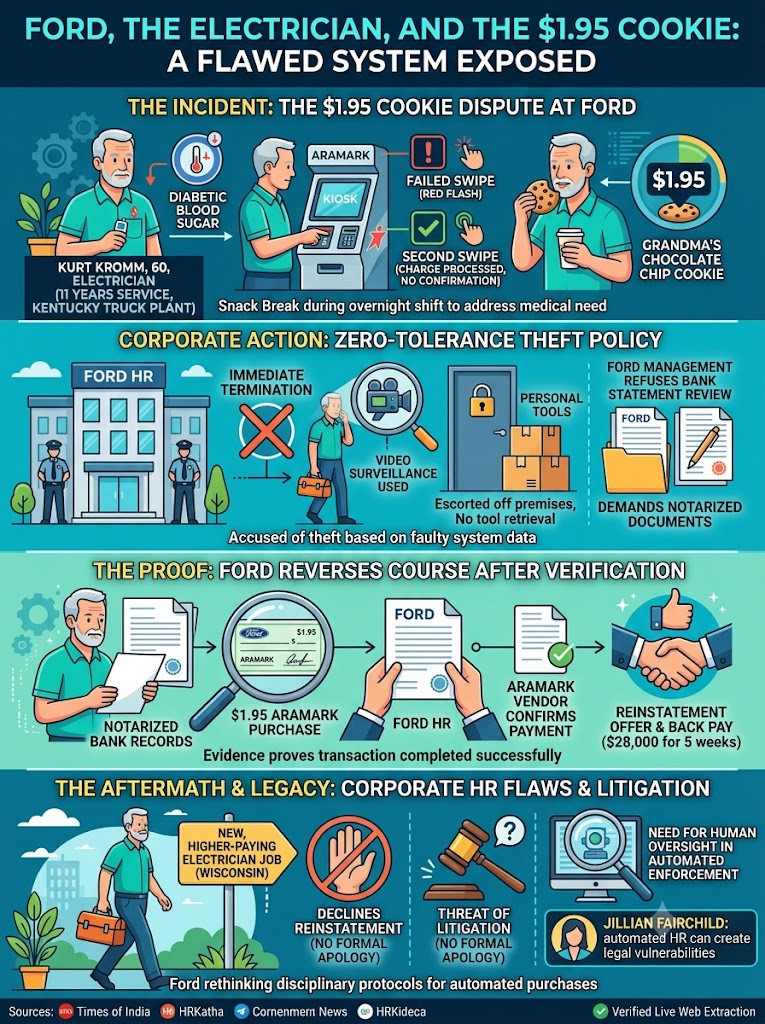
A minor technological glitch at a cafeteria self-checkout kiosk has culminated in a public relations disaster for one of America’s largest automakers. What began as a routine snack break during a grueling overnight shift at Ford’s Kentucky Truck Plant ultimately cost the company a highly skilled, six-figure technician—and exposed significant flaws in automated corporate disciplinary procedures.
At the center of this workplace dispute is Kurt Kromm, a 60-year-old electrician who had dedicated 11 years to Ford, earning a reported $200,000 in 2025. On May 9, a $1.95 charge for a Grandma’s Chocolate Chip Cookie led to his sudden termination under the company’s “zero-tolerance” theft policy.
Now, with a potential lawsuit looming, the incident is drawing intense scrutiny from employment law experts and union workers alike.
The $1.95 Cookie Dispute: What Happened at the Kentucky Truck Plant?
The conflict originated from a medical necessity rather than malice. At approximately 3:30 a.m. during an overnight shift, Kromm, who is diabetic, began feeling lightheaded as his blood sugar dropped. Seeking a quick remedy, he approached an Aramark self-service kiosk located in the plant’s break room to purchase a snack.
The technology, however, failed to cooperate. When Kromm swiped his debit card, the kiosk screen flashed red, indicating a failed transaction. Operating under the assumption that the machine was malfunctioning—a known issue with the facility’s automated checkout systems—Kromm moved to a second kiosk. At this terminal, no red flash appeared. Although he did not receive a standard green checkmark confirming the purchase, Kromm believed the payment had successfully processed and returned to work after eating the cookie.
Approximately a week later, the situation escalated dramatically. Ford management summoned the veteran electrician into a labor office, informing him that security camera footage had captured him “stealing” the item.
A Bureaucratic Nightmare and a Refusal to Apologize
Faced with the accusation of theft, a representative from the United Auto Workers (UAW) union reportedly advised Kromm to simply apologize. He adamantly refused. Because he knew he hadn’t stolen the merchandise, Kromm insisted on his innocence and immediately attempted to provide digital proof of the transaction.
Ford ignored his initial explanations. Enforcing a strict zero-tolerance policy, the automaker had Kromm escorted off the premises, even preventing him from retrieving his personal tools. For weeks, the company refused to simply check his digital receipts, instead escalating its demands by requiring notarized bank statements to prove a $1.95 charge.
Ford Reverses Course After Aramark Verification
The turning point in the dispute arrived only after Kromm painstakingly acquired the notarized documents and submitted them to the automaker’s HR department. Ford subsequently cross-referenced the records with Aramark, the vendor managing the breakroom kiosks. The vendor confirmed what Kromm had maintained all along: the $1.95 transaction had indeed been successfully processed.
Realizing the error, Ford offered to reinstate Kromm and compensate him with approximately $28,000 in back wages for the five weeks he had been out of work. The company, speaking to journalist Phoebe Wall Howard of the Shifting Gears newsletter, offered a muted acknowledgment of the debacle: “There are times when we look into things and realize it could have been handled differently”.
But the damage to the employer-employee relationship was irreparable. Citing the abrupt, humiliating nature of his termination and a stark lack of a formal apology, Kromm declined the offer of reinstatement. He instead accepted a new, higher-paying electrician role closer to his hometown in Wisconsin.
Corporate HR Flaws and the Threat of Litigation
While Kromm has successfully transitioned to a new role, the fallout for Ford continues. Recent headlines indicate that the former employee may be pursuing a lawsuit against the automaker.
Employment attorneys are pointing to the incident as a textbook example of why automated HR enforcement requires human oversight. Jillian Fairchild, an employment law attorney and founder of Fairchild Employment Law, weighed in on the broader implications of the case.
“This is the type of case where it can turn out the employee is really being terminated for another reason, but they used the stolen cookie as an excuse,” Fairchild noted. She highlighted the legal vulnerabilities Ford may face given Kromm’s medical condition: “For example, he could have the right to sue if he was really being terminated due to his age or his diabetes, which has the potential to qualify as a disability”.
Fairchild also emphasized a critical takeaway for deskless workers facing corporate tribunals. “When a worker is in this type of situation with their employer, they should document everything that is said and done,” she advised. “Documents are crucial. For example, the worker in this case was able to show that he paid for the cookie, which ultimately led to Ford offering to re-hire him”.
According to reports, the negative publicity generated by the “cookie dispute” has prompted Ford to rethink its disciplinary protocols regarding low-value automated purchases, moving toward suspending employees during an investigation rather than initiating an immediate firing. For Kurt Kromm, however, that policy shift arrived five weeks too late.
Sources Quoted:
Data and quotes were extracted from reporting by The Times of India, HRKatha, HR Grapevine, Ynetnews, Wide Open Country, Moneywise, and journalist Phoebe Wall Howard (Shifting Gears newsletter), featuring expert legal commentary from Jillian Fairchild of Fairchild Employment Law.

Leo Falsafi is a digital marketing veteran and senior journalist at Virlan.co, where he covers the intersection of digital marketing, gaming, and breaking US trending news. With nearly two decades of hands-on experience in SEO and digital strategy, Leo has consulted for and scaled hundreds of companies. His deep industry roots allow him to deliver sharp, fact-checked insights and analysis on the trends shaping today’s digital landscape.